

Q&A
Eugene Rumer
{
  "authors": [
    "Eugene Rumer"
  ],
  "type": "legacyinthemedia",
  "centerAffiliationAll": "dc",
  "centers": [
    "Carnegie Endowment for International Peace"
  ],
  "collections": [],
  "englishNewsletterAll": "ctw",
  "nonEnglishNewsletterAll": "",
  "primaryCenter": "Carnegie Endowment for International Peace",
  "programAffiliation": "russia",
  "programs": [
    "Russia and Eurasia"
  ],
  "projects": [],
  "regions": [
    "North America",
    "United States",
    "Russia",
    "Eastern Europe",
    "Ukraine",
    "Western Europe"
  ],
  "topics": [
    "Security",
    "Foreign Policy",
    "Global Governance"
  ]
}
Source: Getty
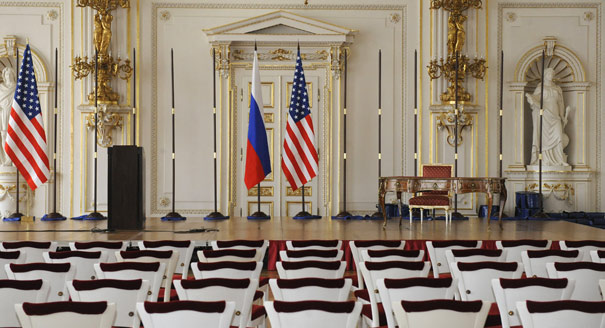
Reports claiming that the world is seeing a second Cold War seem to have forgotten the reality of the original Cold War.
Source: Yahoo! News
The second Cold War is upon us, or so reporting from Kiev, Brussels, Moscow and Washington leads us to believe. There has been no shortage of ideas for how the West should respond to Russia’s takeover of Crimea — from imposing wide-ranging sanctions on Russian political leaders and oligarchs to inviting Georgia to join NATO. Any accurate recollection of the original Cold War seems to be forgotten. The first Cold War was not all about bluster and one-upmanship. Compromise, trade-offs and skillful, patient diplomacy were a big part of U.S. policy then. U.S. actions were guided by a long-term strategy rather than dueling tweets. If we are in a new Cold War, some lessons of the first one should apply today. We should act accordingly.
Compromise and de-escalation were part and parcel of our policy in the darkest moments of the first Cold War — during the Cuban missile crisis, when the United States agreed to withdraw its Jupiter missiles from Turkey in exchange for the Soviet Union removing its missiles from Cuba. In the early 1980s, President Ronald Reagan’s resolve to place intermediate-range nuclear missiles in Europe in response to Soviet missile deployments was paired with a serious commitment to find a compromise with Moscow that would avoid further escalation.
Throughout the first Cold War, and especially after the Cuban missile crisis, the United States and the Soviet Union avoided deliberately provocative steps and were careful not to trespass on each other’s important interests. There was plenty of misunderstanding, but the United States would not intervene in 1956, when Soviet tanks crushed the Hungarian Revolution, or in 1968, when they suppressed the Prague Spring. Even when the Soviet Union invaded Afghanistan in 1979, the United States avoided direct involvement and countered with a covert program. Despite its outrage at the Soviet Union’s actions, U.S. interests did not justify the risks of a more active involvement in those countries.Our national discourse about the crisis in Ukraine has focused almost exclusively on two objectives: punishing Russia for its takeover of Crimea, and getting it to back down and return Crimea to Kiev’s control. We have engaged in this pursuit even though the odds of either outcome appear to be slim to none. The numbers are well known by now: We do $40 billion worth of trade a year with Russia. Our European allies do 10 times that much. Without the allies, our sanctions will be an empty gesture well suited for election year politics but little else. The allies have made it clear they have no appetite for sanctioning Russia. In the early 1980s, the Reagan administration failed to convince Europe not to buy Russian gas from a pipeline then being built from Siberia. What are the odds of changing Europe’s mind now, after two decades of expanding trade and investment in Russia?
Russia is even less likely to return Crimea to Kiev’s control in response to threatened sanctions. Russian presence there is welcomed by a majority of the population. Russian troops control the situation and have encountered little organized opposition. The Russians in Russia approve of their government’s actions. According to a recent poll, more than 70 percent believe that their government should actively defend the rights of Russian-speakers in Crimea. The March 16 referendum on the future of Crimea may be the final step in its reincorporation into Russia.
But if there is still a chance to preserve Crimea within Ukraine, a diplomatic strategy is needed. President Barack Obama’s opening to Russia that would enhance Crimea’s autonomy within Ukraine in exchange for Moscow pulling back its troops is perhaps the last chance at a diplomatic solution before the March 16 referendum in Crimea. If accepted by Russia, it could open doors to negotiations about a comprehensive solution to the crisis in Ukraine leading up to the G8 summit in June, which otherwise is certain to be canceled. It is tempting to cancel the G8 summit now, but why not use it as an opportunity to confront Russian President Vladimir Putin with a tough but pragmatic offer to resolve the crisis? Why not make it a G7&1, where the leaders of the seven industrialized democracies will act in unison and drive a hard bargain with him?
There is no shortage of ideas of what an offer to Russia could look like — from a pledge of no NATO membership for Ukraine (joining NATO was never popular there) to adopting a neutral status to turning it into a federal state that would provide its diverse regions a good measure of autonomy and assure them that local rights would be protected. In exchange, Russia should be asked for a pledge to respect Ukraine’s territorial integrity and sovereignty. An urgent diplomatic effort to bring the G7 countries together and develop such an offer should be at the top of our policy agenda in the time remaining until the summit in Sochi.
Even more important is helping Ukraine’s economic recovery. The list of what ails its economy is long — corruption, excessive government spending, inefficient energy sector, etc. Unless its economy is reformed, Ukraine’s next 10 years will bring about little more than disappointment and frustration, just as the 10 years since the Orange Revolution have done. If living well is the best revenge, Ukraine’s commitment to shed its crony capitalist past and present and to rebuild its economy is its best weapon.
Director and Senior Fellow, Russia and Eurasia Program
Rumer, a former national intelligence officer for Russia and Eurasia at the U.S. National Intelligence Council, is a senior fellow and the director of Carnegie’s Russia and Eurasia Program.
Recent Work
Eugene Rumer
Eugene Rumer
Carnegie India does not take institutional positions on public policy issues; the views represented herein are those of the author(s) and do not necessarily reflect the views of Carnegie, its staff, or its trustees.

After the chill in ties between 2020 and 2024 that brought India–China relations to their lowest point in several decades, the two countries have engaged each other afresh. This paper argues that there are predominantly four imperatives guiding India’s approach to China, and they exist in an order of priority.

Saheb Singh Chadha

This piece argues that India’s central challenge is not managing a single flashpoint but resolving the underlying tension between expansion and institutional coherency of the BRICS grouping.

Vrinda Sahai

A partnership between India, a country of subcontinental size, and Africa, a continent of fifty-four countries, may seem asymmetric until one notes that both are home to nearly the same number of people—1.4 billion. This essay spells out the existing challenges to the partnership, its optimal potential, and the possible pathways to realize it over the next quarter-century.

Rajiv Bhatia

The U.S.–India semiconductor cooperation story is well-stocked with top-level strategic intent. What remains unresolved, however, are some underlying challenges that will determine whether the cooperation actually functions. Three such friction points stand out.

Shruti Mittal

The India–EU Free Trade Agreement (FTA) is shaping up to be one of the most consequential trade negotiations, both economically and strategically. But, what’s in the agreement, what’s missing, and what will determine its success in the years ahead
Vrinda Sahai, Nicolas Köhler-Suzuki