
• Research
  • About
  • Experts
Carnegie India logoCarnegie lettermark logo
AI
{
  "authors": [
    "Dmitri Trenin",
    "Eugene Rumer"
  ],
  "type": "legacyinthemedia",
  "centerAffiliationAll": "dc",
  "centers": [
    "Carnegie Endowment for International Peace",
    "Carnegie Russia Eurasia Center"
  ],
  "collections": [],
  "englishNewsletterAll": "ctw",
  "nonEnglishNewsletterAll": "",
  "primaryCenter": "Carnegie Russia Eurasia Center",
  "programAffiliation": "russia",
  "programs": [
    "Russia and Eurasia"
  ],
  "projects": [],
  "regions": [
    "Russia",
    "Eastern Europe",
    "Ukraine"
  ],
  "topics": [
    "Security",
    "Foreign Policy"
  ]
}

Source: Getty

In The Media
Carnegie Russia Eurasia Center

What's Next in Ukraine and Syria for the US and Russia?

Putin interprets the victory of the Maidan in Ukraine as a victory of anti-Russian and pro-Western forces. He is very concerned about the possibility of having an anti-Russian state right on the Russian border.

Link Copied
By Dmitri Trenin and Eugene Rumer
Published on Mar 3, 2014

Source: KCRW’s To the Point

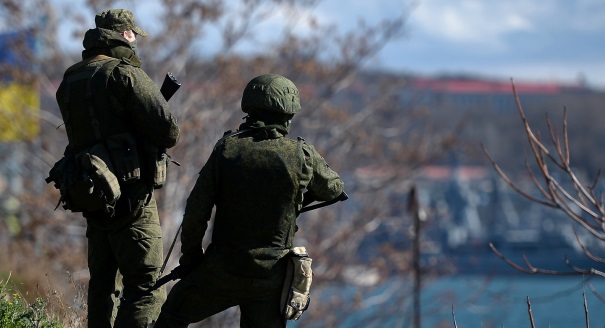
If Russia does intend to forcefully take control of Crimea, it would violate international laws on territorial integrity. Already, the western powers have threatened various ways to isolate Russia diplomatically and economically. Does Vladimir Putin care?

Carnegie’s Eugene Rumer and Dmitri Trenin spoke about the recent developments in Ukraine on KCRW’s To the Point. They were joined by Will Englund of the Washington Post and P. J. Crowley of the George Washington University.

Trenin argued that Russia has switched gears in a dramatic way during the past ten days, moving from moderate reactions to deep involvement in the Ukrainian conflict. This change of policy is a result of Putin’s reassessment of the situation: now he seems to interpret the victory of the Maidan as a victory of anti-Russian forces. Putin does not only fear to lose Ukraine as a good neighbor that can be influenced, Trenin added, but to have an anti-Russian state right on the Russian border.

Rumer said that Ukraine’s close relations with Russia and with the EU seem to be mutually exclusive for Putin, who looks at the world from a zero-sum perspective. Now Ukraine made it clear that it still want to vigorously pursue the path of European integration. Thus, Rumer noted, Putin has calculated the risks and the costs and figured out that getting hold of Crimea and letting Ukraine go west is worth the price of taking actions on the peninsula.

This interview was originally broadcast on KCRW.

About the Authors

Dmitri Trenin

Former Director, Carnegie Moscow Center

Trenin was director of the Carnegie Moscow Center from 2008 to early 2022.

Eugene Rumer
Eugene Rumer

Director and Senior Fellow, Russia and Eurasia Program

Rumer, a former national intelligence officer for Russia and Eurasia at the U.S. National Intelligence Council, is a senior fellow and the director of Carnegie’s Russia and Eurasia Program.

Authors

Dmitri Trenin
Former Director, Carnegie Moscow Center
Eugene Rumer
Director and Senior Fellow, Russia and Eurasia Program
Eugene Rumer
SecurityForeign PolicyRussiaEastern EuropeUkraine

Carnegie India does not take institutional positions on public policy issues; the views represented herein are those of the author(s) and do not necessarily reflect the views of Carnegie, its staff, or its trustees.

More Work from Carnegie India

  • A Halting Turn: India’s Military Transformation
    Commentary
    A Halting Turn: India’s Military Transformation

    In any defense establishment, change is an ongoing process. However, despite the best of intentions, existing bureaucracies, bound by habit and years of socialization, have their limits in implementing transformative change.

      • Anit Mukherjee

      Anit Mukherjee

  • Paper
    Threading the Needle: India’s Path Forward with China

    After the chill in ties between 2020 and 2024 that brought India–China relations to their lowest point in several decades, the two countries have engaged each other afresh. This paper argues that there are predominantly four imperatives guiding India’s approach to China, and they exist in an order of priority.

      Saheb Singh Chadha

  • Article
    Managing Divergence: India’s BRICS Presidency in 2026

    This piece argues that India’s central challenge is not managing a single flashpoint but resolving the underlying tension between expansion and institutional coherency of the BRICS grouping.

      Vrinda Sahai

  • Article
    India–Africa Strategic Partnership: Challenges, Potential, and Possible Pathways

    A partnership between India, a country of subcontinental size, and Africa, a continent of fifty-four countries, may seem asymmetric until one notes that both are home to nearly the same number of people—1.4 billion. This essay spells out the existing challenges to the partnership, its optimal potential, and the possible pathways to realize it over the next quarter-century.

      Rajiv Bhatia

  • Commentary
    Emerging From the “Zombie State” of Trade Agreements: The India-EU FTA

    The India–EU Free Trade Agreement (FTA) is shaping up to be one of the most consequential trade negotiations, both economically and strategically. But, what’s in the agreement, what’s missing, and what will determine its success in the years ahead

      Vrinda Sahai, Nicolas Köhler-Suzuki

Get more news and analysis from
Carnegie India
Carnegie India logo, white
Unit C-4, 5, 6, EdenparkShaheed Jeet Singh MargNew Delhi – 110016, IndiaPhone: 011-40078687
  • Research
  • About
  • Experts
  • Projects
  • Events
  • Contact
  • Careers
  • Privacy
  • For Media
Get more news and analysis from
Carnegie India
© 2026 Carnegie Endowment for International Peace. All rights reserved.





