

Q&A
Eugene Rumer
{
  "authors": [
    "Eugene Rumer"
  ],
  "type": "commentary",
  "centerAffiliationAll": "",
  "centers": [
    "Carnegie Endowment for International Peace",
    "Carnegie Russia Eurasia Center"
  ],
  "collections": [],
  "englishNewsletterAll": "",
  "nonEnglishNewsletterAll": "",
  "primaryCenter": "Carnegie Endowment for International Peace",
  "programAffiliation": "",
  "programs": [],
  "projects": [],
  "regions": [
    "Russia",
    "Eastern Europe",
    "Ukraine"
  ],
  "topics": [
    "Security",
    "Military",
    "Foreign Policy"
  ]
}
Source: Getty
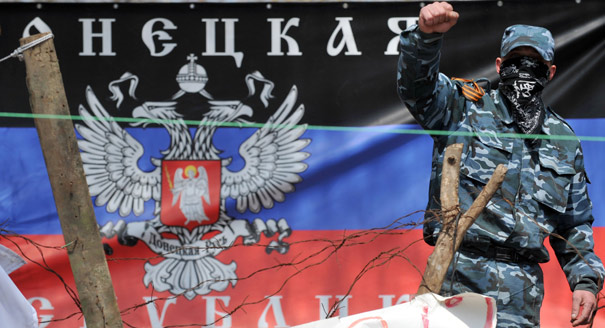
A counter-insurgency strategy from Iraq and Afghanistan may be proving effective as a tool of Russian or pro-Russian insurgency in Eastern Ukraine.
Now largely forgotten, or relegated to the category of near-ancient history, the ink-spot strategy was all the rage at the time when the United States was fighting the counterinsurgency campaigns in Iraq and Afghanistan. Embraced by U.S. counterinsurgency gurus as the answer to the problem of controlling vast stretches of both countries riven by civil war or terrorist activity, the strategy calls for establishing a series of strongholds where normal day-to-day life and government activity are restored. These strongholds, secured by military and police personnel, establish security zones around them. Insurgents are gradually pushed out from these zones or eliminated, and like ink spots on paper, the safety zones spread and expand the security perimeter outward, until the blots merge into one large area.
How far will the insurgents—Russian or pro-Russian—take this strategy? It depends on the larger goals behind it, which remain a mystery. Will the insurgents and their presumed Russian masters be content to simply destabilize Eastern and Southern Ukraine and keep the region permanently unstable as a pressure point and a bargaining chip with the Kyiv government? The ink spot strategy appears well suited for this purpose. It also appears quite effective as an alternative to a full-fledged military invasion of Ukraine, which would run the risk of escalating into a protracted and costly military conflict, in which the insurgency vs. counterinsurgency roles would be reversed, and the Russian military would face the daunting task of stabilizing a vast area of Ukraine. Last, but not least, the spreading ink spots will disrupt the conduct of the May 25 election, thus making it possible for Russia to challenge the legitimacy of Ukraine’s future leadership.
As useful as the ink spot strategy is at the current phase, it cannot be played out indefinitely. The more it spreads, the wider the area consumed by the insurgency, the greater the challenge for the insurgent force to establish its own government and build its credibility as the alternative to the old regime. That’s the point where the erstwhile insurgents will discover that a strategy of denial is a lot easier to implement than recover from it.

Director and Senior Fellow, Russia and Eurasia Program
Rumer, a former national intelligence officer for Russia and Eurasia at the U.S. National Intelligence Council, is a senior fellow and the director of Carnegie’s Russia and Eurasia Program.
Recent Work
Eugene Rumer
Eugene Rumer
Carnegie India does not take institutional positions on public policy issues; the views represented herein are those of the author(s) and do not necessarily reflect the views of Carnegie, its staff, or its trustees.

In any defense establishment, change is an ongoing process. However, despite the best of intentions, existing bureaucracies, bound by habit and years of socialization, have their limits in implementing transformative change.

Anit Mukherjee

After the chill in ties between 2020 and 2024 that brought India–China relations to their lowest point in several decades, the two countries have engaged each other afresh. This paper argues that there are predominantly four imperatives guiding India’s approach to China, and they exist in an order of priority.

Saheb Singh Chadha

This piece argues that India’s central challenge is not managing a single flashpoint but resolving the underlying tension between expansion and institutional coherency of the BRICS grouping.

Vrinda Sahai

A partnership between India, a country of subcontinental size, and Africa, a continent of fifty-four countries, may seem asymmetric until one notes that both are home to nearly the same number of people—1.4 billion. This essay spells out the existing challenges to the partnership, its optimal potential, and the possible pathways to realize it over the next quarter-century.

Rajiv Bhatia

The India–EU Free Trade Agreement (FTA) is shaping up to be one of the most consequential trade negotiations, both economically and strategically. But, what’s in the agreement, what’s missing, and what will determine its success in the years ahead
Vrinda Sahai, Nicolas Köhler-Suzuki