

Research
- +6
Yasmine Farouk, Nathan J. Brown, Maysaa Shuja Al-Deen, …
{
  "authors": [
    "Intissar Fakir"
  ],
  "type": "legacyinthemedia",
  "centerAffiliationAll": "dc",
  "centers": [
    "Carnegie Endowment for International Peace"
  ],
  "collections": [
    "Arab Awakening"
  ],
  "englishNewsletterAll": "menaTransitions",
  "nonEnglishNewsletterAll": "",
  "primaryCenter": "Carnegie Endowment for International Peace",
  "programAffiliation": "MEP",
  "programs": [
    "Middle East"
  ],
  "projects": [],
  "regions": [
    "North Africa",
    "Tunisia",
    "Maghreb"
  ],
  "topics": [
    "Political Reform",
    "Civil Society"
  ]
}
Source: Getty
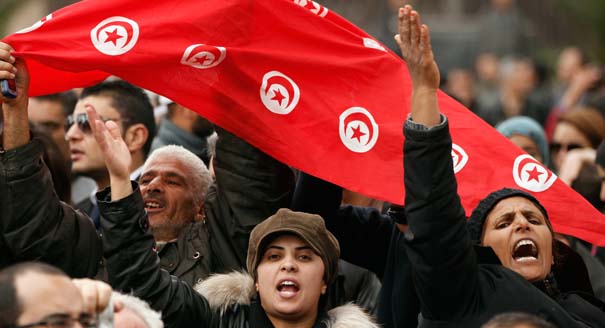
After a turbulent and highly polarizing year, Tunisia’s passage of an election law on May 2 and the consequent upcoming elections give reason for optimism about the country’s transition.
Source: National
After a turbulent and highly polarising year, Tunisia’s passage of an election law on May 2 and the consequent upcoming elections give reason for optimism about the country’s transition. But challenges remain, and the underlying polarisation that has consumed Tunisian politics over the past few years still threatens what is viewed as the Arab Spring’s most successful state.
Polarisation brought the Tunisian government to a halt during summer last year. The parties were divided over key aspects of the transition: a parliamentary or presidential system, the role of Islam in politics and society, the fate of former regime figures, restrictions on free speech (including whether to ban blasphemy and takfir, or apostasy), gender equality and the role of women in society.
Although it is tempting to portray this as an issue of Islamists against secularists, that somewhat simplistic approach precludes understanding and ultimately negotiating the rifts between the various parties who each have their own ideas of what Tunisia should look like.The governance style of Ennahda, Tunisia’s Islamist party that led the ruling coalition, caused many on the secular left to feel excluded. Growing opposition to Ennahda was made even starker by the events in Egypt at the time. The low point came with the assassination last July of Mohamed Brahimi, the outspoken leftist secular opposition leader and member of parliament. It was Tunisia’s second political assassination that year. Many blamed the killings on Ennahda (directly or indirectly) and the role it played in aggravating the political rifts.
A National Constituent Assembly sit-in followed, leading to the suspension of the assembly. This, along with a worsening economy and security challenges (both regionally and internally with the rise of extremist militancy), appeared to be sending Tunisia towards a dangerous crisis, perhaps joining other post-Arab Spring countries consumed by factional rivalries and deep political instability.
How Tunisia was able to address this crisis without widespread violence or military intervention demonstrates why the country is managing its transition more effectively than other post-revolutionary states in the region, but also why its challenges remain.
In late summer 2013, the ruling coalition, the opposition and non-governmental bodies, including leading labour unions and other civil society organisations, negotiated a plan to take Tunisia out of the impasse and toward a national dialogue. As part of the negotiated road map, the National Constituent Assembly finalised and adopted the new constitution at the end of January, and a caretaker government took power.
While admirable on the surface, Ennahda’s acceptance of the road map and its agreement to cede power to a caretaker government was a political calculation. Given the trajectory of Tunisia, some in Ennahda feared the party could face a fate comparable to the Muslim Brotherhood in Egypt. Ennahda admitted to some mistakes in governing but also seemed confident that it could win the next elections. However, even fears among both the left and Islamists that the whole negotiation process could facilitate a return of former regime figures and counter-revolutionaries did not stand in the way of a compromise.
But the pragmatism that allowed Tunisia to regain some stability has not completely eased the polarisation that entrenched political and ideological disagreements about the future of the country. Tunisia’s greatest challenges require practical responses, but because many questions are viewed through the lens of polarisation, practical answers are few.
The economy requires attention and addressing the worsening security situation must be a priority. Since the revolution, the economy has struggled; GDP growth is lagging, inflation is high and trade deficits are putting a strain on foreign reserves. But perhaps the most significant challenge is that youth unemployment – one of the central drivers of the revolt in the first place – remains high. Instability and a lack of security along the Algerian and Libyan borders also require effective strategies that the current political environment has struggled to deliver.
Tunisia’s next government will only have a small margin for error, as it will be dealing with an exhausted populace demanding quick solutions to myriad issues. These issues will need to be resolved through political consensus. If this cannot be done, a return to the polarised political environment of last summer is likely and the country might not be able to step back from the brink a second time.
The resurgence of the security state in Egypt and factional violence in Libya demonstrate the consequences of failing to create a pluralistic political system capable of building consensus around key issues.
Looking ahead to the elections, tentatively planned for November, political parties are already seeking to strengthen their standings and preparing ways to exclude their opponents from forming a government. In these early stages there is too much focus on alliances and potential alliances and not enough on how to resolve the various economic, social and security issues. Although this sort of negotiation process is expected in the run-up to elections under normal circumstances, Tunisia is at a critical juncture. The country’s political forces will have to make sure that the mistakes of exclusion that produced the current situation do not occur again.
Former Fellow, Middle East Program, Editor in Chief, Sada
Intissar Fakir was a fellow and editor in chief of Sada in Carnegie’s Middle East Program.
Recent Work



Yasmine Farouk, Nathan J. Brown, Maysaa Shuja Al-Deen, …
Intissar Fakir
Carnegie India does not take institutional positions on public policy issues; the views represented herein are those of the author(s) and do not necessarily reflect the views of Carnegie, its staff, or its trustees.

A partnership between India, a country of subcontinental size, and Africa, a continent of fifty-four countries, may seem asymmetric until one notes that both are home to nearly the same number of people—1.4 billion. This essay spells out the existing challenges to the partnership, its optimal potential, and the possible pathways to realize it over the next quarter-century.

Rajiv Bhatia
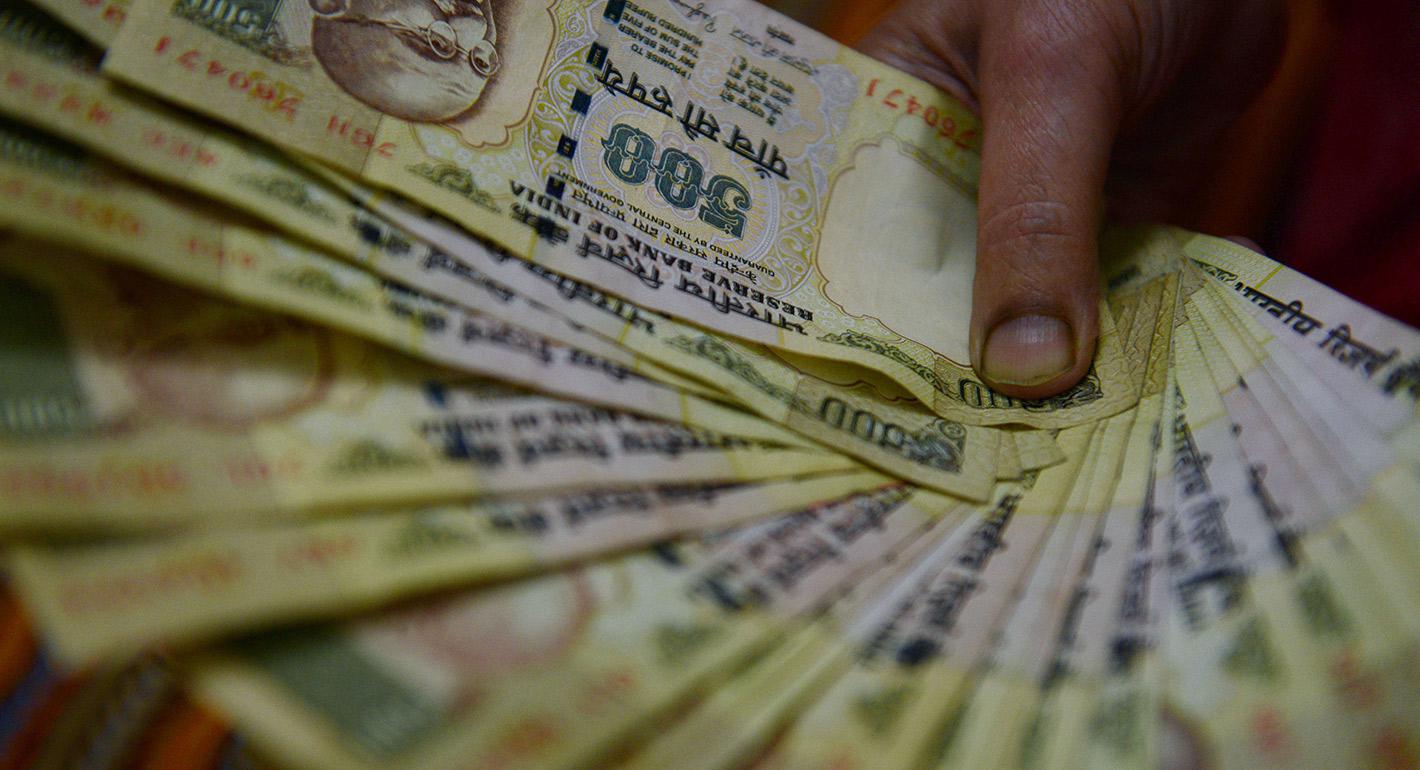
As India’s economy recovers from the coronavirus pandemic, Indian businesses need efficient financial structures to regain their ground. Key reforms to India’s Insolvency and Bankruptcy Code could fill these gaps.

Anirudh Burman

Access to cross-border data is an integral piece of the law enforcement puzzle. India is well placed to lead the discussions on international data agreements subject to undertaking necessary surveillance reforms.
Smriti Parsheera, Prateek Jha
After the coronavirus pandemic wanes, how will China’s reorientation of the Belt and Road Initiative to address global health concerns influence its relationships with South Asian countries?
Deep Pal, Rahul Bhatia
Early in the outbreak, government researchers forecast several high-risk scenarios that were downplayed or ignored in public messaging.
Gautam I. Menon