

Commentary
Dmitri Trenin
{
  "authors": [
    "Dmitri Trenin"
  ],
  "type": "commentary",
  "centerAffiliationAll": "",
  "centers": [
    "Carnegie Endowment for International Peace",
    "Carnegie Russia Eurasia Center"
  ],
  "collections": [],
  "englishNewsletterAll": "",
  "nonEnglishNewsletterAll": "",
  "primaryCenter": "Carnegie Russia Eurasia Center",
  "programAffiliation": "",
  "programs": [],
  "projects": [],
  "regions": [
    "North America",
    "United States",
    "East Asia",
    "China",
    "Japan",
    "Russia"
  ],
  "topics": [
    "Foreign Policy"
  ]
}
Source: Getty
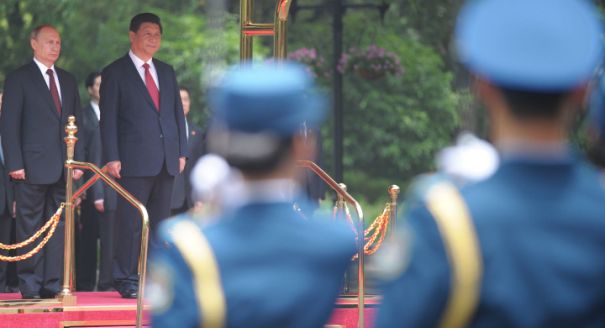
In mid-2014, the United States' relations with China and Russia are substantially worse than those two countries' bilateral relations. The unique position that the United States has held since the 1990s as the dominant power in Eurasia is now history.
From Ukraine to the South and East China Seas, the international system experiences new turbulence, even as it searches a new balance. Ostensibly, the United States and Russia are in a conflict over Ukraine. In reality, they are in a conflict over the fundamentals of the post-Cold War settlement. Russia, pushing back against expanding Western influence, is labeled revisionist and "resurgent." China is not yet in a conflict with the United States, but the Sino-U.S. relationship, too, is experiencing increasing strains. As its power grows, China advances its interests in the maritime zones east and south of its shores, for which it is termed "assertive." Worried, China's smaller neighbors in Asia, like Russia's in Europe, are flocking to seek U.S. protection, thus re-invigorating Cold War-era alliances and creating new informal ones.
In mid-2014, for the first time in four decades, the United States' relations with China and Russia are substantially worse than those two countries' bilateral relations. The lopsided triangle now being formed and probably ignored in Washington, where Russia is heavily discounted as a factor, has Beijing in a more advantageous position than ever before. This position would allow China access to more resources, and would make its strategic rear in the north even more secure as it deals with the issues south and east of its shores. The result is that the unique position that the United States has held since the 1990s as the dominant power in Eurasia is now history. Symbolically, the Pentagon's quiet departure last month from the Manas air base in Kyrgyzstan closes the book on that era.
Former Director, Carnegie Moscow Center
Trenin was director of the Carnegie Moscow Center from 2008 to early 2022.
Recent Work
Dmitri Trenin
Dmitri Trenin
Carnegie India does not take institutional positions on public policy issues; the views represented herein are those of the author(s) and do not necessarily reflect the views of Carnegie, its staff, or its trustees.

How is AI reshaping space security, creating governance challenges, and where does international diplomacy stand today?


Tejas Bharadwaj, Almudena Azcárate Ortega

After the chill in ties between 2020 and 2024 that brought India–China relations to their lowest point in several decades, the two countries have engaged each other afresh. This paper argues that there are predominantly four imperatives guiding India’s approach to China, and they exist in an order of priority.

Saheb Singh Chadha

This piece argues that India’s central challenge is not managing a single flashpoint but resolving the underlying tension between expansion and institutional coherency of the BRICS grouping.

Vrinda Sahai

A partnership between India, a country of subcontinental size, and Africa, a continent of fifty-four countries, may seem asymmetric until one notes that both are home to nearly the same number of people—1.4 billion. This essay spells out the existing challenges to the partnership, its optimal potential, and the possible pathways to realize it over the next quarter-century.

Rajiv Bhatia

The U.S.–India semiconductor cooperation story is well-stocked with top-level strategic intent. What remains unresolved, however, are some underlying challenges that will determine whether the cooperation actually functions. Three such friction points stand out.

Shruti Mittal