

Article
C. Raja Mohan, Darshana M. Baruah
{
  "authors": [
    "C. Raja Mohan"
  ],
  "type": "legacyinthemedia",
  "centerAffiliationAll": "dc",
  "centers": [
    "Carnegie Endowment for International Peace",
    "Carnegie India"
  ],
  "collections": [],
  "englishNewsletterAll": "ctw",
  "nonEnglishNewsletterAll": "",
  "primaryCenter": "Carnegie India",
  "programAffiliation": "SAP",
  "programs": [
    "South Asia"
  ],
  "projects": [],
  "regions": [
    "North America",
    "United States",
    "South Asia",
    "India",
    "Russia"
  ],
  "topics": [
    "Foreign Policy"
  ]
}
Source: Getty
India has a big stake in preventing the further deterioration of U.S.-Russian relations. If India’s silence on Ukraine until now has been misunderstood, it must now speak up.
Source: Financial Express
New Delhi: As the crisis in Ukraine escalates after the downing of a Malaysian airliner last night by a surface-to-air missile, India will find it harder to navigate the growing tensions between Russia and the West.
Prime Minister Narendra Modi made an impressive diplomatic debut on the regional stage by reaching out to India’s South Asian neighbours even before he took charge of the nation. Hit by the civil war in Iraq soon after, the Modi government called on its many friends in the region to help evacuate Indian citizens trapped in the conflict zone. At the BRICS summit this week, Modi put his own stamp on India’s engagement with global issues.But as the West reacts to the tragic turn of events in Ukraine by mounting new pressure on Russian president Vladimir Putin, Modi’s foreign policy strategy of engaging every great power, without a reference to others, will come under some stress.
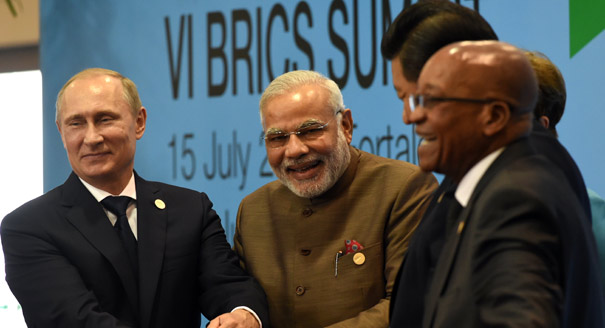
It was easy for Modi to signal the NDA government’s warmth towards Russia when he met Putin on the margins of the BRICS summit. However, with much of the international fury directed at Putin for supporting rebels in eastern Ukraine, the prime suspects in shooting down the Malaysian airliner, Modi may soon find that there are costs associated with India’s “privileged” partnership with Russia.
India now confronts a new phase of international relations where the great powers are no longer at peace with each other. In Europe, Russia is at odds with America and its allies. In Asia, China’s relations with Japan and the US have entered an uncertain phase.
Given its own separatist challenge in Jammu and Kashmir, India had little reason to support the break-up of Ukraine and legitimise Crimea’s integration with Russia through a referendum. Yet, the UPA government was reluctant to criticise Moscow’s actions in Crimea, given the value India attaches to the time-tested strategic partnership with Russia. If the West was disappointed with India’s muted reaction, Putin’s public expression of gratitude for Indian support accentuated Delhi’s diplomatic discomfort.
Although New Delhi is right in acknowledging Russia’s legitimate interests in Crimea, cannot afford to condone the actions of Ukraine’s rebels in the east who are fighting Kiev with Russian support.
India’s problem, however, goes well beyond the question of selective opposition to cross-border terrorism and the use of militant groups to affect territorial changes in another country.
For India, the diplomatic challenge is not about taking consistent positions on international issues, but of recognizing the long-term geopolitical implications of the Ukrainian crisis and acting upon them. Renewed rivalry between Russia and the West will make it harder for Asia to construct a stable balance of power. Through the Cold War, which saw the US and China embrace each other, India relied on Russian support to ensure its security. If Moscow, however, tilts towards a rising China in order to counter the West, India’s strategic dilemmas will become rather acute.
India, then, has a big stake in preventing the further deterioration of U.S.-Russian relations. If India’s silence on Ukraine until now has been misunderstood, it must now speak up.
This article was originally published by the Financial Express.
Former Nonresident Senior Fellow, Carnegie India
A leading analyst of India’s foreign policy, Mohan is also an expert on South Asian security, great-power relations in Asia, and arms control.
Recent Work

C. Raja Mohan, Darshana M. Baruah


Alexander Gabuev, Paul Haenle, C. Raja Mohan, …
Carnegie India does not take institutional positions on public policy issues; the views represented herein are those of the author(s) and do not necessarily reflect the views of Carnegie, its staff, or its trustees.

In any defense establishment, change is an ongoing process. However, despite the best of intentions, existing bureaucracies, bound by habit and years of socialization, have their limits in implementing transformative change.

Anit Mukherjee

As AI grows more sophisticated, as the supply chains that power it become more contested, and as access to frontier models becomes geopolitically charged, India must begin to ask a different set of questions. Not what applications it can build on someone else’s infrastructure but what the world needs.

Konark Bhandari

The Indian Ocean Region hosts one of the densest concentrations of subsea cables in the world. Yet, despite accounting for a significant share of global internet traffic, India’s participation remains limited.

Charukeshi Bhatt

How is AI reshaping space security, creating governance challenges, and where does international diplomacy stand today?


Tejas Bharadwaj, Almudena Azcárate Ortega

After the chill in ties between 2020 and 2024 that brought India–China relations to their lowest point in several decades, the two countries have engaged each other afresh. This paper argues that there are predominantly four imperatives guiding India’s approach to China, and they exist in an order of priority.

Saheb Singh Chadha