

Commentary
Dmitri Trenin
{
  "authors": [
    "Dmitri Trenin"
  ],
  "type": "commentary",
  "centerAffiliationAll": "",
  "centers": [
    "Carnegie Endowment for International Peace",
    "Carnegie Russia Eurasia Center"
  ],
  "collections": [],
  "englishNewsletterAll": "",
  "nonEnglishNewsletterAll": "",
  "primaryCenter": "Carnegie Russia Eurasia Center",
  "programAffiliation": "",
  "programs": [],
  "projects": [],
  "regions": [
    "Russia"
  ],
  "topics": [
    "Security",
    "Foreign Policy"
  ]
}
Source: Getty
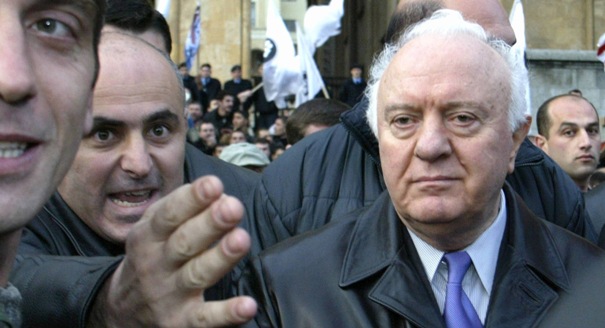
President Shevardnadze belongs to the people of Georgia. At the same time, Foreign Minister Shevardnadze will forever remain a major figure in Russia’s history, because he helped wind down the Cold War.
President Eduard Shevardnadze belongs to the people of Georgia. Foreign Minister Shevardnadze will forever remain a major figure in Russia’s history. A controversial figure, no doubt, but one that certainly commands respect. In the powerful duo with Mikhail Gorbachev, and in partnership with U.S. and other western leaders, Shevardnadze helped wind down the Cold War. Thus, they did a great service to humanity as a whole, and to those living in the former Soviet Union. We need not ignore the simple fact that among the alternatives to the Cold War there was not only the peace order that some have later come to detest, but a real war directly involving the United States and the Soviet Union. That now, despite the very real U.S.-Russian confrontation over Ukraine, there is no talk—and no likelihood—of a nuclear exchange between Moscow and Washington is also to Shevardnadze’s credit.
This does not mean that Foreign Minister Shevardnadze made no mistakes. Like Gorbachev, he was overly enthusiastic about their “new thinking,” and overly optimistic about the future of relations with the West. The end of the Cold War must have seemed to him the end of history, which of course it was not. The binary construct of the era of confrontation—friend or foe—demanded turning foes into friends, a conversion which proved far from fully satisfactory. “Universal interests of humankind” were not given a proper place among the various echelons of Moscow’s foreign policy, but instead appeared to overshadow the country’s specific national interests. Against that background, the charges that are usually brought against Shevardnadze by his critics, from banning the Oka missile to the Bering Sea settlement, should be seriously discussed by foreign policy historians. Luckily, they have so much more access to the papers of the Gorbachev presidency than of the periods that have followed.
Former Director, Carnegie Moscow Center
Trenin was director of the Carnegie Moscow Center from 2008 to early 2022.
Recent Work
Dmitri Trenin
Dmitri Trenin
Carnegie India does not take institutional positions on public policy issues; the views represented herein are those of the author(s) and do not necessarily reflect the views of Carnegie, its staff, or its trustees.

In any defense establishment, change is an ongoing process. However, despite the best of intentions, existing bureaucracies, bound by habit and years of socialization, have their limits in implementing transformative change.

Anit Mukherjee

After the chill in ties between 2020 and 2024 that brought India–China relations to their lowest point in several decades, the two countries have engaged each other afresh. This paper argues that there are predominantly four imperatives guiding India’s approach to China, and they exist in an order of priority.

Saheb Singh Chadha

This piece argues that India’s central challenge is not managing a single flashpoint but resolving the underlying tension between expansion and institutional coherency of the BRICS grouping.

Vrinda Sahai

A partnership between India, a country of subcontinental size, and Africa, a continent of fifty-four countries, may seem asymmetric until one notes that both are home to nearly the same number of people—1.4 billion. This essay spells out the existing challenges to the partnership, its optimal potential, and the possible pathways to realize it over the next quarter-century.

Rajiv Bhatia

The India–EU Free Trade Agreement (FTA) is shaping up to be one of the most consequential trade negotiations, both economically and strategically. But, what’s in the agreement, what’s missing, and what will determine its success in the years ahead
Vrinda Sahai, Nicolas Köhler-Suzuki