

Commentary
Thomas de Waal
{
  "authors": [
    "Thomas de Waal"
  ],
  "type": "commentary",
  "centerAffiliationAll": "",
  "centers": [
    "Carnegie Endowment for International Peace",
    "Carnegie Europe",
    "Carnegie Russia Eurasia Center"
  ],
  "collections": [],
  "englishNewsletterAll": "",
  "nonEnglishNewsletterAll": "",
  "primaryCenter": "Carnegie Europe",
  "programAffiliation": "",
  "programs": [],
  "projects": [],
  "regions": [
    "Russia"
  ],
  "topics": [
    "Political Reform",
    "Foreign Policy"
  ]
}
Source: Getty
With Russia—for better or worse. That is the message society in Abkhazia is receiving now that a new Abkhaz-Russian treaty has been drafted which could be signed as early as next week.
With Russia—for better or worse. That is the message society in Abkhazia is receiving now that a new Abkhaz-Russian treaty has been drafted which could be signed as early as next week.
The latest draft of the treaty, sent by the Abkhaz government to Moscow on November 18, has added the line that Abkhazia shares a “common social and economic space” with Russia. In many ways it does so already.
Nowadays in the city the locals call Sukhum (but most of the rest of the world still calls by its Soviet-era Georgian name, Sukhumi) the effects of the one billion dollars Russia has poured in here over the last six years, since it recognized Abkhazia as independent in 2008, are visible. Ruined buildings have been reconstructed, there are Japanese cars on the streets, shops selling Tissot watches and iPhones. Abkhazia is still poor, but no longer devastated.
The republic uses the Russian ruble and is sharing the best and worst of its current fall: rising inflation, combined with greater demand for its citrus fruits and other products. The public watches Russian television, travels abroad only via Russia.
Yet the Russia relationship is far from smooth. Society is bubbling with heated discussions over the treaty on “Union Relations and Strategic Partnership.”
The first version drafted in Moscow had a different word in the title, “Integration.” It was the work of Vladislav Surkov, adviser and chief ideologist to President Vladimir Putin. It proposed merging most of Abkhazia’s government structures with Russia’s. Crucially, Russians were to be given a fast track to acquiring Abkhaz citizenship, which would also give them the right to acquire property, a right they are currently denied.
Abkhazia is still poor, but no longer devastated.Tweet This
This looked to be Russia’s answer to Georgia’s Association Agreement with the European Union and also a quick cure to the problem that the Kremlin saw Abkhazia as increasingly unstable and unpredictable, especially after the murder there of Russian consul Dmitry Vishernev in September 2013.
Surkov had also quarreled with former Abkhaz leader Alexander Ankvab, a proud and aggressive personality, and he shared his ideas with the opposition. In May, according to several Abkhaz sources, the Kremlin gave it to understand that they would not act to support the unpopular Ankvab if there was a domestic political crisis. The emboldened opposition went out on the streets and eventually forced Ankvab to resign. In August Raul Khajimba was elected as his successor.
Society is still bruised and polarized from the “May event,” seen variously as a popular uprising or a putsch. That has spilled into angry debates about the new draft treaty.
In its draft, the Abkhaz government has taken out several of the more unpopular points, including the one on Abkhaz citizenship. But it still keeps many elements which its critics believe will undermine whatever sovereignty Abkhazia currently enjoys. Article 3 says the bilateral relationship will be based on “a coordinated foreign policy” and “creation of a common defense and security space.” It forms new “authorized organs” to manage relations, a “joint information-coordination center of the organs of internal affairs” and a “united group of forces” of both the Abkhaz and Russian militaries.
The public will mainly notice that the treaty promises Russian money to raise pensions and government salaries to the level of Russia’s Southern Federal District. There will also be a five billion ruble sweetener handed to the government once the document is signed.
The critics are in mourning for what they see as missed opportunities, both inside and outside Abkhazia, to strengthen its sovereignty. In Nezavisimaya Gazeta Arda Inal-Apa writes, “Unfortunately, a detailed reading of all points of the treaty, beginning with defense and ending with social guarantees, says that, in the thinking of the team of Russian authors, for Russia the further existence of the state under the name ‘Republic of Abkhazia’ is not needed. Most likely, the name of the republic will be preserved but essentially, as many Russian experts write, it will become a Russian region over time.”
Abkhazia’s de facto foreign minister Vyacheslav Chirikba disagrees. No one in Abkhazia liked the first draft, he says, but the new one does not threaten Abkhazia’s sovereignty. “We have 135 agreements with Russia. This will be the 136th, so what’s the problem?” he says.
Meanwhile, the international community is a bystander in this drama of Abkhazia’s future. European Union high representative Federica Mogherini made only routine remarks about support for Georgia’s territorial integrity and made no mention of what this move means for the people living in Abkhazia.

Senior Fellow, Carnegie Europe
Thomas de Waal is a senior fellow at Carnegie Europe, specializing in Eastern Europe and the Caucasus.
Recent Work
Thomas de Waal
Thomas de Waal
Carnegie India does not take institutional positions on public policy issues; the views represented herein are those of the author(s) and do not necessarily reflect the views of Carnegie, its staff, or its trustees.

After the chill in ties between 2020 and 2024 that brought India–China relations to their lowest point in several decades, the two countries have engaged each other afresh. This paper argues that there are predominantly four imperatives guiding India’s approach to China, and they exist in an order of priority.

Saheb Singh Chadha

This piece argues that India’s central challenge is not managing a single flashpoint but resolving the underlying tension between expansion and institutional coherency of the BRICS grouping.

Vrinda Sahai

A partnership between India, a country of subcontinental size, and Africa, a continent of fifty-four countries, may seem asymmetric until one notes that both are home to nearly the same number of people—1.4 billion. This essay spells out the existing challenges to the partnership, its optimal potential, and the possible pathways to realize it over the next quarter-century.

Rajiv Bhatia

The India–EU Free Trade Agreement (FTA) is shaping up to be one of the most consequential trade negotiations, both economically and strategically. But, what’s in the agreement, what’s missing, and what will determine its success in the years ahead
Vrinda Sahai, Nicolas Köhler-Suzuki
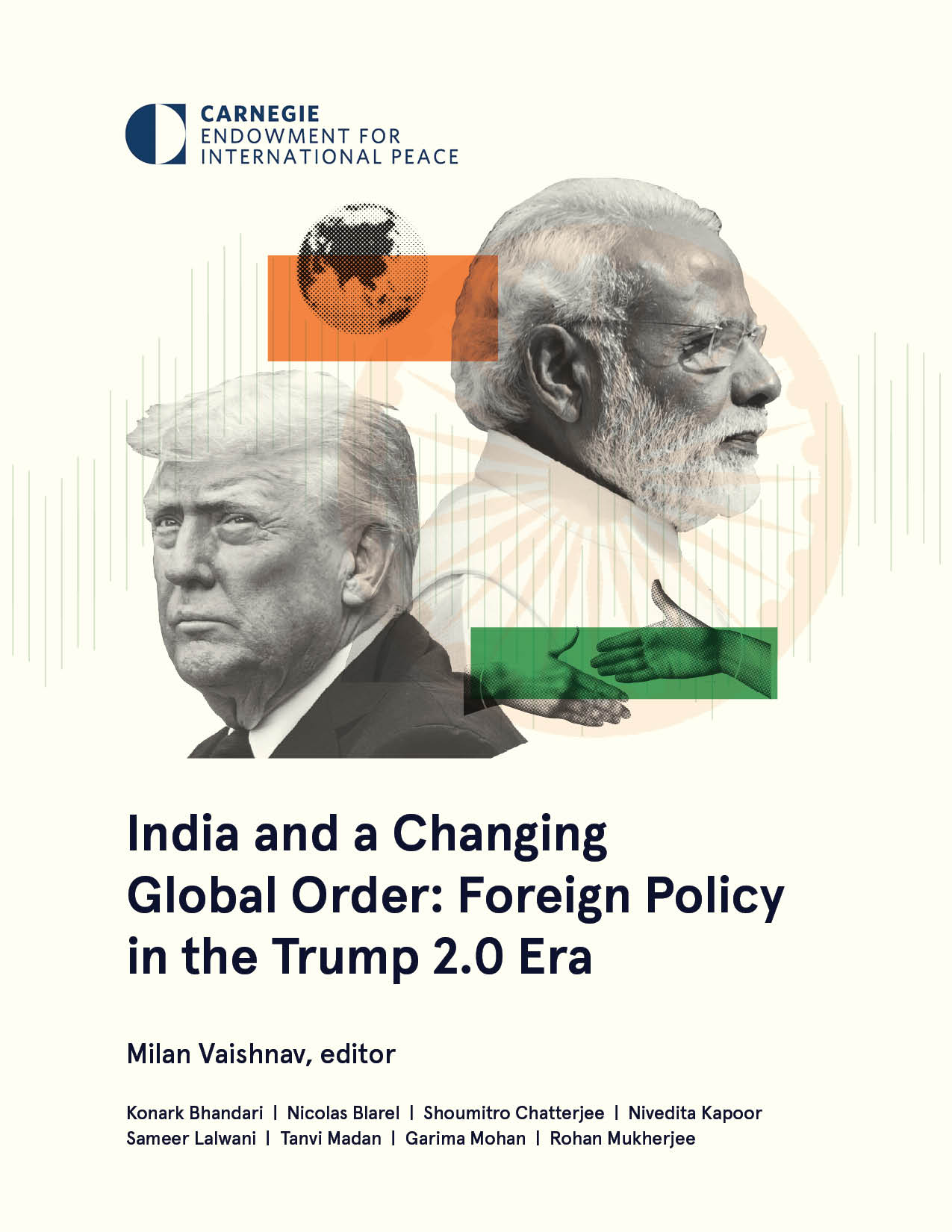
Trump 2.0 has unsettled India’s external environment—but has not overturned its foreign policy strategy, which continues to rely on diversification, hedging, and calibrated partnerships across a fractured order.



Milan Vaishnav, ed., Sameer Lalwani, Tanvi Madan, …