

In The Media
John Judis
{
  "authors": [
    "John Judis"
  ],
  "type": "legacyinthemedia",
  "centerAffiliationAll": "",
  "centers": [
    "Carnegie Endowment for International Peace"
  ],
  "collections": [],
  "englishNewsletterAll": "",
  "nonEnglishNewsletterAll": "",
  "primaryCenter": "Carnegie Endowment for International Peace",
  "programAffiliation": "",
  "programs": [],
  "projects": [],
  "regions": [
    "North America",
    "United States"
  ],
  "topics": [
    "Political Reform"
  ]
}
Source: Getty
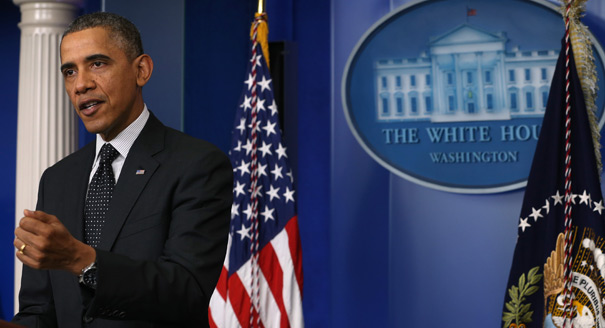
Obama didn’t just uphold the important principle of net neutrality — that internet providers not be allowed to discriminate among providers and customers — but he did so in the only way that counted.
Would Barack Obama, in the wake of Republican victories in this month’s election, turn rightward in order to appease his detractors? Or would Obama, who is now freed from worrying about elections, defy the Republicans and some of his own campaign contributors and embrace the liberal principles he espoused during his two presidential campaigns? It will take months to see, but in issuing a statement Monday on how the Federal Communications Commission (FCC) should regulate the Internet, the liberal Obama emerged like a phoenix from the ashes of defeat.
Obama didn’t just uphold the important principle of net neutrality—that internet providers not be allowed to discriminate among providers and customers—but he did so in the only way that counted: by advocating that the FCC change the classification of internet companies from “information providers” to “telecommunications companies.” That’s a seemingly technical change, but it lies at the heart of whether government can force megaliths like Comcast, Verizon, and AT&T to act in the public interest.
In 1996, Congress passed the Telecommunications Act, an ill-conceived bill, backed by Democrats and Republicans alike, that was supposed to make the broader telecommunications/internet industry more competitive by freeing companies from some regulations. Instead, the bill led to greater consolidation of the phone, wireless, and broadband industries. The internet was still in its infancy then, and the bill left ambiguous whether the FCC would be able to regulate it under the original Communications Act of 1934, like it did the big phone companies. Phone companies, for instance, couldn’t block or impede legal enterprises from using their networks; they had to sell access to their “pipes” at the same prices; and they couldn’t promise certain customers who paid a premium static-free calls, while subjecting the average caller to noisy interference. Would these same kind of rules—under Title II of the act—also apply to internet providers?In 2002, George W. Bush’s FCC chairman Michael Powell, the son of Colin Powell, and a business Republican who is now chief lobbyist for the cable companies, championed an interpretation that broadband providers were “information services” that did not require the same level of regulation as the phone companies, and he got the Republican majority on the FCC to adopt formally this interpretation. Its effect became clear in April 2010 when a Federal Appeals court struck down a ruling by the FCC that Comcast had acted illegally in slowing traffic from Bit Torrent, a file-sharing site. The court ruled that when the FCC had declared broadband an “information service,” it had precluded its right to prevent Comcast from discriminating against particular content or services. The FCC was toothless in trying to enforce what those in the industry called “net neutrality.”
In his 2008 campaign, Obama had advocated net neutrality, and his new FCC Commissioner Julius Genachowski, a law school friend, followed suit. In response to the April court ruling, Genachowski announced that the FCC would move to classifying broadband under Title II. That unleashed a thunderstorm of lobbying and intense opposition from Republicans on Capitol Hill. Susan Crawford, who had earlier served as Obama’s internet czar, said that the administration feared that if they adopted the reclassification, it would lead to “World War III.” In December, Genachowski backed off and issued instead a legally circuitous set of regulations that attempted to enforce certain aspects of net neutrality, but Verizon brought suit against the new rules, and in January 2014, the DC Appeals court threw out the new rules.
Incredibly, the new FCC chairman, Tom Wheeler, an Obama fundraiser and former cable lobbyist, who succeeded a frustrated Genachowski, has attempted to make still another end run around Powell’s 2002 interpretation of the rules. In May, Wheeler announced a new attempt to reformulate rules about net neutrality. Genachowski’s plan had loopholes—mobile internet was excluded—but Wheeler’s plan seemed to undermine the very principle by allowing internet providers to provide superior service to content-providers for a price. There was a tremendous uproar. As Obama recounted in his statement, the FCC has received almost 4 million letters of protest. Wheeler himself seemed unresponsive. While attending meetings of trade groups, he avoided public hearings called by consumer groups. In late October, he floated a new “hybrid” approach that would include stricter Title II-like regulation of particular activities, but by appearing to uphold Powell’s overall interpretation, would still be open to a court challenge. That’s where matters stood when Obama issued his statement today.
Obama hit the issue directly. He said:
So the time has come for the FCC to recognize that broadband service is of the same importance and must carry the same obligations as so many of the other vital services do. To do that, I believe the FCC should reclassify consumer broadband service under Title II of the Telecommunications Act—while at the same time forbearing from rate regulation and other provisions less relevant to broadband services. This is a basic acknowledgment of the services ISPs [Internet Service Providers] provide to American homes and businesses, and the straightforward obligations necessary to ensure the network works for everyone—not just one or two companies.
Obama also called for net neutrality rules that go well beyond what Genachowski or Wheeler had proposed. The new rules would apply to wireless broadband (with some allowance for preventing bottlenecks). Companies would not be allowed to block a website or service or “slow down some content and speed up others,” and “no service should be stuck in a ‘slow lane’ because it does not pay a fee.” Some details remain unclear, but these rules, combined with the reclassification of broadband, would insure that the internet remains a democratic medium. And the reclassification would also allow the FCC to oversee public access to the internet.
Obama, however, cannot order Wheeler or the five FCC commissioners to take a position. Obama may have been trying to create political space for Wheeler, but the FCC chairman’s response to Obama’s statement was not reassuring. Wheeler declared, “The more deeply we examined the issues around the various legal options, the more it has become plain that there is more work to do.” Wheeler and the commission are expected to issue their recommendations in December. In the meantime, the big companies and their lobbies will do what they can to block the FCC from following Obama’s advice. Verizon warned that reclassifying broadband would be “a radical reversal of course.” I would expect that Republicans in the House and Senate will threaten to cut the FCC’s funding if the commission adopts Obama’s proposal. Obama’s statement will, perhaps, cause World War III on Capitol Hill and K Street, but if there are political battles worth fighting in Obama’s last two years, this is certainly one of them.

Former Visiting Scholar
As a visiting scholar at Carnegie, Judis wrote The Folly of Empire: What George W. Bush Could Learn from Theodore Roosevelt and Woodrow Wilson.
Recent Work
John Judis
John Judis
Carnegie India does not take institutional positions on public policy issues; the views represented herein are those of the author(s) and do not necessarily reflect the views of Carnegie, its staff, or its trustees.

How is AI reshaping space security, creating governance challenges, and where does international diplomacy stand today?


Tejas Bharadwaj, Almudena Azcárate Ortega

The U.S.–India semiconductor cooperation story is well-stocked with top-level strategic intent. What remains unresolved, however, are some underlying challenges that will determine whether the cooperation actually functions. Three such friction points stand out.

Shruti Mittal

India and the United States are close to concluding a Reciprocal Defense Procurement Agreement (RDPA) that will allow firms from the two countries to sell to each other’s defense establishments more easily. While this may not remedy the specific grievances both sides may have regarding larger bilateral issues, an RDPA could restore some momentum, following the trade deal announcement.

Konark Bhandari

On the last day of the India AI Impact Summit, India signed Pax Silica, a U.S.-led declaration seemingly focused on semiconductors. While India’s accession to the same was not entirely unforeseen, becoming a signatory nation this quickly was not on the cards either.
Konark Bhandari

This piece examines India’s response to U.S. sanctions and tariffs, specifically assessing the immediate market consequences, such as alterations in import costs, and the broader strategic implications for India’s energy security and foreign policy orientation.

Vrinda Sahai