• Research
  • About
  • Experts
Carnegie India logoCarnegie lettermark logo
AI
{
  "authors": [
    "Akio Kawato"
  ],
  "type": "commentary",
  "centerAffiliationAll": "",
  "centers": [
    "Carnegie Endowment for International Peace",
    "Carnegie Russia Eurasia Center"
  ],
  "collections": [],
  "englishNewsletterAll": "",
  "nonEnglishNewsletterAll": "",
  "primaryCenter": "Carnegie Russia Eurasia Center",
  "programAffiliation": "",
  "programs": [],
  "projects": [],
  "regions": [
    "East Asia",
    "China",
    "Japan",
    "Russia"
  ],
  "topics": [
    "Economy",
    "Foreign Policy",
    "Global Governance"
  ]
}

Source: Getty

Commentary
Carnegie Russia Eurasia Center

Pax Sinica: China and the New Russia

Pax Sinica has come. Countries in China’s orbit will be given security guarantees and trade preferences as long as they remain allegiant. Thus, the pivot to Asia will only drive Russia to unnecessary dependence on China.

Link Copied
By Akio Kawato
Published on Nov 14, 2014

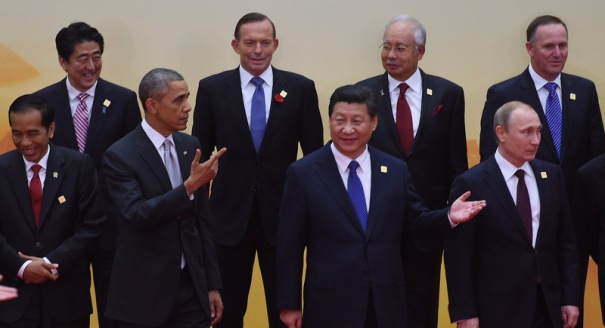
Chinese leader Xi Jinping is consolidating power. The APEC (Asia-Pacific Economic Cooperation) Summit in Beijing smacked of an ancient imperial pageant, to which foreign kings were summoned to pay tribute to and win the favor of the great Chinese emperor.

Russian King Vladimir Putin got an ambiguous promise from Xi Jinping that China will someday import natural gas through the Altai; Japanese King Shinzo Abe was granted an audience with Xi Jinping, indicating that Japan and China may end their dangerous confrontation; and the great American King Barack Obama was assured that China will not rule the world alone—yet.

China’s position looks firm; Russia is isolated from the West, North and South Korea are under China’s spell, Japan and the United States have been pacified, South-East Asia and Central Asia are under Chinese economic and political sway, and India, despite predictions about Modi’s economic policy, will probably not grow nearly as quickly as some analysts suggests.

In the Middle East, China has its own clout, especially in Iran. In Europe, the EU has lost its erstwhile economic and cultural lure, no country is fighting to preserve internal cohesion, some pundits have started to talk about the EU’s break-up à la the Soviet Union or the formation of a new “Berlin-Moscow-Beijing” axis, and the countries that used to crave membership in the EU are having second thoughts, looking elsewhere for sources of easy money. In such a milieu Chinese leaders’ visits are welcomed like manna from heaven.

China is rapidly expanding its network of currency swap agreements, widening the use of the Renminbi in international transactions. It is launching one after another new “International Development Bank” and a “Development Fund” for various regions, as if attempting to replace the IMF and IBRD. Pax Sinica has come (or perhaps “Pax Cynica”). Countries in China’s orbit will be given security guarantees and trade preferences as long as they remain allegiant to China, a revival of the ancient order of Chao gong and Ce feng.

However, all Chinese dynasties end at some point, and contemporary China’s weaknesses suggest that it is no exception. Firstly, its economy is not as robust as it looks. China’s phenomenal growth was realized through heavy dependence on foreign capital and technology. During the 2000s China banked about 200 billion dollars of foreign capital in foreign direct investments and trade surplus every year. Even today, about 50 percent of China’s exporting is done by foreign companies. Further, Beijing does not follow the principles of the market economy, which is a prerequisite for self-sustaining growth. Its banking system periodically generates huge numbers of bad loans, which may trigger high inflation, a recipe for the fall of many previous Chinese dynasties. Societal pressure for democratic reforms is simmering, as the recent movement in Hong Kong demonstrated. Finally, the danger of Islamic terrorism is mounting: one of the leaders of ISIS recently declared that China will eventually be its largest target. Despite all these draw-backs, however, China will remain a global power for quite some time.

For Russia, the only viable way out from the East-West quagmire is in finding a modus vivendi in the Ukraine crisis.
 
Tweet This

How will Russia’s “pivot to Asia” operate in this environment? It is likely doomed to fail because Russia needs Asia more than Asia needs Russia. Japan is ending its confrontation with China, which it means that Japan will not need Russia as a balance vis-à-vis China so much as in the past. India is not powerful enough to become a meaningful ally for Russia. Thus, the pivot to Asia will only drive Russia to unnecessary dependence on China.

For Russia, the only viable way out from the East-West quagmire is in finding a modus vivendi in the Ukraine crisis. Russia counted too much on the ephemeral economic strength brought by high oil prices, and prematurely attempted to resurrect its reduced sphere of influence. Did those who inspired the archaic imperialistic ideas to President Putin correctly measure the limits and bounds of Russia’s power? Are they not risking bringing Russia into an impasse again?

About the Author

Akio Kawato

Writer

Akio Kawato is a former Japanese diplomat and blogger.

Akio Kawato
Writer
EconomyForeign PolicyGlobal GovernanceEast AsiaChinaJapanRussia

Carnegie India does not take institutional positions on public policy issues; the views represented herein are those of the author(s) and do not necessarily reflect the views of Carnegie, its staff, or its trustees.

More Work from Carnegie India

  • Paper
    Threading the Needle: India’s Path Forward with China

    After the chill in ties between 2020 and 2024 that brought India–China relations to their lowest point in several decades, the two countries have engaged each other afresh. This paper argues that there are predominantly four imperatives guiding India’s approach to China, and they exist in an order of priority.

      Saheb Singh Chadha

  • Article
    Managing Divergence: India’s BRICS Presidency in 2026

    This piece argues that India’s central challenge is not managing a single flashpoint but resolving the underlying tension between expansion and institutional coherency of the BRICS grouping.

      Vrinda Sahai

  • Article
    India–Africa Strategic Partnership: Challenges, Potential, and Possible Pathways

    A partnership between India, a country of subcontinental size, and Africa, a continent of fifty-four countries, may seem asymmetric until one notes that both are home to nearly the same number of people—1.4 billion. This essay spells out the existing challenges to the partnership, its optimal potential, and the possible pathways to realize it over the next quarter-century.

      Rajiv Bhatia

  • Commentary
    Emerging From the “Zombie State” of Trade Agreements: The India-EU FTA

    The India–EU Free Trade Agreement (FTA) is shaping up to be one of the most consequential trade negotiations, both economically and strategically. But, what’s in the agreement, what’s missing, and what will determine its success in the years ahead

      Vrinda Sahai, Nicolas Köhler-Suzuki

  • Article
    India’s Press Note 3 Gamble: Opening the FDI Door to China

    On March 10, 2026, India’s Union Cabinet approved amendments to Press Note 3, a regulation that mandated government approval on all foreign direct investment (FDI) from countries sharing a land border with India. This amendment raises questions primarily about whether its stated benefits will materialize and if the risks have been adequately weighed. This piece will address the same.

      Konark Bhandari

Get more news and analysis from
Carnegie India
Carnegie India logo, white
Unit C-4, 5, 6, EdenparkShaheed Jeet Singh MargNew Delhi – 110016, IndiaPhone: 011-40078687
  • Research
  • About
  • Experts
  • Projects
  • Events
  • Contact
  • Careers
  • Privacy
  • For Media
Get more news and analysis from
Carnegie India
© 2026 Carnegie Endowment for International Peace. All rights reserved.