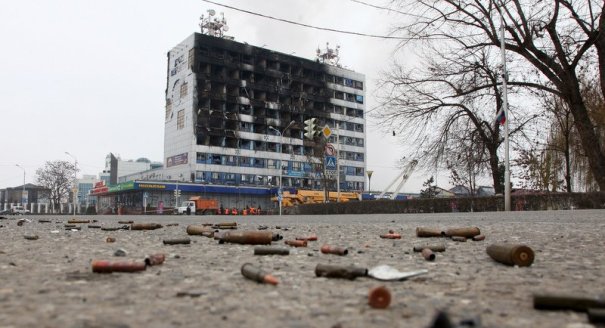
The atrocious terrorist attacks in the Chechen capital city of Grozny on the night of December 4 left 10 policemen dead and 28 others wounded. Nine militants were reportedly killed in the government’s anti-terrorist operation. The timing of the attacks is certainly not coincidental, with President Putin addressing the Russian Federal Assembly as the operation entered its final stages. For many, the hours-long skirmish and subsequent virtual siege of the city were not only shocking but also quite symptomatic.
For Putin, the violence recalls an issue he thought he had resolved in the early 2000s. In the early days of his tenure, he rallied the populace around his successes defeating extremists in Chechnya, later subcontracting the job to Ramzan Kadyrov, the son of former Chechen President Akhmad Kadyrov, who was assassinated in 2004.
Ramzan Kadyrov is thus deeply invested in the fight against jihadists in Chechnya. The recent violence in Grozny punctuated a relatively long-lasting peace in Chechnya, due in no small part to Kadyrov's anti-terrorism initiatives, and came as a blow to his leadership profile. In September of 2013 Kadyrov announced the killing of Dokku Umarov, the leader of the extremist group “Caucasus Emirate,” which he claimed as a personal victory. This November, Kadyrov announced that a key ISIS commander, Omar al-Shishani, had been killed—allegedly with the “help” of Kadyrov’s fighters operating abroad.
In what has become Kadyrov's personal war, the recent violence in Grozny represents another painful battle.
The attacks came as a surprise to the region. Surrounded by socio-economic discontent and intensifying radical movements in the neighboring republics of Dagestan, Ingushetia, and Kabardino-Balkaria, Chechnya had become a beacon of stability.
For Russians, it was a doleful reminder of the gloomy days of the early noughties, when painful stories about events in Chechnya made daily headlines, enveloping the country in what came to be known as “Chechnya fatigue.” For Westerners, it was an indication, if not a full disclosure, that the situation in the once rebellious republic is less stable than official reports suggest.
For the Russian state, the important question is whether the attack was the first ISIS-orchestrated operation on Russian soil.
It would be premature to argue that Chechnya is slipping back into the chaos of the 1990s and early 2000s. Ultimately, Ramzan Kadyrov still has a tight grip on the Republic. His social contract with Putin is still valid, with the Russian leader pinning his hopes of stability on his loyal “foot solder”—for better or worse. Putin touched on the events in Grozny in his address before the Federal Assembly, assuring the Russian people that “local guys and local law enforcement will cope with them [terrorists] properly.”
A more important consequence of the dramatic violence in Grozny may be the impact it has on Russia-Western relations. In the past, hostilities in Chechnya were a significant irritant for Moscow. Amidst a stand-off with the West over Ukraine, the Kremlin may interpret this and any other terrorist acts in the Caucasus as “Western attempts to fuel instability inside Russia.” Some troubling signs already point in this direction. In his speech to the Federal Assembly, Putin noted that “direct support for separatist movements and even terror in Russia [in the 1990s]” was a part of the West’s “containment policy against Russia”—drawing a striking parallel to the recent events in Chechnya.
So far this is only a signal.
But in order to prevent this from becoming a real policy, the West—for its part—should not return to the language of the 1990s, when it called terrorists “freedom-fighters” and offered them tacit and actual support. Instead, a more sympathetic approach emphasizing the common threat of Islamist terrorism might be the very little straw that sinking Russia-Western relations need to grasp at.
For some, Friedrich Nietzsche’s philosophy of “that which is falling should also be pushed” may be tempting. However, it would certainly drive an even bigger wedge between Russia and the West, perhaps sending the two parties beyond the point of no return.
Maxim A. Suchkov, PhD, a former Fulbright visiting fellow at Georgetown University (2010–11), is currently a contributor to Al Monitor (Russia Pulse) and fellow at the Institute for Strategic Studies (Pyatigorsk).