

Article
C. Raja Mohan, Darshana M. Baruah
{
  "authors": [
    "C. Raja Mohan"
  ],
  "type": "legacyinthemedia",
  "centerAffiliationAll": "dc",
  "centers": [
    "Carnegie Endowment for International Peace",
    "Carnegie India",
    "Malcolm H. Kerr Carnegie Middle East Center"
  ],
  "collections": [],
  "englishNewsletterAll": "ctw",
  "nonEnglishNewsletterAll": "",
  "primaryCenter": "Carnegie India",
  "programAffiliation": "SAP",
  "programs": [
    "South Asia"
  ],
  "projects": [],
  "regions": [
    "South Asia",
    "Pakistan",
    "Gulf",
    "Middle East",
    "Saudi Arabia"
  ],
  "topics": [
    "Political Reform",
    "Foreign Policy"
  ]
}
Source: Getty
Squeezed between the Sunni extremism of the Islamic State on the one hand and the rising political clout of the Shia Iran on the other, the Saudis are apparently eager to cash in their many IOUs in Pakistan.
Source: Indian Express
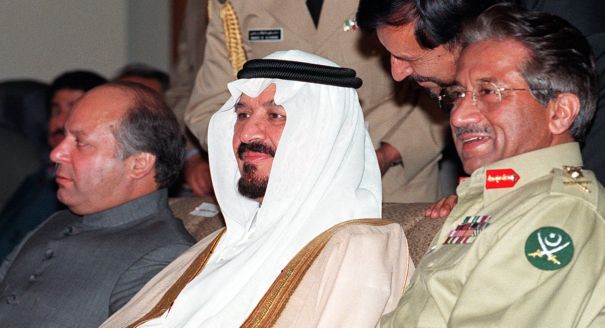
It is not often that the King of Saudi Arabia receives visiting foreign dignitaries at the airport. That precisely is what King Salman did on Wednesday when he went to the Riyadh airport to lay out an ostentatious welcome to Pakistan’s Prime Minister Nawaz Sharif.
There is speculation that the Saudi Kingdom is seeking Pakistan’s military support to shore up its internal and external defences amidst mounting regional tensions. No announcements were made after Sharif met King Salman and other senior members of the Saudi Royal family. But security cooperation was reportedly at the top of the agenda.Squeezed between Sunni extremism of the Islamic State on the one hand and the rising political clout of the Shia Iran on the other, the Saudis are apparently eager to cash in their many IOUs in Pakistan.
Sharif, of course, owes big to Saudi Arabia, which sheltered him at the darkest moment of his political career, when Gen Pervez Musharraf ousted him in a coup and put him behind bars in 1999. The Saudis persuaded Musharraf to let Sharif out of prison and take exile in Jeddah.
Beyond the personal, the Saudis have always bailed Pakistan out of economic crises by providing oil and money at concessional rates. There have also been reports that Saudis finance Pakistan’s clandestine nuclear weapon programme that began in the 1970s.
Pakistan’s civilian and military establishments tend to be quite deferential to the Saudi royals and allow them the kind of privileges that a sovereign government rarely extends to another. But the relationship between Pakistan and Saudi Arabia was never entirely one-sided.
The Pakistan security forces have long acted as a military reserve for the House of Saud. After the Islamic revolution in Iran in 1979, Gen. Zia ul Haque sent Pakistani troops to bolster Saudi security. The size and scope of that deployment was never revealed.
Early last year, there was a Saudi ‘gift’ to Pakistan of $1.5 billion when Islamabad’s foreign exchange reserves sunk to a perilously low level. Analysts in the region linked this gift to requests from Riyadh for the recruitment and training of Saudi-backed Sunni militant groups fighting the Bashar al Assad regime in Syria.
Saudi Arabia’s regional security environment has gotten worse since then. Riyadh has been deeply concerned about the gains made by the Shia Houthi rebels in Yemen, with which Saudi Arabia shares a restive frontier. The Saudis are also anxious about the prospect of a nuclear deal between Iran and America that might further boost Tehran’s clout in the Middle East.
As Pakistan gets drawn into the regional rivalries in the Middle East, Islamabad is of course conscious of the need to walk the tight rope between its long-standing benefactor Saudi Arabia and Iran with which it shares a long border.
Mounting attacks on the Shia minority in Pakistan by Sunni extremists has been poisoning the political atmosphere between Tehran and Islamabad for some time. There have also been frequent clashes between dissident Iranian Sunni militant groups that have taken shelter on the Pakistani side of the border and Tehran’s border security forces.
As Pakistan begins to gain new political leverage in the Gulf, the unfolding geopolitical dynamic in the Gulf has not drawn adequate attention in Delhi. Although foreign minister Sushma Swaraj has travelled to the region frequently and has hosted many senior leaders from the region in Delhi, the government of Narendra Modi appears some distance away from developing a coherent strategy towards the Middle East.
This article was originally published in the Indian Express.
Former Nonresident Senior Fellow, Carnegie India
A leading analyst of India’s foreign policy, Mohan is also an expert on South Asian security, great-power relations in Asia, and arms control.
Recent Work

C. Raja Mohan, Darshana M. Baruah


Alexander Gabuev, Paul Haenle, C. Raja Mohan, …
Carnegie India does not take institutional positions on public policy issues; the views represented herein are those of the author(s) and do not necessarily reflect the views of Carnegie, its staff, or its trustees.

After the chill in ties between 2020 and 2024 that brought India–China relations to their lowest point in several decades, the two countries have engaged each other afresh. This paper argues that there are predominantly four imperatives guiding India’s approach to China, and they exist in an order of priority.

Saheb Singh Chadha

This piece argues that India’s central challenge is not managing a single flashpoint but resolving the underlying tension between expansion and institutional coherency of the BRICS grouping.

Vrinda Sahai

A partnership between India, a country of subcontinental size, and Africa, a continent of fifty-four countries, may seem asymmetric until one notes that both are home to nearly the same number of people—1.4 billion. This essay spells out the existing challenges to the partnership, its optimal potential, and the possible pathways to realize it over the next quarter-century.

Rajiv Bhatia

The India–EU Free Trade Agreement (FTA) is shaping up to be one of the most consequential trade negotiations, both economically and strategically. But, what’s in the agreement, what’s missing, and what will determine its success in the years ahead
Vrinda Sahai, Nicolas Köhler-Suzuki
Trump 2.0 has unsettled India’s external environment—but has not overturned its foreign policy strategy, which continues to rely on diversification, hedging, and calibrated partnerships across a fractured order.



Milan Vaishnav, ed., Sameer Lalwani, Tanvi Madan, …