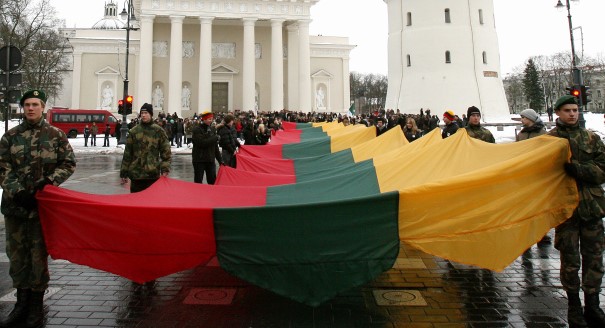
About seven years after abolishing compulsory military service and amidst the tense situation in Ukraine, Lithuania has restored conscription. Eurasia Outlook asked its experts to weigh in on the deeper meaning of this maneuver and what its consequences might be.
Luke CoffeyMargaret Thatcher fellow at the Heritage Foundation’s Davis Institute for National Security and Foreign Policy, Washington, DC
Is the decision to reinstate conscription of real military value, or is it only symbolic? What will the consequences of this decision be?
Due to the unique security situation Lithuania faces, its decision to reinstate conscription could have both military and symbolic value if implemented properly.
As a rule, I am normally against the idea of compulsory military service. It usually leads to undeployable and expensive armed forces. The financial strain it places on the defense budget is disproportionately large compared to the benefit received. Frankly, in a democratic society conscription seems very anachronistic.
That being said, there are always exceptions to the rule. Lithuania’s move toward conscription demonstrates once again that Russia is still a driving force behind military planning and foreign policy formulation in the Baltic region. In a way that is simply unimaginable in many Western European countries and North America, Lithuania still sees Russia has an existential threat. Lithuania’s decision must be viewed within this context.
Most of the usual problems associated with compulsory military service should not be issues for Lithuania since its military will be focused on territorial defense of the homeland and not expeditionary warfare. The challenge for Vilnius is to ensure that every precious euro spent on conscription is not wasted and goes toward a well-funded and highly trained military that could respond in the event of Russian aggression.
Nothing compares to highly trained and fully funded professional armed forces. However, desperate times call for desperate measures. If Russia was to attack Lithuania, each hour and day that the Russian advance could be delayed gives NATO more time to respond. Lithuania is doing what it thinks is best for its national defense (and in some cases, its national survival).
I often hear that the “Baltic states could be next” for Russia—but what this really means is that NATO is next. Lithuania is taking the threat seriously. Is the rest of NATO taking the threat seriously?
Konstantin RanksScientist and journalist, Helsinki
The recently announced, temporary reinstatement of compulsory military service in Lithuania appears to be a symbolic gesture aimed at winning the sympathies of the country’s major NATO allies.
Lithuania does not share a border with “mainland” Russia. In the east, it is bordered by Belarus, which certainly shows no interest in getting involved in any military campaigns. Lithuania’s northern and southern neighbors, Latvia and Poland, are its NATO allies. And only in the west does it share a border with the Kaliningrad region—a militarized but small Russian enclave whose border with Lithuania runs mostly along rivers and swamps. This border is clearly delimited according to European standards.
Russians, Lithuania’s second ethnic minority after Poles, constitute less than six percent of the country’s population. What is very important is that all of them are Lithuanian citizens, since Lithuania granted all of its residents citizenship in 1991. In fact, Lithuania’s ethnic Russians have much warmer feelings toward their country than the ethnic Russians in the two other Baltic countries do.
Lithuanians have a 700-year history of independent statehood behind them and are certainly ready to protect their country, as many years of their armed resistance against the Soviet authorities during the aftermath of World War II bear out. Thus, Lithuanians will clearly rise up against any form of foreign military invasion.
Therefore, Lithuania appears to be in a safer position that its Baltic neighbors, who nevertheless are not rushing to repeat the Lithuanian experience in their territory. In the final analysis, this decision may prompt many Lithuanian youths that do not want to waste time serving in the military to leave the country. This will increase the already significant amount of Lithuanian labor migration to the EU, which may undermine the country’s security in the long run.