

Commentary
Andrei Kolesnikov
{
  "authors": [
    "Andrei Kolesnikov"
  ],
  "type": "legacyinthemedia",
  "centerAffiliationAll": "",
  "centers": [
    "Carnegie Endowment for International Peace",
    "Carnegie Russia Eurasia Center"
  ],
  "collections": [
    "Inside Russia"
  ],
  "englishNewsletterAll": "",
  "nonEnglishNewsletterAll": "",
  "primaryCenter": "Carnegie Endowment for International Peace",
  "programAffiliation": "",
  "programs": [],
  "projects": [],
  "regions": [
    "Russia"
  ],
  "topics": [
    "Political Reform",
    "Security",
    "Foreign Policy"
  ]
}
Source: Getty
The Kremlin needs the constant narrative of a war in which it plays a righteous role to maintain public loyalty
Source: Vedomosti
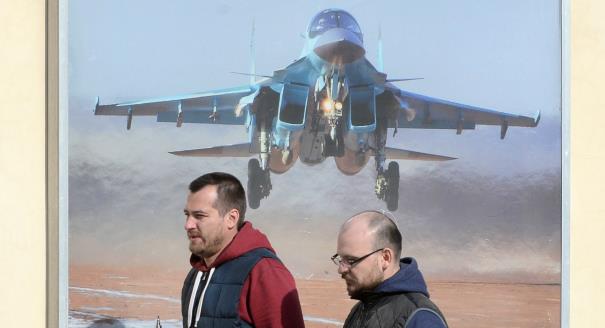
A constant war waged in the name of peace and running in the background. This is what the Russian ruling class needs to preserve itself in power, especially if its involvement only amounts to air strikes—some precise, some less so.
The television series named “War” must keep on changing in space and time. In recent years, we have had the accession of Crimea, seized as per the example of Catherine the Great, without a shot being fired. Next came the hybrid war in Donetsk and Luhansk, expanding the zone of quasi-state formations around Russia’s perimeter. Now we have Russia’s involvement in the Syrian conflict, which is nostalgically Cold-War-like in spirit.
Soon, I believe the Kremlin’s official historians will prove that all of the wars that Russia has waged, whether openly or covertly, have been three things: righteous, fought in self-defense and preventative in nature.
Seen in this way, the favored slogan of successive Soviet and Russian generations, “Anything but war,” does not sound so paradoxical. By this logic, even the Winter War between the Soviet Union and Finland (1939-1940) was a “preventative” one. In fact, Russian President Vladimir Putin has already argued as much at a meeting with military historians, in flagrant disregard of that war’s disgraceful nature, senselessness, horrific casualties, and ultimate failure.The goal of maintaining power requires that the show must go on, like a triumphal victory banquet. Once set in motion with Crimea, Donbass, or Syria, the machine cannot stop. There are rational motives: the need to deflect attention away from the economic crisis onto victorious air strikes, to sustain a wave of patriotism and presidential approval ratings at current levels through at least 2018. But there is also the irrational self-perpetuating cycle of mass military hysteria.
It is worth noting that intervention in a conflict in a Muslim country does not instill in the Russian authorities a fear of retaliatory domestic terrorist acts. No terrorist attack in post-Soviet history has ever affected the ruling elite, at least not physically. The most defenseless members of society—hospital patients, children, parents—have paid the price. And the moral trauma of tragedies such as the hostage seizures in Budyonnovsk in 1995, in Moscow in 2002 or in Beslan in 2004 can be healed quickly with the remedies of silence and oblivion.
Efforts to make sense of tragedies like these are drowned in an endless white noise of information. Moreover, the history of the Putin era shows that a terrorist act can serve as an excuse to tighten the screws under the guise of “anti-extremism” and “security.” This is precisely the excuse spin doctors and government ideologists need as they plan parliamentary and presidential election campaigns.
So, Russia will keep on finding new enemies and new targets. Next, it may send attack bombers to Afghanistan, or increase its military contingent in the Arctic. The exercise keeps the military-patriotic spirit of the Russian people in good working order without their ever stepping away from their TV screens.
The key is for war to become the default, the ever-present hum, a simple but always-inspiring tune in a noisy cacophony of information. It is the background that will allow Russians to choose and be chosen—and I am not referring to the Bible but to the next elections.
This article originally appeared in Russian in Vedomosti.
Former Senior Fellow, Carnegie Russia Eurasia Center
Kolesnikov was a senior fellow at the Carnegie Russia Eurasia Center.
Recent Work
Andrei Kolesnikov
Andrei Kolesnikov
Carnegie India does not take institutional positions on public policy issues; the views represented herein are those of the author(s) and do not necessarily reflect the views of Carnegie, its staff, or its trustees.

In any defense establishment, change is an ongoing process. However, despite the best of intentions, existing bureaucracies, bound by habit and years of socialization, have their limits in implementing transformative change.

Anit Mukherjee

After the chill in ties between 2020 and 2024 that brought India–China relations to their lowest point in several decades, the two countries have engaged each other afresh. This paper argues that there are predominantly four imperatives guiding India’s approach to China, and they exist in an order of priority.

Saheb Singh Chadha

This piece argues that India’s central challenge is not managing a single flashpoint but resolving the underlying tension between expansion and institutional coherency of the BRICS grouping.

Vrinda Sahai

A partnership between India, a country of subcontinental size, and Africa, a continent of fifty-four countries, may seem asymmetric until one notes that both are home to nearly the same number of people—1.4 billion. This essay spells out the existing challenges to the partnership, its optimal potential, and the possible pathways to realize it over the next quarter-century.

Rajiv Bhatia

The India–EU Free Trade Agreement (FTA) is shaping up to be one of the most consequential trade negotiations, both economically and strategically. But, what’s in the agreement, what’s missing, and what will determine its success in the years ahead
Vrinda Sahai, Nicolas Köhler-Suzuki