

Report
- +3
James M. Acton, Alexey Arbatov, Vladimir Dvorkin, …
{
  "authors": [
    "Petr Topychkanov"
  ],
  "type": "legacyinthemedia",
  "centerAffiliationAll": "",
  "centers": [
    "Carnegie Endowment for International Peace",
    "Carnegie Russia Eurasia Center"
  ],
  "collections": [],
  "englishNewsletterAll": "",
  "nonEnglishNewsletterAll": "",
  "primaryCenter": "Carnegie Russia Eurasia Center",
  "programAffiliation": "",
  "programs": [],
  "projects": [],
  "regions": [
    "South Asia",
    "India",
    "Russia"
  ],
  "topics": [
    "Economy",
    "Trade",
    "Security",
    "Military",
    "Foreign Policy"
  ]
}
Source: Getty
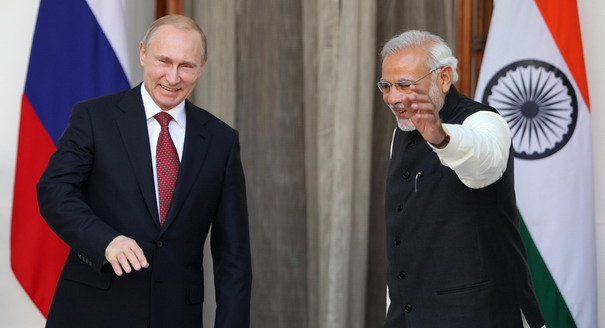
Despite looking at others for high-tech defense deals, India lacks a steady partner that can replace Russia. Moscow, too, badly needs such cooperation.
Source: India Today
India and Russia have well-known success stories of military-technological cooperation. Land, air, and sea-based supersonic missile BrahMos, multipurpose fighter Su-30MKI, aircraft carrier INS Vikramaditya are top achievements of cooperation between New Delhi and Moscow after the collapse of the Soviet Union. But to say that the Indo-Russian cooperation is problem-free would be unfair. Delays, imperfect servicing, slow responses to India's complaints and requests, reluctance to provide India with the most advanced technologies are chronic diseases of bilateral ties.
Russia has also borne the brunt of India's defence and procurement policy. Both New Delhi and Moscow missed a unique opportunity to transform generally source-recipient relations in joint development and production of advanced military technologies for their armed forces and other nations. But despite these failures India lacks defence partners which can replace Russia and launch joint development and production of advanced military technologies. India has experienced delays, in the case of French Scorpene submarines; corruption from a range of countries, including Germany, Israel, and Italy; and, finally, a reluctance to provide advanced technology and political limitations, the most evident example being the United States.Successful visits of US President Barak Obama to India and Prime Minister Narendra Modi to America did not succeed in breaking the ice of numerous restrictions on transfer of certain technologies to India that the US continues to have. The US also makes India's other defence partners follow this policy. For Delhi, it is clear that Washington may deny it access to vital technologies due to political reasons. This understanding was one key reason why India's armed forces opted to join the Russian-operated GLONASS space navigation system over the more efficient American GPS.
India may be able to get some technologies, but to build a high-tech military-industries complex would be very hard without Russia's help. Moscow, too, badly needs such cooperation. It would help Russia strengthen its position in India's arms market, as it is a country cooperating in critical areas where other countries are not ready to share and develop military technology jointly with India. The joint efforts of Moscow and Delhi could create components or whole systems for strategically important weapons. In modern conditions, such cooperation would undoubtedly serve Russia's interests.
After the deterioration in relations with several countries over the Ukraine crisis, obstacles have arisen for Russia to obtain several components used in manufacturing Russian military products. The sanctions imposed on Russia by these countries after the annexation of Crimea "has somewhat slowed down the pace of our work", says A.P. Isaikin, Rosoboronexport's General Director.
Until the current crisis, Russian arms manufacturers worked with about 100 companies from 28 countries. It does not appear an unsolvable task to replace the foreign countries that decline to continue supplying components for armaments and military hardware of Russian manufacture. The re-orientation towards such states as the BRICS members and, above all, India will help resolve the problem.
Former Fellow, Nonproliferation Program, Moscow Center
Topychkanov was a fellow in the Carnegie Moscow Center’s Nonproliferation Program.
Recent Work

James M. Acton, Alexey Arbatov, Vladimir Dvorkin, …
Petr Topychkanov
Carnegie India does not take institutional positions on public policy issues; the views represented herein are those of the author(s) and do not necessarily reflect the views of Carnegie, its staff, or its trustees.

In any defense establishment, change is an ongoing process. However, despite the best of intentions, existing bureaucracies, bound by habit and years of socialization, have their limits in implementing transformative change.

Anit Mukherjee

As AI grows more sophisticated, as the supply chains that power it become more contested, and as access to frontier models becomes geopolitically charged, India must begin to ask a different set of questions. Not what applications it can build on someone else’s infrastructure but what the world needs.

Konark Bhandari

The Indian Ocean Region hosts one of the densest concentrations of subsea cables in the world. Yet, despite accounting for a significant share of global internet traffic, India’s participation remains limited.

Charukeshi Bhatt

How is AI reshaping space security, creating governance challenges, and where does international diplomacy stand today?


Tejas Bharadwaj, Almudena Azcárate Ortega

After the chill in ties between 2020 and 2024 that brought India–China relations to their lowest point in several decades, the two countries have engaged each other afresh. This paper argues that there are predominantly four imperatives guiding India’s approach to China, and they exist in an order of priority.

Saheb Singh Chadha