

Article
C. Raja Mohan, Darshana M. Baruah
{
  "authors": [
    "C. Raja Mohan"
  ],
  "type": "legacyinthemedia",
  "centerAffiliationAll": "dc",
  "centers": [
    "Carnegie Endowment for International Peace",
    "Carnegie India"
  ],
  "collections": [],
  "englishNewsletterAll": "ctw",
  "nonEnglishNewsletterAll": "",
  "primaryCenter": "Carnegie India",
  "programAffiliation": "SAP",
  "programs": [
    "South Asia"
  ],
  "projects": [],
  "regions": [
    "United States",
    "South Asia",
    "India"
  ],
  "topics": [
    "Foreign Policy",
    "Political Reform"
  ]
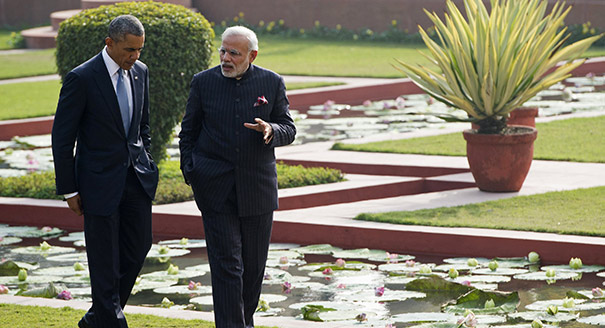
}
Source: Getty
Washington’s newly acquired taste for public diplomacy could result in squandering the recent gains in the U.S.-India strategic partnership.
Source: Indian Express
India has long irritated its international interlocutors by its penchant for “public diplomacy”. What we mean by public diplomacy here is somewhat different from the current usage of the term — about informing and influencing public opinion at home and abroad. It used to be called “propaganda” in the old days. Our reference here is to the style of public argumentation that marked India’s engagement with the world over the decades. New Delhi’s mandarins privileged public posturing over tough but outcome-oriented negotiating strategies.
American diplomatic tradition, in contrast, emphasised deal-making and splitting differences. American statecraft also understood a simple but important dictum: “If there are no negotiations in private, there will be no covenants to be signed in public.”
In the last few months though, Delhi and Washington have begun to trade places. Delhi now speaks a lot less in public and Washington can’t stop talking. If Indian media complains that official Delhi doesn’t keep them in the loop, Washington is trying to conduct negotiations with India through the Indian media.Under Prime Minister Narendra Modi, Delhi has been compelled to curb its enthusiasm for public argumentation. Its mandate now is to bargain hard in private and be prepared to give and take on a pragmatic basis. The focus is on finding win-win outcomes.
This approach has, for example, helped India wrap up the outstanding issues in implementing the historic civil nuclear initiative. Even as Delhi tries to advance India’s strategic cooperation with the United States, an overly eager Washington is undermining the prospects for forward movement with its public diplomacy. Consider, for example, the recent diplomatic confusion on “joint patrols”. In the last few weeks, US officials have been publicly pressing India to agree on joint operations, including naval patrols in the Indo-Pacific.
There’s no doubt that Washington considers the joint patrols an important part of the effort to secure freedom of navigation in East Asia’s waters amidst Beijing’s vigorous assertion of its expansive territorial claims in the South China Sea.
Unlike the UPA government, which was hesitant to be drawn into the debate on the South China Sea that unfolded at the turn of this decade, Modi has been forthright in affirming India’s stakes in the waters to the east of Malacca. The NDA government has also been more open than the UPA government on defence cooperation with the US. It has renewed the 10-year defence pact signed by the UPA in 2005 and has unveiled an ambitious vision for strategic cooperation in the Indo-Pacific during President Barack Obama’s visit to India in January 2015.
Beyond the bilateral, the Modi government has invited Japan back into the naval exercises with the US in the Indian Ocean and elevated the trilateral political consultations with Washington and Tokyo to the ministerial level. If Delhi is ready to expand the envelope of security cooperation with the US, it has been irritated by Washington’s ceaseless public talk on joint naval patrols that has excited the Indian media and the commentators in Beijing. Delhi indeed bit its tongue for a while, but defence minister Manohar Parrikar stepped out last week to deny that Delhi was considering joint patrols at this point of time.
As the question of joint patrols gains salience every day in the South China Sea, Delhi and Washington certainly need intensive consultations on how to deal with Beijing’s forward policy in Asia’s waters. But America’s needless public diplomacy has only complicated Indian decision-making on the subject.
Quiet diplomacy is also the need of the hour to manage the traditional divergence between India and the US on the issue of Pakistan. At a time when Modi finds his bold outreach to Pakistan tested by cross-border terrorism, the public warmth for Rawalpindi in sections of Washington’s bureaucracy has become more than an irritant for the Modi government. South Block realists have no problem in recognising that America has enduring interests in Pakistan. What it finds hard to accept is Washington’s embrace of Rawalpindi’s quest for nuclear parity with India and its approach to the Kashmir question.
Modi has gone to great lengths in addressing many American interests — including Obama’s appeal to make the Paris summit on climate change a success. But the PM is apparently concerned at Washington’s inability to appreciate India’s concerns on Pakistan. Modi and Obama have surprised the world by injecting unprecedented energy into the transformation of the bilateral relationship. Modi’s visit later this month to Washington to attend the Nuclear Security Summit is a big opportunity to turn the last 10 months of the Obama administration into a very productive moment.
But Washington’s lack of high-level political attention to Delhi, its ingrained habit of pandering to Pakistan’s military, and the newly acquired taste for public diplomacy could result in squandering the moment at hand to consolidate the recent gains in the strategic partnership.
This article was originally published in the Indian Express.
Former Nonresident Senior Fellow, Carnegie India
A leading analyst of India’s foreign policy, Mohan is also an expert on South Asian security, great-power relations in Asia, and arms control.
Recent Work

C. Raja Mohan, Darshana M. Baruah


Alexander Gabuev, Paul Haenle, C. Raja Mohan, …
Carnegie India does not take institutional positions on public policy issues; the views represented herein are those of the author(s) and do not necessarily reflect the views of Carnegie, its staff, or its trustees.

As AI grows more sophisticated, as the supply chains that power it become more contested, and as access to frontier models becomes geopolitically charged, India must begin to ask a different set of questions. Not what applications it can build on someone else’s infrastructure but what the world needs.

Konark Bhandari

The Indian Ocean Region hosts one of the densest concentrations of subsea cables in the world. Yet, despite accounting for a significant share of global internet traffic, India’s participation remains limited.

Charukeshi Bhatt

How is AI reshaping space security, creating governance challenges, and where does international diplomacy stand today?


Tejas Bharadwaj, Almudena Azcárate Ortega

After the chill in ties between 2020 and 2024 that brought India–China relations to their lowest point in several decades, the two countries have engaged each other afresh. This paper argues that there are predominantly four imperatives guiding India’s approach to China, and they exist in an order of priority.

Saheb Singh Chadha

This piece argues that India’s central challenge is not managing a single flashpoint but resolving the underlying tension between expansion and institutional coherency of the BRICS grouping.

Vrinda Sahai