

This piece argues that India’s central challenge is not managing a single flashpoint but resolving the underlying tension between expansion and institutional coherency of the BRICS grouping.
Vrinda Sahai
{
"authors": [
"Nikolay Kozhanov"
],
"type": "legacyinthemedia",
"centerAffiliationAll": "",
"centers": [
"Carnegie Endowment for International Peace",
"Carnegie Russia Eurasia Center"
],
"collections": [],
"englishNewsletterAll": "",
"nonEnglishNewsletterAll": "",
"primaryCenter": "Carnegie Russia Eurasia Center",
"programAffiliation": "",
"programs": [],
"projects": [],
"regions": [
"Middle East",
"Russia"
],
"topics": [
"Foreign Policy"
]
}Source: Getty
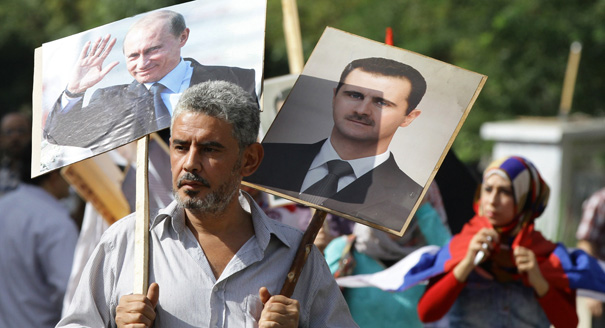
By intensifying its current activities in the Middle East, the Kremlin is pursuing three goals: economic, political, and security.
Source: Cipher Brief
Since 2012, there has been a period of diplomatic activity by the Kremlin in the Middle East which is unprecedented since the fall of the USSR. Existing records of diplomatic and political contacts show an increased exchange of multilevel delegations between Russia and Middle Eastern countries. Moscow is attempting to cultivate deeper involvement in regional issues and to establish contacts with those forces in the region which the Kremlin considers as legitimate. If before 2012 the Kremlin’s diplomacy in the Middle East could be characterized as inconsistent and shaped by the opportunism of the Russian authorities, the growing confrontation with the West became the factor which impelled Moscow to intensify its activities in the Middle East. All in all, by intensifying its current activities in the region, the Kremlin is pursuing the following three goals:
This article was originally published on The Cipher Brief website.
Nikolay Kozhanov
Former nonresident scholar, Foreign and Security Policy Program, Moscow Center
Kozhanov is a former nonresident scholar at the Carnegie Moscow Center and a contributing expert to the Moscow-based Institute of the Middle East.
Carnegie India does not take institutional positions on public policy issues; the views represented herein are those of the author(s) and do not necessarily reflect the views of Carnegie, its staff, or its trustees.
This piece argues that India’s central challenge is not managing a single flashpoint but resolving the underlying tension between expansion and institutional coherency of the BRICS grouping.
Vrinda Sahai
A partnership between India, a country of subcontinental size, and Africa, a continent of fifty-four countries, may seem asymmetric until one notes that both are home to nearly the same number of people—1.4 billion. This essay spells out the existing challenges to the partnership, its optimal potential, and the possible pathways to realize it over the next quarter-century.
Rajiv Bhatia
The India–EU Free Trade Agreement (FTA) is shaping up to be one of the most consequential trade negotiations, both economically and strategically. But, what’s in the agreement, what’s missing, and what will determine its success in the years ahead
Vrinda Sahai, Nicolas Köhler-Suzuki
Trump 2.0 has unsettled India’s external environment—but has not overturned its foreign policy strategy, which continues to rely on diversification, hedging, and calibrated partnerships across a fractured order.
Milan Vaishnav, ed., Sameer Lalwani, Tanvi Madan, …
This piece examines India’s response to U.S. sanctions and tariffs, specifically assessing the immediate market consequences, such as alterations in import costs, and the broader strategic implications for India’s energy security and foreign policy orientation.
Vrinda Sahai







