

Article
C. Raja Mohan, Darshana M. Baruah
{
  "authors": [
    "C. Raja Mohan"
  ],
  "type": "legacyinthemedia",
  "centerAffiliationAll": "dc",
  "centers": [
    "Carnegie Endowment for International Peace",
    "Carnegie India"
  ],
  "collections": [],
  "englishNewsletterAll": "ctw",
  "nonEnglishNewsletterAll": "",
  "primaryCenter": "Carnegie India",
  "programAffiliation": "SAP",
  "programs": [
    "South Asia"
  ],
  "projects": [],
  "regions": [
    "South Asia",
    "India"
  ],
  "topics": [
    "Domestic Politics",
    "Economy",
    "Foreign Policy",
    "Security"
  ]
}
Source: Getty
New Delhi has been tentative on the international stage despite a number of factors that demand a stronger Indian role in the world.
Source: Live Mint
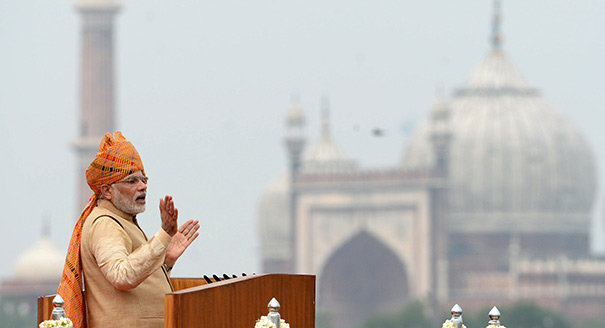
Prime Minister Narendra Modi’s central contribution to the conduct of the nation’s external relations has been the imagination of India as a “leading power” in the international system. Since the end of the Cold War, Delhi has deliberately taken a low profile in the international arena. The limited focus on narrowly defined self-interest meant India punched way below its weight in key regions and on global issues over the last quarter of a century.
Over the last two years, Modi has sought to move away from this approach by taking a more active approach on global issues. He has often talked of India moving away from being a reactive power to one that shapes regional and international outcomes. We have seen some of that in India’s efforts to facilitate a practical outcome in the climate change summit at Paris last December and promote regional cooperation in the subcontinent.There is no denying that India has a long way to go before fulfilling the promise of a leading power. If Modi had thought Delhi’s leadership could evolve slowly over a period of time, the latest turn of events around the world is adding to the urgency of India’s leadership imperative.
India’s caution on global issues since the early 1990s seemed sensible given the compulsion to reconstitute India’s foreign policy after the demise of the Soviet Union and the end of Cold War. The shambolic state of the Indian economy at the turn of the 1990s reinforced that proposition.
While no one in India put it in those terms, Delhi was following the advice that Deng Xiaoping gave China as it entered the era of reform and opening up at the end of 1970s. Deng told the new generation of communist leaders in Beijing to “keep a cool head, maintain a low profile and avoid taking the lead”.
But large nations like China and India cannot forever keep their heads down in the world. While pragmatism must necessarily temper the ideological posturing and a balance must be maintained between ends and means, large civilizational states like China and India must necessarily revert to more ambitious foreign policy principles.
Almost four decades after Deng’s launch of reforms, China no longer maintains a low profile. It is taking the lead in building new regional institutions and pressing for a reform of the global power structure.
Modi’s idea of India as a leading power is probably the beginning of a similar phase in India’s international evolution.
But unlike China’s assertiveness, which has made Asia and the world nervous, the rise of a democratic India, with internal checks and balances, is viewed as a benign development. The problem in fact has been Delhi’s tentativeness on the international stage despite a number of factors that demand a stronger Indian role in the world.
The first is the improvement of India’s relative weight in the international system. A quarter-century of reforms, however hesitant and reluctant, have resulted in high economic growth rates and the elevation of India as one the world’s leading economies.
India is today the seventh largest economy in nominal terms and the third in purchasing power parity terms. This increased weight has been coupled with India’s growing economic interdependence with the world. In the era of self-reliance and inward economic orientation, the world did not really matter much to the “socialist India”.
Now, nearly 40% of India’s gross domestic product is linked to global trade. Managing this interdependence becomes critical for sustaining economic development at home. Delhi no longer has the luxury of thumbing its nose at the world. It must necessarily shape the world around it. Getting this new imperative understood in the policy and political classes has not been easy.
Second, there is growing demand that India make more contributions to the maintenance of the regional order in Asia. A quarter century ago, Delhi’s aim was to win membership of major regional organizations in Asia. Delhi now faces the challenge of overcoming its image as a laggard in Asia’s regional integration, and the perception of India as a reluctant regional power.
Third, as India becomes the world’s fastest growing economy, the expectation is that Delhi will take larger responsibilities to facilitate global economic revival and strengthen regional economic integration. Here again, there is a deep sense of disappointment with Delhi’s approach to global trade issues and its continuing defensiveness on economic globalization.
Fourth, the old order is breaking down at the global level as well as in different regions. The world is yet to recover from the effects of the global economic crisis of 2008. Uncertainty hangs over the internal political evolution of all the major powers: America, China, Europe, Russia and Japan.
Meanwhile, the traditional balance of power in the Eurasian landmass is being shaken by the assertiveness of Russia, the rise of China, the emerging American temptation for retrenchment, the chaos in Europe and the turmoil in the Middle East. India can no longer afford to stay aloof from these developments.
Finally, international leadership is a vital necessity for India to accelerate its internal economic development and improve its national security environment. At the same time, India’s ability to lead in the region and the world will depend critically on how effectively it modernizes its internal political and economic structures. Responding to the interconnected policy imperatives at home and abroad is at once a historic challenge and an extraordinary opportunity for the current generation of policy community in Delhi.
Former Nonresident Senior Fellow, Carnegie India
A leading analyst of India’s foreign policy, Mohan is also an expert on South Asian security, great-power relations in Asia, and arms control.
Recent Work

C. Raja Mohan, Darshana M. Baruah


Alexander Gabuev, Paul Haenle, C. Raja Mohan, …
Carnegie India does not take institutional positions on public policy issues; the views represented herein are those of the author(s) and do not necessarily reflect the views of Carnegie, its staff, or its trustees.

In any defense establishment, change is an ongoing process. However, despite the best of intentions, existing bureaucracies, bound by habit and years of socialization, have their limits in implementing transformative change.

Anit Mukherjee

As AI grows more sophisticated, as the supply chains that power it become more contested, and as access to frontier models becomes geopolitically charged, India must begin to ask a different set of questions. Not what applications it can build on someone else’s infrastructure but what the world needs.

Konark Bhandari

The Indian Ocean Region hosts one of the densest concentrations of subsea cables in the world. Yet, despite accounting for a significant share of global internet traffic, India’s participation remains limited.

Charukeshi Bhatt

How is AI reshaping space security, creating governance challenges, and where does international diplomacy stand today?


Tejas Bharadwaj, Almudena Azcárate Ortega

After the chill in ties between 2020 and 2024 that brought India–China relations to their lowest point in several decades, the two countries have engaged each other afresh. This paper argues that there are predominantly four imperatives guiding India’s approach to China, and they exist in an order of priority.

Saheb Singh Chadha