

Article
Thomas Carothers
{
  "authors": [
    "Thomas Carothers"
  ],
  "type": "other",
  "centerAffiliationAll": "dc",
  "centers": [
    "Carnegie Endowment for International Peace"
  ],
  "collections": [
    "Democracy and Governance"
  ],
  "englishNewsletterAll": "democracy",
  "nonEnglishNewsletterAll": "",
  "primaryCenter": "Carnegie Endowment for International Peace",
  "programAffiliation": "DCG",
  "programs": [
    "Democracy, Conflict, and Governance"
  ],
  "projects": [],
  "regions": [],
  "topics": [
    "Democracy",
    "Civil Society",
    "Foreign Policy"
  ]
}
Source: Getty
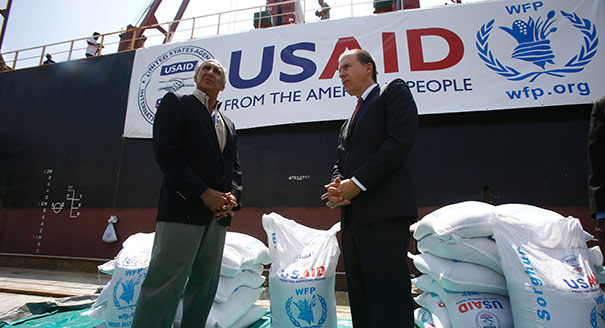
Empowering international aid recipients with better information on the different aid organizations, their motivations, and their methods may help solve some of aid’s great challenges.
Source: Oxfam
While interviewing the director of a women’s rights NGO in Zambia some years back, I asked her why she thought various foreign groups supporting her organization were present in her country. Her initial answer centered on the UK government, which she suspected of wanting to regain control of Zambia’s copper mines. Not wanting to touch that minefield (sorry), I mentioned her Nordic funders, noting that that they had less of a colonial legacy and, in my experience, a tradition of notable idealism. She smiled ruefully, shook her head, and then offered her own explanation: “I have heard that the weather is very cold in their countries. I think they come here to enjoy the beautiful weather in Lusaka.”
This was from an individual with extensive direct contact with aid providers, in a country where donors had been present for decades. In countries experiencing a sudden aid rush after emerging from dictatorship or civil war, the aid community is often even less familiar to those on the receiving end. Sorting out the different kinds of organizations offering help, their motivations, and their methods—not to mention their underlying interests and longer-term objectives—can be a bewildering challenge. This is true whether the recipient is a newly-minted minister with a waiting room crowded with aid officials, a civic activist pondering the pluses and minuses of seeking foreign help, or an ordinary citizen wondering what all these newly present foreigners are doing in his or her country. And the impact of the frequent misunderstandings is hardly benign or transitory. Dozens of governments are actively demonizing aid providers these days, accusing them of all sorts of nefarious schemes, while taking steps to limit their efforts to work directly with civil society actors or anyone else outside their direct control.
How often and how seriously does the aid community try to explain itself? Not just one institution introducing itself to its intended local partners, but the community as a whole explaining its methods and goals to a wide range of people in a country where it is arriving to help? Or in a country where aid is systematically being misrepresented and vilified?
Several colleagues (Mark Freeman, Cale Salih, and Robert Templer) and I have taken what we hope might be a modest step in this direction by writing a guide for recipients of international aid in transitional contexts. We focused on the areas of aid we know best—aid for democracy-building and peace-building—with the hope that what we put forward on those areas would largely read across to other parts of the aid enterprise.
It was a relatively straightforward idea, but proved less so in practice. Early on, a friend at DFID listened to our plan and exclaimed, “You could get sued!” Though we think that won’t happen, her intuition that trying to “explain” the aid community has many potential pitfalls was correct. A sample of some of the challenges with which we struggled:
We finished the guide wondering whether and how the aid community can take on the challenge of explaining itself more regularly and thoroughly to those it tries to help, especially in countries where it arrives in a hurry without much prior history. With many decades of aid already behind us, the guide comes terribly late in the game, but aid rushes in transitional countries do keep occurring (Myanmar and Ukraine a few years back, and perhaps Cuba soon?) with all the attendant misunderstandings.
We are strongly convinced of the need to think of these issues in reverse. Trying to solve all (or even most) of the problems on the supply side of international aid has repeatedly failed. Empowering recipients with better information about aid’s many peculiarities, and encouraging them to be more active drivers in their relationships with donors, may be a more promising avenue.

Harvey V. Fineberg Chair for Democracy Studies; Senior Fellow, Democracy, Conflict, and Governance Program
Thomas Carothers, a senior fellow in the Carnegie Endowment for International Peace’s Democracy, Conflict, and Governance Program, is a leading expert on comparative democratization and international support for democracy.
Recent Work
Thomas Carothers
Thomas Carothers
Carnegie India does not take institutional positions on public policy issues; the views represented herein are those of the author(s) and do not necessarily reflect the views of Carnegie, its staff, or its trustees.

After the chill in ties between 2020 and 2024 that brought India–China relations to their lowest point in several decades, the two countries have engaged each other afresh. This paper argues that there are predominantly four imperatives guiding India’s approach to China, and they exist in an order of priority.

Saheb Singh Chadha

This piece argues that India’s central challenge is not managing a single flashpoint but resolving the underlying tension between expansion and institutional coherency of the BRICS grouping.

Vrinda Sahai

A partnership between India, a country of subcontinental size, and Africa, a continent of fifty-four countries, may seem asymmetric until one notes that both are home to nearly the same number of people—1.4 billion. This essay spells out the existing challenges to the partnership, its optimal potential, and the possible pathways to realize it over the next quarter-century.

Rajiv Bhatia

The India–EU Free Trade Agreement (FTA) is shaping up to be one of the most consequential trade negotiations, both economically and strategically. But, what’s in the agreement, what’s missing, and what will determine its success in the years ahead
Vrinda Sahai, Nicolas Köhler-Suzuki

Trump 2.0 has unsettled India’s external environment—but has not overturned its foreign policy strategy, which continues to rely on diversification, hedging, and calibrated partnerships across a fractured order.



Milan Vaishnav, ed., Sameer Lalwani, Tanvi Madan, …