

Commentary
Chung Min Lee
{
  "authors": [
    "Chung Min Lee"
  ],
  "type": "other",
  "centerAffiliationAll": "dc",
  "centers": [
    "Carnegie Endowment for International Peace"
  ],
  "collections": [
    "Inside Korea"
  ],
  "englishNewsletterAll": "asia",
  "nonEnglishNewsletterAll": "",
  "primaryCenter": "Carnegie Endowment for International Peace",
  "programAffiliation": "AP",
  "programs": [
    "Asia"
  ],
  "projects": [],
  "regions": [
    "East Asia",
    "South Korea"
  ],
  "topics": [
    "Security",
    "Foreign Policy"
  ]
}
Source: Getty
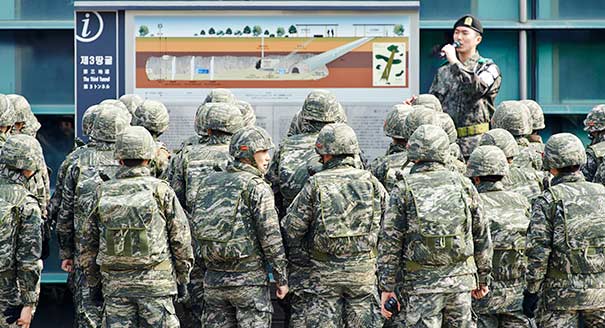
Given that South Korea is the only country on the entire Asian continent where the United States continues to deploy ground forces and air assets, the U.S. alliance with the Republic of Korea plays a critical role in supporting U.S. power projection in Northeast Asia and by extension, in East Asia.
Source: Breakthrough on the Peninsula: Third Offset Strategies and the Future Defense of Korea
Given that South Korea is the only country on the entire Asian continent where the United States continues to deploy ground forces and air assets, the U.S. alliance with the Republic of Korea plays a critical role in supporting America’s power projection in Northeast Asia and by extension, in East Asia. The focus of this chapter is on how the Third Offset Strategy will affect U.S. power projection capabilities on the Korean Peninsula. The chapter is organized around three broad questions. First, how will future U.S. power projection capabilities built largely to cope with rising Chinese military power affect the alliance? Second, what operational burdens and challenges could the alliance face following regime collapse or other major political turbulence in North Korea? Third, what impact might the Third Offset have on South Korea’s own medium- to longer-term force modernization and defense reform pathways?
These questions attempt to identify some of the dynamics that could be triggered by the implementation of a Third Offset, combined with the ROK armed
forces’ own offset strategies and programs to cope more effectively with North Korea’s growing asymmetrical capabilities. In short, this chapter seeks to capture the strategic ramifications of the Third Offset for the U.S.-ROK alliance and Northeast Asia.
Read full text
Senior Fellow, Asia Program
Chung Min Lee is a senior fellow in Carnegie’s Asia Program. He is an expert on Korean and Northeast Asian security, defense, intelligence, and crisis management.
Recent Work
Chung Min Lee
Carnegie India does not take institutional positions on public policy issues; the views represented herein are those of the author(s) and do not necessarily reflect the views of Carnegie, its staff, or its trustees.

In any defense establishment, change is an ongoing process. However, despite the best of intentions, existing bureaucracies, bound by habit and years of socialization, have their limits in implementing transformative change.

Anit Mukherjee

After the chill in ties between 2020 and 2024 that brought India–China relations to their lowest point in several decades, the two countries have engaged each other afresh. This paper argues that there are predominantly four imperatives guiding India’s approach to China, and they exist in an order of priority.

Saheb Singh Chadha

This piece argues that India’s central challenge is not managing a single flashpoint but resolving the underlying tension between expansion and institutional coherency of the BRICS grouping.

Vrinda Sahai

A partnership between India, a country of subcontinental size, and Africa, a continent of fifty-four countries, may seem asymmetric until one notes that both are home to nearly the same number of people—1.4 billion. This essay spells out the existing challenges to the partnership, its optimal potential, and the possible pathways to realize it over the next quarter-century.

Rajiv Bhatia

The India–EU Free Trade Agreement (FTA) is shaping up to be one of the most consequential trade negotiations, both economically and strategically. But, what’s in the agreement, what’s missing, and what will determine its success in the years ahead
Vrinda Sahai, Nicolas Köhler-Suzuki