

Article
C. Raja Mohan, Darshana M. Baruah
{
  "authors": [
    "C. Raja Mohan"
  ],
  "type": "legacyinthemedia",
  "centerAffiliationAll": "dc",
  "centers": [
    "Carnegie Endowment for International Peace",
    "Carnegie India"
  ],
  "collections": [],
  "englishNewsletterAll": "ctw",
  "nonEnglishNewsletterAll": "",
  "primaryCenter": "Carnegie India",
  "programAffiliation": "SAP",
  "programs": [
    "South Asia"
  ],
  "projects": [],
  "regions": [
    "South Asia",
    "India"
  ],
  "topics": [
    "Foreign Policy"
  ]
}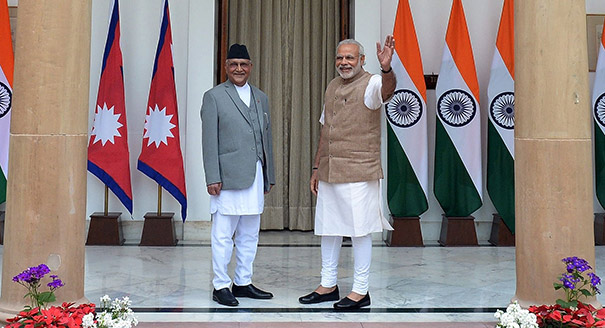
Source: Getty
Indian President Pranab Mukherjee’s visit to Nepal should focus on looking to the future and laying out a road map for the modernization of a very unique partnership.
Source: Indian Express
As the first Indian president to visit Nepal in nearly two decades, Pranab Mukherjee would want to bring the healing touch to a relationship that has come under considerable recent stress. Putting the tensions behind is only one part of Mukherjee’s diplomatic assignment. It is also about looking to the future and laying out a road map for the modernisation of a very unique partnership.
For India, Nepal is the “Punya Bhoomi”, as Prime Minister Narendra Modi often reminds us. Nepal’s sacred geography is a living repository of the Subcontinent’s spiritual heritage. For Nepal, India is the vast economic hinterland and may well be called its “Karma Bhoomi”. If their destinies are inseparably intertwined, problems have often arisen whenever Delhi or Kathmandu has acted against the logic of extraordinary interdependence.
If proponents of identity politics in Kathmandu have emphasised the “separateness” of Nepal, big power chauvinism in Delhi has often inflamed Nepali nationalism. Those in Nepal who seek to enforce a divide between Kathmandu and Delhi in the name of sovereignty do not acknowledge Delhi’s conscious limitation of its sovereignty.
Consider, for example, the fact that India offers the citizens of Nepal national treatment on its soil. Nepalese are free to come and work in India including in its Central government services. India will not offer this to any other country, nor would Nepal get it from anyone else. This arrangement, of course, is unilateral. Nepal does not offer national treatment to Indian citizens. Nepal on its part allows its citizens to serve in large numbers in the Indian army. This is the kind of intimacy that you rarely see between any two nations.
Delhi’s too deep an involvement in Nepal’s internal affairs is indeed a problem. India’s frequent political interventions fuel the demands in Nepal for breaking the interdependence. Delhi must learn to resist the temptation to meddle in Nepal’s political processes. Frequent interventions, in pursuit of tactical goals, damage India’s strategic interests in Nepal.
There is a flip side to India’s interventions. The special access of Nepal’s elite to different sections of the Indian establishment — from erstwhile princes to communists and security agencies to godmen — means every political churn in Nepal has its resonance in India. Every political faction in Nepal believes it has allies in Delhi.
Nepal’s internal divisions make its political classes seek Delhi’s intervention in their favour and resent it when the Indian moves help their opponents. If Nepal has a settled constitutional framework and its elites share power on that basis and ensure peaceful political transitions, Delhi will have no reason for injecting itself into its internal disputes. Besides Kathmandu, President Mukherjee is visiting Janakpur in Terai where the Madhesis are fighting for their rights. Mukherjee must encourage both sides to resolve the current political disputes and close the internal ranks.
The messiness on the political front, however, masks the larger economic failures of Kathmandu and Delhi. If geography makes Delhi the most important economic partner for Kathmandu, Nepali leaders have often politicised commercial cooperation with India at great costs to the people. Delhi, which must take the larger share of the blame, has had no economic imagination beyond formal aid projects that increasingly ran into political resistance from the Left in Nepal.
While Delhi’s political classes see Nepal as a mere extension of India and the security establishment views the northern neighbour as part of India’s exclusive sphere of influence, the economic decision makers have treated Nepal as a separate sovereign entity. Delhi’s economic separatists have done more damage to the relationship than the political separatists in Nepal.
The prickliness of India’s international economic engagement was translated in full measure to Nepal. Those in Delhi emphasising self-reliance had little appreciation for the value of trading with neighbours. They allowed the border infrastructure to deteriorate and turned an open frontier into a huge barrier for trade and commerce. In the last two decades, India has indeed talked about regionalism and connectivity; but progress has been very slow.
The Modi government has promised to change this; President Mukherjee has the opportunity to signal that India is now ready to advance the economic relationship with Nepal. This can’t be just about getting Delhi’s act together on implementing major infrastructure projects. It is also about changing the nature of the frontier through trade facilitation, simplifying transit arrangements, removing non-tariff barriers, improving transborder roads, improving the ease of business for Nepali enterprises and making life easier for Nepali citizens working in India.
For all the political efforts in Kathmandu to construct a political symmetry between relations with Delhi and Beijing, the logic of economic geography tilts Nepal massively towards India. If Delhi has allowed this advantage to dissipate over the decades, Beijing is trying to overcome its geographic disadvantage through mega projects like the Tibet Railway. But Nepal’s nearest ports will always be in India and the Gangetic plain will remain its largest market. If only Delhi respects the logic of its profound interdependence with Kathmandu and acts in tune with it, it would have fewer reasons to worry about China’s rising profile in Nepal.
This article was originally published in the Indian Express.
Former Nonresident Senior Fellow, Carnegie India
A leading analyst of India’s foreign policy, Mohan is also an expert on South Asian security, great-power relations in Asia, and arms control.
Recent Work

C. Raja Mohan, Darshana M. Baruah


Alexander Gabuev, Paul Haenle, C. Raja Mohan, …
Carnegie India does not take institutional positions on public policy issues; the views represented herein are those of the author(s) and do not necessarily reflect the views of Carnegie, its staff, or its trustees.

In any defense establishment, change is an ongoing process. However, despite the best of intentions, existing bureaucracies, bound by habit and years of socialization, have their limits in implementing transformative change.

Anit Mukherjee

As AI grows more sophisticated, as the supply chains that power it become more contested, and as access to frontier models becomes geopolitically charged, India must begin to ask a different set of questions. Not what applications it can build on someone else’s infrastructure but what the world needs.

Konark Bhandari

The Indian Ocean Region hosts one of the densest concentrations of subsea cables in the world. Yet, despite accounting for a significant share of global internet traffic, India’s participation remains limited.

Charukeshi Bhatt

How is AI reshaping space security, creating governance challenges, and where does international diplomacy stand today?


Tejas Bharadwaj, Almudena Azcárate Ortega

After the chill in ties between 2020 and 2024 that brought India–China relations to their lowest point in several decades, the two countries have engaged each other afresh. This paper argues that there are predominantly four imperatives guiding India’s approach to China, and they exist in an order of priority.

Saheb Singh Chadha