

Article
C. Raja Mohan, Darshana M. Baruah
{
  "authors": [
    "C. Raja Mohan"
  ],
  "type": "legacyinthemedia",
  "centerAffiliationAll": "dc",
  "centers": [
    "Carnegie Endowment for International Peace",
    "Carnegie India"
  ],
  "collections": [],
  "englishNewsletterAll": "ctw",
  "nonEnglishNewsletterAll": "",
  "primaryCenter": "Carnegie India",
  "programAffiliation": "SAP",
  "programs": [
    "South Asia"
  ],
  "projects": [],
  "regions": [
    "India",
    "Oceania",
    "Japan",
    "North America",
    "United States",
    "South Asia",
    "East Asia"
  ],
  "topics": [
    "Foreign Policy"
  ]
}
Source: Getty
New coalitions like India, Japan and Australia will still lack sufficient weight to balance China on their own. But in developing an agency of its own and taking a larger share of the burden of Asian security, the India-Japan-Australia coalition will send strong messages to both China and the United States.
Source: Indian Express
Donald Trump sent a tremor through one of America’s most solid alliances last week in his leaked phone call with the Australian Prime Minister Malcolm Turnbull. He reportedly got angry at one of his country’s most loyal allies and cut short the conversation before it could move to major issues such as fighting ISIS.
The friction was over whether America would honour the Obama administration’s parting promise to Canberra to take 1,250 refugees left in limbo by Australian border control policies. In a tweet, President Trump attacked this “dumb deal”, implying he might change his mind and reject it.
The larger question matters to all of America’s security partners, including India. It is about strategy and geopolitics in a confusing new era — and whether US allies and partners can continue to trust the commitments of Washington or the confidentiality of their top-level discussions.
The Australia story feeds into a wider narrative which includes America’s abandonment of the Trans-Pacific Partnership, the trade agreement that was meant to be the economic foundation of Washington’s renewed security engagement with Asia. The episode is a reminder that many nations in the Indo-Pacific are struggling to navigate a path between assertive Chinese power and the new uncertainties that come with Trump’s “America First” outlook in Washington. Although Trump has accentuated the problem, it has deep structural roots in Washington.
How does America cope with the ever-rising power of China? Should Washington confront Beijing or cut deals with it?
Or might the US simply abandon Asia to the mercies of Chinese primacy? What does Asia do as America oscillates between these multiple options?
The solution is not to assume that America has suddenly lost sight of its deep strategic equities in the Indo-Pacific, or that every country is better off imagining China as a core of regional and global stability. Substantial powers of many sizes, including India, Japan, Indonesia, Australia, South Korea, Vietnam and Singapore need to steer a path that is steady and interest-based, avoiding both complacency and panic.
A multi-polar great game was already afoot across our two-ocean region well before the Trump presidency.
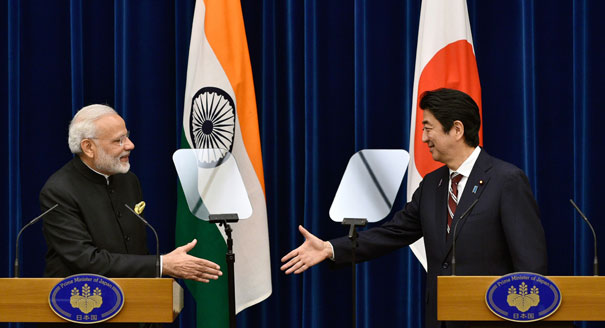
Along with Prime Minister Modi’s India, Shinzo Abe’s Japan has been quietly effective in constructing new partnerships of security, economic and political cooperation to ensure their countries can together shape the regional order and not simply accept the results of US-China competition, collision or collusion.
It was telling that perhaps the most momentous meeting globally on the day Donald Trump was elected last November was a long and outcomes-rich conversation between Modi and Abe. It marked the convergence of India’s Act East vision and Japan’s Free and Open Indo-Pacific Strategy. But the geometry to buttress India’s region against US-China vagaries is not purely bilateral.
Australia has long been another leader in building a more robust regional security architecture. Popular notions of the scale of its ties with China — its largest trading partner — overlook the concerns with which successive Australian governments have seen Chinese power and the diversification of Australia’s regional relationships.
Alongside solid economic and people-to-people links, Australia-India security ties have intensified, including with an anti-submarine warfare exercise in the Bay of Bengal last year. Meanwhile, the Tokyo-Canberra relationship is bouncing back.
Last month, Abe and Turnbull pre-empted the Trump factor with a meeting that led to a joint statement noting the synergies in their Indo-Pacific strategies and identifying India as a key third partner. After all, one of the most promising new strategic dialogues in recent years has been the annual trilateral among the foreign secretaries of India, Japan and Australia. Now is the time for these maritime democracies to move beyond dialogue and build practical cooperation that helps all three, and the wider region, prepare for uncertain times.
Of course, Delhi, Tokyo and Canberra are not the only middle powers (or middle players, if you prefer). But they are the three best positioned to demonstrate the value of the new triangular approach to Indo-Pacific diplomacy. They could build the first of multiple middle power coalitions for promoting regional resilience: Informal arrangements of nations cooperating with one another on strategic issues, working in self-selecting groups that do not include China or the United States.
Their mutual self-help could span many priority areas, to firm up the multi-polar context with which Chinese power will have to come to terms.
These include security dialogues, intelligence exchanges, sharing of maritime surveillance data, capacity-building of military or civilian maritime forces in smaller countries in Southeast Asia or the Indian Ocean, technology sharing, agenda-setting in regional forums like the East Asia Summit and coordinated diplomatic initiatives to influence both US and Chinese strategic calculations.
This is not about constructing an Asia without America. Nor can it seek to contain China. This is about finding ways to limit regional instability amidst the shifting dynamic between America and China.
To be sure, the new coalitions like India, Japan and Australia will still lack sufficient weight to balance China on their own. But in developing an agency of its own and taking a larger share of the burden of Asian security, the India-Japan-Australia coalition will send strong messages to both China and America.
Delhi, Tokyo and Canberra want Beijing to know that it can’t simply disregard the political and security interests of its Asian neighbours in either pushing America out of the region or negotiating a new regional sphere of influence for itself. While America’s allies and partners want the US to stay strong in the region, they would like Trump’s Washington to stop lecturing them and start listening instead.
This article was originally published in the Indian Express.
Former Nonresident Senior Fellow, Carnegie India
A leading analyst of India’s foreign policy, Mohan is also an expert on South Asian security, great-power relations in Asia, and arms control.
Recent Work

C. Raja Mohan, Darshana M. Baruah


Alexander Gabuev, Paul Haenle, C. Raja Mohan, …
Carnegie India does not take institutional positions on public policy issues; the views represented herein are those of the author(s) and do not necessarily reflect the views of Carnegie, its staff, or its trustees.

This piece argues that India’s central challenge is not managing a single flashpoint but resolving the underlying tension between expansion and institutional coherency of the BRICS grouping.

Vrinda Sahai

The ASML MoU with Tata Electronics is an indicator of how far the Indian semiconductor ecosystem has come. This ecosystem has been years in the making and represents real commercial logic.

Konark Bhandari
This paper examines the relationship between India’s evolving space policy and the corresponding growth in private space ventures. It analyzes both the enabling factors created by recent regulatory changes and the persistent challenges facing entrepreneurs in this capital-intensive, highly regulated industry.

Harshan Vazhakunnam

A partnership between India, a country of subcontinental size, and Africa, a continent of fifty-four countries, may seem asymmetric until one notes that both are home to nearly the same number of people—1.4 billion. This essay spells out the existing challenges to the partnership, its optimal potential, and the possible pathways to realize it over the next quarter-century.

Rajiv Bhatia

The U.S.–India semiconductor cooperation story is well-stocked with top-level strategic intent. What remains unresolved, however, are some underlying challenges that will determine whether the cooperation actually functions. Three such friction points stand out.

Shruti Mittal