

Article
Thomas Carothers
{
  "authors": [
    "Thomas Carothers"
  ],
  "type": "other",
  "centerAffiliationAll": "dc",
  "centers": [
    "Carnegie Endowment for International Peace"
  ],
  "collections": [
    "Democracy and Governance"
  ],
  "englishNewsletterAll": "democracy",
  "nonEnglishNewsletterAll": "",
  "primaryCenter": "Carnegie Endowment for International Peace",
  "programAffiliation": "DCG",
  "programs": [
    "Democracy, Conflict, and Governance"
  ],
  "projects": [],
  "regions": [],
  "topics": [
    "Political Reform",
    "Democracy",
    "Foreign Policy"
  ]
}
Source: Getty
Since political parties in both established and emerging democracies face similar challenges, Western party aid should avoid the donor-recipient paradigm and instead embody a productive spirit of mutuality.
Source: 21st Century Parties
Turbulence among political parties in established Western democracies is rife—whether it is the harsh churning within the British Labor Party, the serious challenges facing Spain’s two traditional parties, the notable gains by the right-wing parties in Denmark, France, and Sweden, or the unusually open-ended candidate competition within the U.S. Republican Party. These developments are taken by some observers as proof that mainstream Western political parties are losing, or indeed have already lost credibility as sources of ideas or assistance to counterparts in new or struggling democracies. But this need not be the case. At least it need not be if Western party aid groups can move even more decisively than they have so far away from their old habits.
In particular, they need to deemphasize training efforts to help build party organizations in other countries along the lines of an idealized model of what a well-established party should look like. Instead, Western party aid should take a more specific problem-centered approach, focusing on the vexing issues that are staring Western political parties in the face and that are also present in the political life of many developing and post-Communist countries. The spirit should be one of mutuality of both problems and responses, openly recognizing that Western parties are facing just as much public skepticism and criticism in many countries as are their counterparts in other parts of the world, and just as many uncertainties about how to grapple with changing political developments.
Some issues for such an agenda:
In all areas of international support for democracy, the old assumed line between a set of countries that have largely achieved success and a set of countries looking for lessons and help has been effaced by global political change. In all areas of democracy assistance, aid groups are struggling to adapt their efforts to a world in which democratic deficiencies are remarkably similar in many old and new democracies alike. Given that party aid is a more compact domain of international assistance than most other areas, and that Western party aid specialists are often close to the ground politically, they should be able to be leaders within the wider assistance community in crafting new types of programming that embody a productive spirit of mutuality learning and avoid old patterns of “provider” and “recipient.”
This article was originally published on 21st Century Parties.

Harvey V. Fineberg Chair for Democracy Studies; Senior Fellow, Democracy, Conflict, and Governance Program
Thomas Carothers, a senior fellow in the Carnegie Endowment for International Peace’s Democracy, Conflict, and Governance Program, is a leading expert on comparative democratization and international support for democracy.
Recent Work
Thomas Carothers
Thomas Carothers
Carnegie India does not take institutional positions on public policy issues; the views represented herein are those of the author(s) and do not necessarily reflect the views of Carnegie, its staff, or its trustees.

After the chill in ties between 2020 and 2024 that brought India–China relations to their lowest point in several decades, the two countries have engaged each other afresh. This paper argues that there are predominantly four imperatives guiding India’s approach to China, and they exist in an order of priority.

Saheb Singh Chadha

This piece argues that India’s central challenge is not managing a single flashpoint but resolving the underlying tension between expansion and institutional coherency of the BRICS grouping.

Vrinda Sahai

A partnership between India, a country of subcontinental size, and Africa, a continent of fifty-four countries, may seem asymmetric until one notes that both are home to nearly the same number of people—1.4 billion. This essay spells out the existing challenges to the partnership, its optimal potential, and the possible pathways to realize it over the next quarter-century.

Rajiv Bhatia

The India–EU Free Trade Agreement (FTA) is shaping up to be one of the most consequential trade negotiations, both economically and strategically. But, what’s in the agreement, what’s missing, and what will determine its success in the years ahead
Vrinda Sahai, Nicolas Köhler-Suzuki
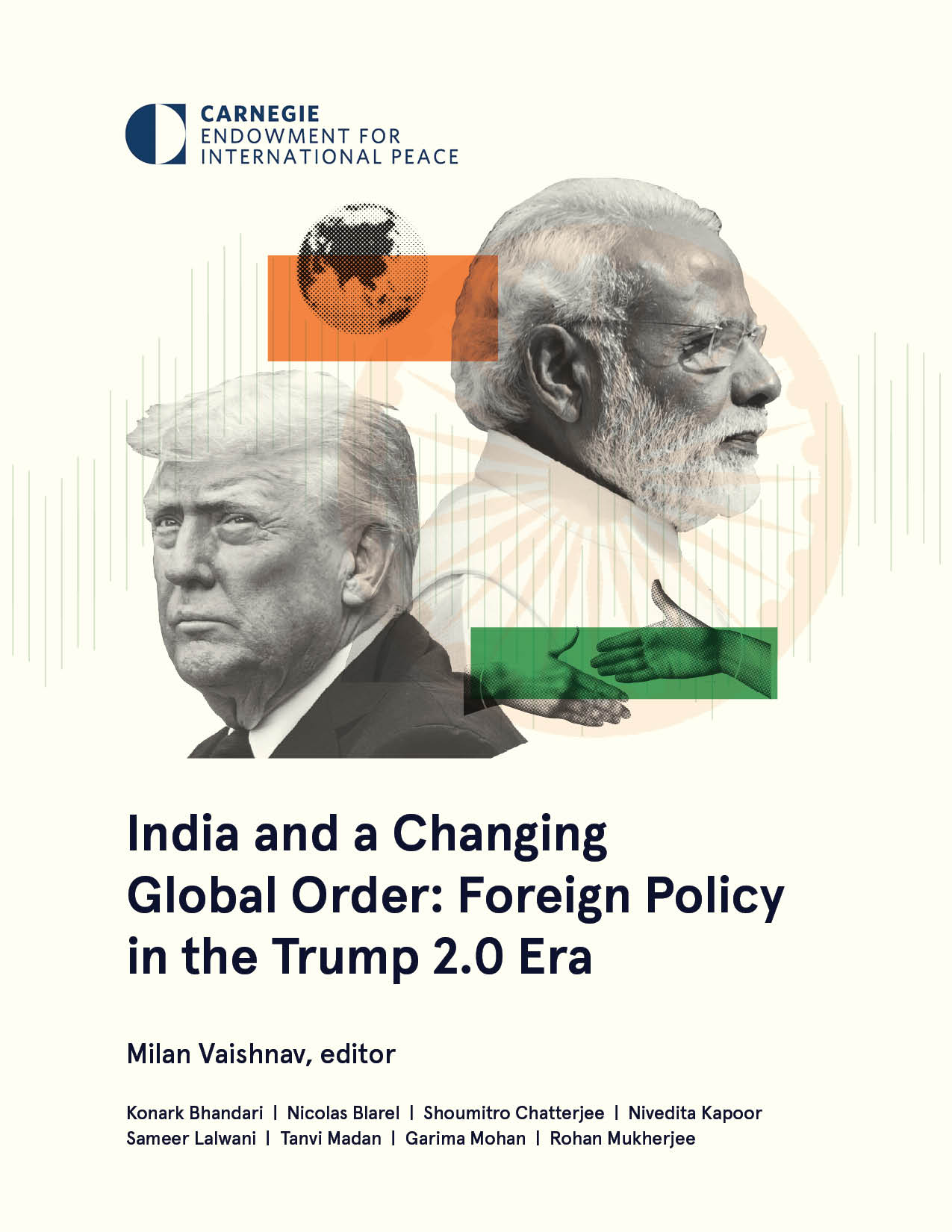
Trump 2.0 has unsettled India’s external environment—but has not overturned its foreign policy strategy, which continues to rely on diversification, hedging, and calibrated partnerships across a fractured order.



Milan Vaishnav, ed., Sameer Lalwani, Tanvi Madan, …