

Article
Deborah Gordon, Smriti Kumble, David Livingston
{
  "authors": [
    "David Livingston"
  ],
  "type": "legacyinthemedia",
  "centerAffiliationAll": "dc",
  "centers": [
    "Carnegie Endowment for International Peace"
  ],
  "collections": [],
  "englishNewsletterAll": "ctw",
  "nonEnglishNewsletterAll": "",
  "primaryCenter": "Carnegie Endowment for International Peace",
  "programAffiliation": "SCP",
  "programs": [
    "Sustainability, Climate, and Geopolitics"
  ],
  "projects": [
    "Carnegie Oil Initiative"
  ],
  "regions": [
    "North America",
    "United States",
    "East Asia",
    "China"
  ],
  "topics": [
    "Climate Change"
  ]
}
Source: Getty
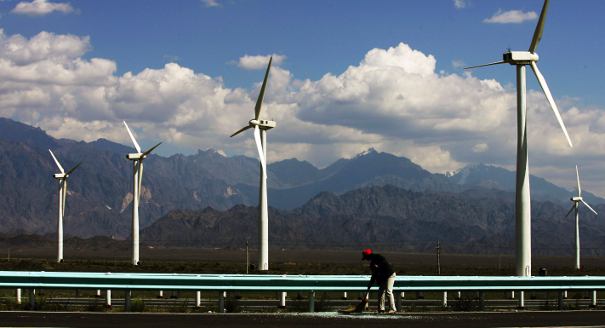
As the Trump administration casts doubt on the future of the U.S. role under the Paris climate accords, China finds itself positioned to lead.
Source: CGTN
Carnegie associate fellow David Livingston joined a panel at CGTN America to discuss China’s emerging leadership on climate change internationally, at a time when the new U.S. administration seems increasingly reluctant to continue under the Paris Accords. “This is a unique moment in time,” Livingston said, “because if you look at the Paris Agreement, it’s not just the first really promising effort among 190 plus nations to combat climate change... but it happens to be the first international agreement where China is in the driver’s seat.’
Livingston went on to note that “the United States at the moment still has a leadership role so long as they stay in,” but that “if the U.S. pulls out, China becomes the sole country in the driver’s seat and they can use the Paris Agreement to draw significant leverage diplomatically.” He added that China has a number of critical interests that align with the goals of the Paris Accord, including “local air pollution issues in cities like Beijing, energy security challenges as China’s oil imports are rising again, ... [and] the need for more energy efficient and more streamlined, rational coal and energy production sector.”
“In implementing the Paris Agreement it also checks a number of domestic policy boxes that are very much in its own interest,” Livingston concluded. “I would expect China to push ahead with this quite aggressively.”
However, Livingston said that there are key players within the United States who have an interest in staying committed to the goals of the Paris Agreement. “Like never before we’ve seen businesses—and not just green energy businesses—but companies like Exxon Mobile and Shell…various members of the Fortune 500 companies say ‘we think it’s wise for the U.S. to stay in the Paris Climate Agreement.” Furthermore, he said, states copuld also be standard bearers for domestic action on climate change. “Regardless of what the Trump Administration does on the Paris Agreement, California is going to go ahead with what are some of the most climate policies not only in the United States but also in the world.”
“Even if you see very little action on the federal level, you are still going to have some gains made by coalitions of states that are willing to demonstrate leadership where climate policies and going out a little bit on a leadership role align with their own self-interests,” he said.
The panel and original broadcast video can be found at CGTN America.
Former Associate Fellow, Energy and Climate Program
Livingston was an associate fellow in Carnegie’s Energy and Climate Program, where his research focuses on emerging markets, technologies, and risks.
Recent Work

Deborah Gordon, Smriti Kumble, David Livingston

Erik Brattberg, David Livingston
Carnegie India does not take institutional positions on public policy issues; the views represented herein are those of the author(s) and do not necessarily reflect the views of Carnegie, its staff, or its trustees.

How is AI reshaping space security, creating governance challenges, and where does international diplomacy stand today?


Tejas Bharadwaj, Almudena Azcárate Ortega

After the chill in ties between 2020 and 2024 that brought India–China relations to their lowest point in several decades, the two countries have engaged each other afresh. This paper argues that there are predominantly four imperatives guiding India’s approach to China, and they exist in an order of priority.

Saheb Singh Chadha

This piece argues that India’s central challenge is not managing a single flashpoint but resolving the underlying tension between expansion and institutional coherency of the BRICS grouping.

Vrinda Sahai

The U.S.–India semiconductor cooperation story is well-stocked with top-level strategic intent. What remains unresolved, however, are some underlying challenges that will determine whether the cooperation actually functions. Three such friction points stand out.

Shruti Mittal

India and the United States are close to concluding a Reciprocal Defense Procurement Agreement (RDPA) that will allow firms from the two countries to sell to each other’s defense establishments more easily. While this may not remedy the specific grievances both sides may have regarding larger bilateral issues, an RDPA could restore some momentum, following the trade deal announcement.

Konark Bhandari