

Commentary
Russia is testing the waters of NATO’s mutual defense clause. What do strikes in Romanian territorial waters mean for the alliance’s posture toward Moscow?
Dimitar Bechev
{
  "authors": [
    "Erik Brattberg",
    "David Livingston"
  ],
  "type": "commentary",
  "blog": "Strategic Europe",
  "centerAffiliationAll": "",
  "centers": [
    "Carnegie Endowment for International Peace",
    "Carnegie Europe"
  ],
  "collections": [
    "Transatlantic Cooperation"
  ],
  "englishNewsletterAll": "",
  "nonEnglishNewsletterAll": "",
  "primaryCenter": "Carnegie Endowment for International Peace",
  "programAffiliation": "",
  "programs": [],
  "projects": [],
  "regions": [
    "North America",
    "United States",
    "Western Europe",
    "Europe"
  ],
  "topics": [
    "Political Reform",
    "Climate Change",
    "EU",
    "Global Governance",
    "Economy"
  ]
}
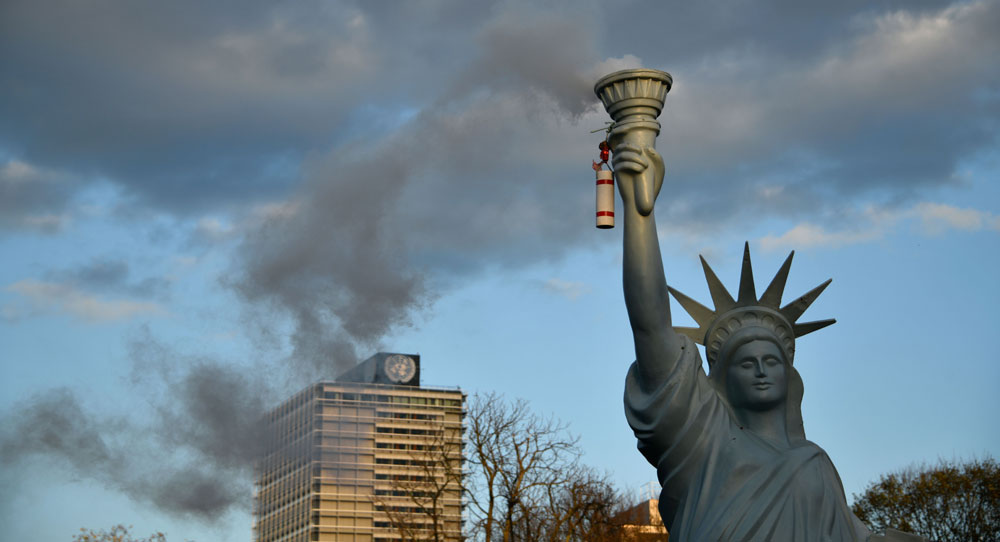
Source: Getty
Despite what the White House says about climate change, conservative states and some of America’s largest companies—not just tech giants—are embracing cleaner energy. What an opportunity for Europe.
As the UN climate change conference in Bonn draws to a close, surprisingly, the worst fears of many Europeans went unrealized when it came to U.S. engagement.
With America’s departure from the Paris Agreement far from assured, the world is looking to Europe for leadership. Europe should take a long look at its own climate diplomacy efforts to ensure it seizes the moment. The EU should embrace an “all-of-the-above” climate strategy that includes catalyzing the emergence of a new, clean energy-based political economy, particularly in the U.S. heartland.
Despite President Donald Trump’s defiant announcement in June that the United States will withdraw from the Paris Agreement, Washington cannot pull out of the deal until 2020 at the earliest. At least until then, the United States will continue to participate in UN climate change discussions. Many activists have feared that during these talks, U.S. officials would seek to stymie or disrupt the business of further refining and advancing other countries’ climate commitments, particularly given that it remains co-chair of a critical emissions verification working group.
However, the Bonn conference saw a United States that was not anarchic. Instead, the U.S. delegation showcased a mix of both pragmatism (from career officials) and dogmatism (from political appointees) in the administration’s pursuit of perceived self-interest. Several experts—including Amos Hochstein, who served as former U.S. president Obama’s official energy envoy—to speak on the benefits of nuclear power and efficient fossil fuel use. Their remarks may not have been music to everyone’s ears, but at least there was dialogue.
Meanwhile, state and local leaders from across the United States threatened to overshadow the federal government’s presence.
At an unofficial U.S. pavilion, California Governor Jerry Brown, on the heels of a ten-day climate-focused trip through Europe, provided Bonn participants with a more holistic view of the current state of climate action in the United States.
Governor Brown and former New York City mayor Michael Bloomberg are leading a group of subnational entities that comprise over half of the American population and GDP and, if it were a country, would make up the third largest economy in the world. Separately, a grouping of fifteen U.S. states (the “U.S. Climate Alliance”), along with Canada and Mexico, have formed the North American Climate Leadership Dialogue, offering a new, quasi-supranational platform with which the EU can engage.
This blossoming of initiatives is a positive development in terms of thickening and maturing climate ambitions across the transatlantic. However, Europe should not turn its back on quieter, more conservative parts of the United States that represent the largest share of U.S. emissions and will likely serve as the political fulcrum of future elections.
Despite the polarized and sclerotic divide in Congress over climate change, something important is happening in many Republican strongholds. Nearly 30,000 megawatts of wind power are either under construction or in advanced stages of planning across the United States. Notably, around 90 percent of this wind development is centered not along the America’s liberal coasts, but in the country’s more conservative heartland: the Midwest, the Mountain West, the Great Plains, and Texas. By the end of 2018, Texas could be producing more electricity from wind than from coal—a remarkable turn for what has been the country’s largest coal consumer.
Moreover, it is no longer corporate tech giants, such as Apple or Google, that are leading the way in terms of clean energy procurement. Those signing power purchase agreements are increasingly brand names that resonate in middle America, including Anheuser-Busch, Walmart, and the Western Farmers Electric Cooperative.
What takeaways, if any, should Europe draw regarding possibilities to engage with the United States on climate issues in the Trump era?
First, President Trump’s approach to the Paris Agreement is indicative of his approach to foreign policy more broadly. It demonstrates his willingness to use foreign policy to score domestic political points among core voters and his desire to tear up the legacy of the Obama administration. It also illustrates Trump’s deep skepticism of multilateral frameworks and institutions, a common theme during the presidential campaign. And, it confirms that to the president, the U.S. national interest—narrowly defined in terms of short-term domestic economic gains—trumps other broader interests such as America’s international reputation.
Yet for all that, things are changing on the ground in the United States. This presents a big opportunity for the Europeans.
Europe should continue to speak out clearly against the U.S. decision to withdraw from the Paris accord. The EU should be willing to hear the administration out on its ideas cleaner fossil fuel and nuclear energy but also demand details in order to separate salesmanship from substance. After President George W. Bush’s rejection of the Kyoto Protocol, worthwhile climate and advanced energy efforts were nonetheless moved forward. In this vein, Europe should hold the Trump administration accountable to its rhetoric of supporting energy innovation and pollution reduction, despite a Paris withdrawal.
At the same time, Europeans should also continue to work around the president and his administration by engaging directly with state and local authorities, particularly in “red” states. By zeroing in on the commercial aspects of climate diplomacy, Europeans can build vital U.S. allies, who can in turn put pressure on the Trump administration to move its climate policy in the right direction.

Former Director, Europe Program, Fellow
Erik Brattberg was director of the Europe Program and a fellow at the Carnegie Endowment for International Peace in Washington. He is an expert on European politics and security and transatlantic relations.
Former Associate Fellow, Energy and Climate Program
Livingston was an associate fellow in Carnegie’s Energy and Climate Program, where his research focuses on emerging markets, technologies, and risks.
Carnegie does not take institutional positions on public policy issues; the views represented herein are those of the author(s) and do not necessarily reflect the views of Carnegie, its staff, or its trustees.

Russia is testing the waters of NATO’s mutual defense clause. What do strikes in Romanian territorial waters mean for the alliance’s posture toward Moscow?

Dimitar Bechev

With its public finances in shambles, the far right polling at 35 percent ahead of the 2027 presidential election, and a growing protest movement, is France’s crisis a threat to the EU’s geopolitical awakening?

Rym Momtaz, ed.

Ahead of a tough winter for Ukraine, Donald Trump’s swing back toward Russia bodes ill. But instead of panicking, Kyiv’s European allies are focusing on action.
Rym Momtaz

While the EU and European governments are embracing the much-lauded middle-power moment, this entails three difficult conundrums.

Richard Youngs

Much has been said of the changes Brussels is trying to make to the EU enlargement process. Here’s why gradual integration might—or might not—be the answer.
Dimitar Bechev