

In The Media
David Rothkopf
{
  "authors": [
    "David Rothkopf"
  ],
  "type": "legacyinthemedia",
  "centerAffiliationAll": "",
  "centers": [
    "Carnegie Endowment for International Peace"
  ],
  "collections": [],
  "englishNewsletterAll": "",
  "nonEnglishNewsletterAll": "",
  "primaryCenter": "Carnegie Endowment for International Peace",
  "programAffiliation": "",
  "programs": [],
  "projects": [],
  "regions": [
    "North America",
    "United States"
  ],
  "topics": [
    "Democracy",
    "Foreign Policy",
    "Global Governance"
  ]
}
Source: Getty
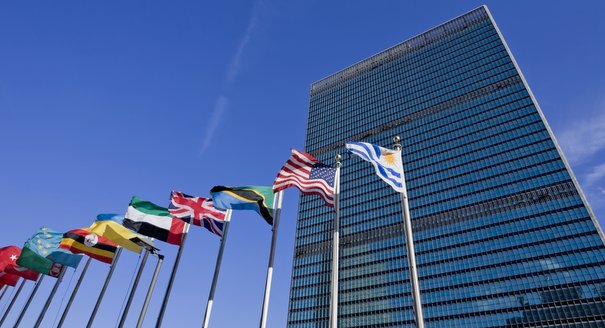
President Trump, the most isolationist American president since the founding of the United Nations, will be giving his first address to the General Assembly this week.
Source: Washington Post
If there are two things that New Yorkers love to hate, it’s the opening session of the United Nations General Assembly and President Trump. This week, for the first time, these two will come together in a cluster-summit of traffic jams, media hype and overheated rhetoric that will send the blood pressure of locals soaring and have foreign visitors rifling through their phrase books trying to make sense of the potent, home-brewed language that cabdrivers use to shout at passing motorcades.
Of course, New Yorkers love to hate the U.N. General Assembly meetings because it allows them to complain about the inconveniences caused by the fact that world leaders descend on their city, while at the same time they love to remind everyone that world leaders are coming there rather than someplace else.
When it comes to Trump, many New Yorkers can’t stand him. In 2016, Trump got only 18 percent of the vote overall in his home town and only 10 percent of the vote in Manhattan — where he actually lived. As one New York native said to me, “To know him is to loathe him.” (All right, I’ll admit it — that was my New York-born mother.) Even sources to whom I am not related confirm this view. I recently spoke to a top Wall Street executive who lives next door to a major New York real estate developer who is often described as a friend of Trump’s. When questioned about this “friendship,” the fellow squirmed a bit and then deflected by saying, “Well, my father was friendly with his father.”
This year will be the first year that Trump attends the gathering of world leaders as its unofficial host. Tomorrow, he will give an address to the General Assembly that will be watched closely worldwide to see whether Trump offers up the nationalist, anti-U.N., belligerent bombast of his campaign (and his Twitter account) or instead we get a more muted president, doing his best to sound statesmanlike.
In part, the side of Trump that we will see will depend on whom among his formal and informal advisers he listens to. On his roster are nationalists such as Stephen Miller in the White House. The other nationalist Steve, last name Bannon, is now outside the government but still influential. Trump also still has former U.S. ambassador to the United Nations John Bolton, who is a pariah within the U.N., to consult. On the other hand, Trump’s successful current U.N. ambassador, Nikki Haley, could use her time at Trump’s side this week to seal the deal so that she might someday replace Secretary of State Rex Tillerson (if he leaves office soon, as many expect he will). She is well-liked and respected by her colleagues at the U.N. — one of whom joked to me that given that “the lights seem to be out in Foggy Bottom,” Haley “more or less is already the secretary of state.”
Another reason Trump will be the bright shiny object at this year’s gathering is that many of the most important leaders in the world will be absent, including President Vladimir Putin of Russia, Chancellor Angela Merkel of Germany and President Xi Jinping of China, who has stepped up on issues such as trade and the environment to fill the void created by Trump policies and postures. The leaders of India, Pakistan, Mexico and Venezuela will also not be attending.
While Trump’s tweets containing schoolyard taunts on questions such as North Korea and Iran will be scrutinized, it is likely that the most important points he makes to the press and via social media during the meeting are like to be produced by his body language. Trump’s pullback from the Paris climate accord (wobbly though it seems to be at the moment), departure from the Trans-Pacific Partnership, reconsideration of the North American Free Trade Agreement, attacks on NATO, dismissive talk about the value of the U.N., and “America First” refrains have made him the most isolationist, anti-multilateralist American president since the U.N. was founded more than 70 years ago.
The United States played the central role in the creation of the United Nations — and, in a moment of institutional creativity unequaled in modern history, in putting in place a global system including the International Monetary Fund, the World Bank, the precursor to the World Trade Organization as well as other alliances and regional organizations. Since then, although U.S. presidents may have sometimes grumbled about the weaknesses of the international system, they supported its expansion.
The man who will take the podium on Sept. 19 will therefore be the first American president since the country became a world power to make “Retreat!” his international battle cry. His focus has been not only on undoing international deals but also on building walls, making it harder for foreigners to enter the United States, alienating allies and focusing on what sets the United States apart from the community of nations rather than what enables it to lead in that community. Will he double down and make matters worse on this front? Or will he surprise us all with a Trumpian vision for remaking that community — which would be welcome considering that U.N. reform is the central focus of this year’s General Assembly gathering?
Given Trump’s track record to date, the expectation is that his familiar belligerence will make his U.N. appearance must-see TV, regardless of the policy choices that he ultimately outlines. It’s the same reason that New Yorkers stand on the sidewalk to watch converging motorcades during U.N. General Assembly week — both for the spectacle and to witness the unholy mess that is likely to result at the end.
This article was originally published in the Washington Post.
Former Visiting Scholar
David Rothkopf was a visiting scholar at the Carnegie Endowment as well as the former CEO and editor in chief of the FP Group.
Recent Work
David Rothkopf
David Rothkopf
Carnegie India does not take institutional positions on public policy issues; the views represented herein are those of the author(s) and do not necessarily reflect the views of Carnegie, its staff, or its trustees.

How is AI reshaping space security, creating governance challenges, and where does international diplomacy stand today?


Tejas Bharadwaj, Almudena Azcárate Ortega

After the chill in ties between 2020 and 2024 that brought India–China relations to their lowest point in several decades, the two countries have engaged each other afresh. This paper argues that there are predominantly four imperatives guiding India’s approach to China, and they exist in an order of priority.

Saheb Singh Chadha

This piece argues that India’s central challenge is not managing a single flashpoint but resolving the underlying tension between expansion and institutional coherency of the BRICS grouping.

Vrinda Sahai

A partnership between India, a country of subcontinental size, and Africa, a continent of fifty-four countries, may seem asymmetric until one notes that both are home to nearly the same number of people—1.4 billion. This essay spells out the existing challenges to the partnership, its optimal potential, and the possible pathways to realize it over the next quarter-century.

Rajiv Bhatia

The U.S.–India semiconductor cooperation story is well-stocked with top-level strategic intent. What remains unresolved, however, are some underlying challenges that will determine whether the cooperation actually functions. Three such friction points stand out.

Shruti Mittal