

Commentary
How is AI reshaping space security, creating governance challenges, and where does international diplomacy stand today?
Tejas Bharadwaj, Almudena Azcárate Ortega
{
  "authors": [
    "Richard Sokolsky",
    "Aaron David Miller"
  ],
  "type": "legacyinthemedia",
  "centerAffiliationAll": "",
  "centers": [
    "Carnegie Endowment for International Peace",
    "Malcolm H. Kerr Carnegie Middle East Center"
  ],
  "collections": [],
  "englishNewsletterAll": "",
  "nonEnglishNewsletterAll": "",
  "primaryCenter": "Carnegie Endowment for International Peace",
  "programAffiliation": "",
  "programs": [],
  "projects": [],
  "regions": [
    "United States",
    "Middle East",
    "Syria",
    "Levant"
  ],
  "topics": [
    "Political Reform",
    "Foreign Policy"
  ]
}
Source: Getty
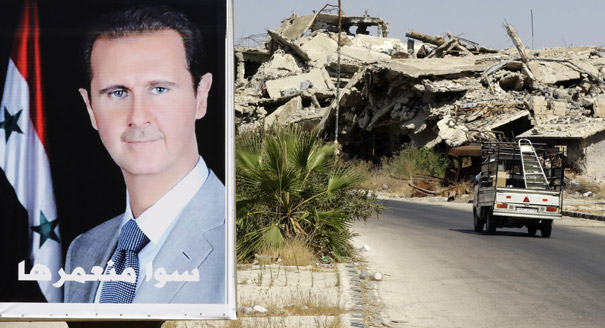
The gap between U.S. rhetoric and action on Assad’s departure has long characterized Washington’s policy toward the Syrian leader.
Source: CNN
Today in Geneva, Secretary of State Rex Tillerson -- in the wake of his meeting with the UN's special envoy on Syria -- strained the bounds of his and American credibility to the breaking point with this stunning statement:
"The United States wants a whole and unified Syria with no role for Bashar al-Assad in the government ... the reign of the Assad family is coming to an end, and the only issue is how that should be brought about."
Not only does the statement raise serious questions about Tillerson's analytical abilities, but it again introduces the worrisome question of precisely who the secretary of state is speaking for. President Donald Trump clearly has no love for Bashar Assad; but he has never made regime change through a peaceful transition or by military force a priority for the United States.
And if Tillerson's comments represent a new tougher approach toward Assad -- perhaps as part of the administration's harder-line policy on Iran -- it will face long odds in achieving its goal.
The Grand Canyon-like gap between US rhetoric and action on Assad's departure has long characterized Washington's policy toward the Syrian leader. President Barack Obama -- joined by Secretary of State John Kerry -- repeatedly called for Assad's removal during the early years of the Syrian civil war when there was at least a faint hope of producing it. Then, the odds in favor of getting rid of the regime were at least plausible, even though the Obama administration hadn't the vaguest idea of how it might be done and was unwilling to commit enough resources to the fight to bring it about either unilaterally or by backing Assad's opponents.
Today, Tillerson's comments seem otherworldly. Backed by Iran and Russia, the Assad regime has not only survived but is poised to take back much if not all of the country. Assad controls the capital, all the major cities, the ports, airports, the UN seat and -- despite the ravishing of both the Syrian military and the economy-- seems likely to survive. Jordan is considering opening up a border crossing with Syria and has accepted the reality that Assad will stay, as has Iraq and, of course, Lebanon, home to Hezbollah -- a key Assad ally.
Tillerson's bold comments about the end of the regime reflect a stale talking point that frankly damages US credibility and opens up a large gap between American rhetoric and actions into which US credulity falls and disappears. It may well be that Tillerson felt the need after meeting with UN envoy Staffan de Mistura, who's poised to resume seemingly never-ending negotiations about the future of Syria, to make a strong statement about getting rid of Assad.
But it doesn't help de Mistura or the US when the world knows there's not a chance that such a goal might be implemented or that the US is serious about putting any muscle behind it. President Trump recently talked about a political transition in Syria; but in much milder terms; as a candidate and as President he never seemed convinced that getting rid of Assad was more important than eliminating ISIS.
Indeed, given Trump's preternatural tendency not to tangle with Vladimir Putin, it's no wonder he's never sought Assad's removal -- a goal that would bring him into direct conflict with Moscow. More than likely, Tillerson and Trump aren't on the same page on this issue, certainly not with respect to the urgency and certitude that Tillerson expressed about the imminence of Assad's end. Sadly, all of this reflects the problem of trying to determine what US policy is and who -- the secretary of state or the President -- represents it.
And in the unlikely event that Tillerson's comments reflect a change in Washington's approach and a new urgency in hastening Assad's departure, the administration is setting itself a mission impossible. Assad will never accept a political transition and the Iranians and Russians having sacrificed so much in Syria to shore up his regime, will resist. And it's unlikely, even if the Trump administration is toughening up its policy on Assad to confront Iran, that it will be able to remove him through political pressure or military force.
Assad, though clearly the main source of Syria's problems, won't be leaving the scene anytime soon. Against all the odds, he's managed to do what no other authoritarian challenged by the Arab uprisings has succeeded in doing: not just hanging on but hanging on to most of his country. And in a cruel irony, there's a pretty good chance that Tillerson will have departed his post before Assad departs his.
Nonresident Senior Fellow, Russia and Eurasia Program
Richard Sokolsky is a nonresident senior fellow in Carnegie’s Russia and Eurasia Program. His work focuses on U.S. policy toward Russia in the wake of the Ukraine crisis.

Senior Fellow, American Statecraft Program
Aaron David Miller is a senior fellow at the Carnegie Endowment for International Peace, focusing on U.S. foreign policy.
Carnegie India does not take institutional positions on public policy issues; the views represented herein are those of the author(s) and do not necessarily reflect the views of Carnegie, its staff, or its trustees.

How is AI reshaping space security, creating governance challenges, and where does international diplomacy stand today?


Tejas Bharadwaj, Almudena Azcárate Ortega

After the chill in ties between 2020 and 2024 that brought India–China relations to their lowest point in several decades, the two countries have engaged each other afresh. This paper argues that there are predominantly four imperatives guiding India’s approach to China, and they exist in an order of priority.

Saheb Singh Chadha

This piece argues that India’s central challenge is not managing a single flashpoint but resolving the underlying tension between expansion and institutional coherency of the BRICS grouping.

Vrinda Sahai

A partnership between India, a country of subcontinental size, and Africa, a continent of fifty-four countries, may seem asymmetric until one notes that both are home to nearly the same number of people—1.4 billion. This essay spells out the existing challenges to the partnership, its optimal potential, and the possible pathways to realize it over the next quarter-century.

Rajiv Bhatia

The U.S.–India semiconductor cooperation story is well-stocked with top-level strategic intent. What remains unresolved, however, are some underlying challenges that will determine whether the cooperation actually functions. Three such friction points stand out.

Shruti Mittal