

Article
C. Raja Mohan, Darshana M. Baruah
{
  "authors": [
    "C. Raja Mohan"
  ],
  "type": "other",
  "centerAffiliationAll": "",
  "centers": [
    "Carnegie Endowment for International Peace",
    "Carnegie India"
  ],
  "collections": [],
  "englishNewsletterAll": "",
  "nonEnglishNewsletterAll": "",
  "primaryCenter": "Carnegie India",
  "programAffiliation": "",
  "programs": [],
  "projects": [],
  "regions": [
    "United States",
    "Asia",
    "South Asia",
    "India",
    "North America",
    "East Asia",
    "Southeast Asia"
  ],
  "topics": [
    "Foreign Policy"
  ]
}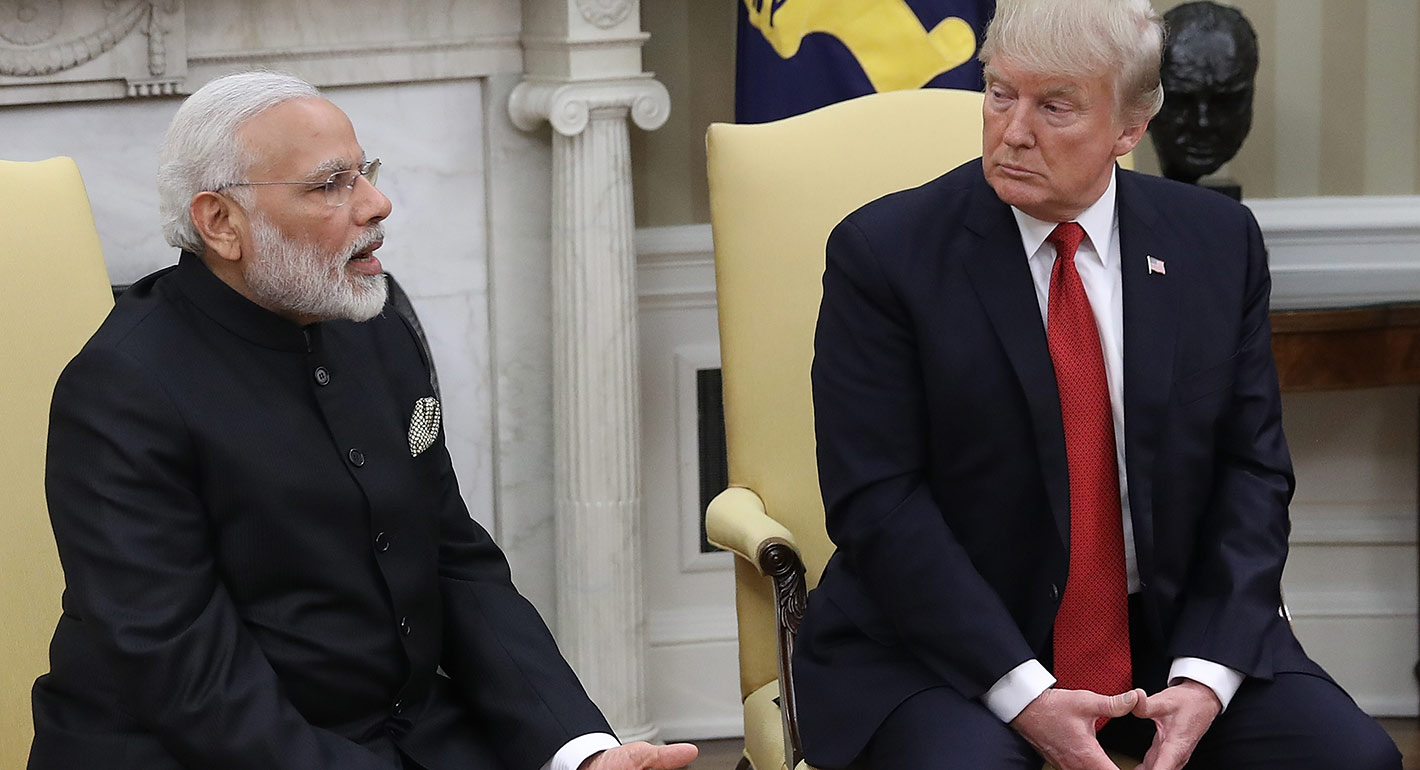
Source: Getty
The durability of the Indo-Pacific dynamic will depend essentially on New Delhi’s willingness to work with the United States and its allies in the region.
Source: Institute of South Asian Studies
One of the new dynamics of the gathering geopolitical turbulence in Asia and its waters is the growing use of the term ‘Indo-Pacific’. During his extended visit to Asia in November 2017, United States (US) President Donald Trump has defined the region as ‘Indo-Pacific’ rather than the customary ‘Asia-Pacific’. Concepts of geopolitical space are never static, and Trump’s emphasis on the Indo-Pacific underlines the rise of India, China’s assertiveness and its expanding footprint in the Indian Ocean, as well as Washington’s plans to elevate its strategic partnership with New Delhi. It involves America’s strategic bet on India’s future role in shaping the security architecture in the eastern hemisphere. Actively promoted in recent years by Japanese Prime Minister Shinzo Abe, the Indo-Pacific conception can be traced back to the decision of the Association of Southeast Asian Nations to invite India as a founding member of the East Asia Summit in 2005. The durability of the Indo-Pacific dynamic, however, will depend essentially on New Delhi’s willingness to work with the US and its allies in the region.
Former Nonresident Senior Fellow, Carnegie India
A leading analyst of India’s foreign policy, Mohan is also an expert on South Asian security, great-power relations in Asia, and arms control.
Recent Work

C. Raja Mohan, Darshana M. Baruah


Alexander Gabuev, Paul Haenle, C. Raja Mohan, …
Carnegie India does not take institutional positions on public policy issues; the views represented herein are those of the author(s) and do not necessarily reflect the views of Carnegie, its staff, or its trustees.

A partnership between India, a country of subcontinental size, and Africa, a continent of fifty-four countries, may seem asymmetric until one notes that both are home to nearly the same number of people—1.4 billion. This essay spells out the existing challenges to the partnership, its optimal potential, and the possible pathways to realize it over the next quarter-century.

Rajiv Bhatia

The U.S.–India semiconductor cooperation story is well-stocked with top-level strategic intent. What remains unresolved, however, are some underlying challenges that will determine whether the cooperation actually functions. Three such friction points stand out.

Shruti Mittal

The India–EU Free Trade Agreement (FTA) is shaping up to be one of the most consequential trade negotiations, both economically and strategically. But, what’s in the agreement, what’s missing, and what will determine its success in the years ahead

Vrinda Sahai, Nicolas Köhler-Suzuki

Drawing on ten public discussions from the India AI Impact Summit 2026, this article highlights key outlooks on open source in AI that are likely to shape policy and governance conversations going forward.
Shruti Mittal
This collection of essays by scholars from Carnegie India’s Technology and Society program traces the evolution of the AI summit series and examines India’s framing around the three sutras of people, planet, and progress. Scholars have catalogued and assessed the concrete deliverables that emerged and assessed what the precedent of a Global South country hosting means for the future of the multilateral conversation.


Nidhi Singh, Tejas Bharadwaj, Shruti Mittal, …