

Commentary
How is AI reshaping space security, creating governance challenges, and where does international diplomacy stand today?
Tejas Bharadwaj, Almudena Azcárate Ortega
{
  "authors": [
    "Sarah Chayes",
    "Kendra McSweeney"
  ],
  "type": "legacyinthemedia",
  "centerAffiliationAll": "dc",
  "centers": [
    "Carnegie Endowment for International Peace"
  ],
  "collections": [
    "Democracy and Governance",
    "Anti-Corruption"
  ],
  "englishNewsletterAll": "democracy",
  "nonEnglishNewsletterAll": "",
  "primaryCenter": "Carnegie Endowment for International Peace",
  "programAffiliation": "DCG",
  "programs": [
    "Democracy, Conflict, and Governance"
  ],
  "projects": [],
  "regions": [
    "North America",
    "United States",
    "South America"
  ],
  "topics": [
    "Political Reform",
    "Democracy",
    "Foreign Policy"
  ]
}
Source: Getty
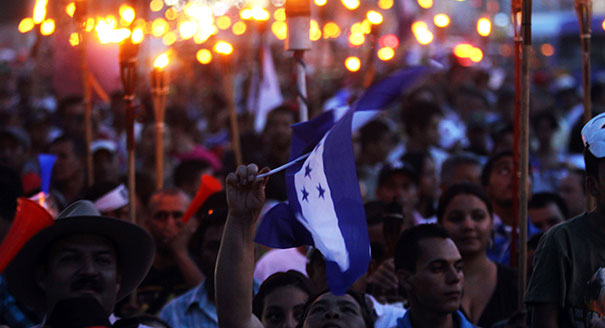
Honduran citizens are standing up for democracy, despite apparent efforts to rig the recent presidential election. The U.S. government should demand an impartial ballot recount.
Source: Washington Post
The news out of Honduras has taken dizzying turns since the Nov. 26 presidential election — some predictably sickening, but some so exceptional as to startle even veteran analysts of this Central American country. A partial recount of disputed ballots now puts the incumbent, Juan Orlando Hernandez, ahead by a whisker – after inexplicable halts and delays in the counting.
That Hernandez should seek to doctor the numbers is no surprise. What is remarkable — and what deserves the support of democracies everywhere — is the civic patriotism of everyday Hondurans, who braved the odds to vote massively against a power grab Hernandez has been engineering for years.
Hernandez’s tenure has been marred by egregious corruption, the hijacking of government institutions and brazen assassinations of environmental activists, who have exposed the systemic character of that corruption. Despite this track record, Washington — the Obama and Trump administrations alike — has bolstered Hernandez, applauding him as a trusted ally. He has proved deft at securing material and moral support in exchange for a degree of cooperation on two U.S. obsessions: narcotics trafficking and immigrant flows.
While the Organization of American States has called for an expanded recount, muted U.S. statements speak merely of “monitoring closely” and urge “calm and patience.” Meanwhile, on Nov. 28, in the midst of the unfolding chaos, Secretary of State Rex Tillerson reportedly certified that Honduras has made enough progress combating corruption to receive the latest installment of U.S. aid. Responses like this risk abetting a coup d’etat in the making.
A first coup, in 2009, paved the way for Hernandez to become president. Since then, such violence and fear have reigned that journalists and activists often write down their answers during one-on-one interviews and ask interlocutors to take the batteries out of their cellphones. Homicides have soared, and small-business owners often can’t tell whether they’re being extorted by a gang or the police. No wonder so many Honduran children have taken the dangerous route north to the United States.
The above is plenty of cause for alarm. But don’t let it hide the real story.
Hernandez has spent years working to ensure the outcome of this election. Three years ago he packed the Supreme Court with loyalists, which later obliged him by striking down a constitutional term limit that would have prevented him from running again. Meanwhile, he has consolidated his hold on the armed forces, police, public prosecution, agencies overseeing infrastructure contracting, oversight institutions such as the High Tribunal of Accounts, social welfare agencies that can trade handouts for votes, and, of course, the Supreme Electoral Tribunal.
So when Hondurans headed to the polls two Sundays ago, there was little reason to believe Hernandez could possibly lose. In fact, there seemed little incentive to turn out at all. Everything in Hondurans’ experience suggested that this election would be only a scripted performance of democracy, not the real thing.
But turn out they did. From villages perched on forested slopes, where indigenous farmers plant coffee and stand up to mining corporations, from the gang-controlled barrios — they turned out. Factory workers, who sew the clothes and assemble the electronics we pounce on in post-Thanksgiving cyber-sales, turned out. Agricultural laborers who pick the cantaloupes, haul the bananas and harvest the shrimp that stock our supermarkets turned out. Nurses and teachers whose pensions have been lost to corruption, people recently deported from the United States — they all turned out.
Twenty-four hours after the polls closed, with 57 percent of ballots counted, opposition candidate Salvador Nasralla held a commanding five-point lead. “The technical experts here say it’s irreversible,” one of the electoral tribunal’s magistrates told Reuters. Hardly daring to believe what they had achieved, euphoric crowds spilled into the streets.
Then the machinations began. Orders came for counting to cease. The top election official reported a mysterious “computer glitch” via Twitter. When numbers began trickling out again 36 hours later, Hernandez was pulling ahead. He now allegedly leads by 1.6 points.
Hondurans aren’t having it. This past Sunday, they organized huge marches to demand a proper recount. And in a jaw-dropping development, the police in the capital announced the next day they would cease enforcing a declared curfew. “We don’t want to repress and violate the rights of the Honduran people,” a spokesman told the Guardian.
Hondurans have sent an inspiring message of faith in the power of democracy to deliver a better future to their beleaguered country. They deserve U.S. support. Two months ago, Tillerson assured Hondurans of the U.S. commitment to “our joint efforts to strengthen democratic institutions in the region.”
Washington should stand by those words. The United States must demand a full and impartial recount, making the release of aid contingent on that step. Without action, declarations in praise of democracy are just hollow words. They feed the despair that drives people whose hopes of accountable government have been trampled to give up on their country and leave.
For now, Hondurans are standing and fighting for good government. This time, let’s stand with them.
This article was originally published in the Washington Post.
Former Senior Fellow, Democracy, Conflict, and Governance Program
Sarah Chayes is internationally recognized for her innovative thinking on corruption and its implications. Her work explores how severe corruption can help prompt such crises as terrorism, revolutions and their violent aftermaths, and environmental degradation.
Kendra McSweeney
Kendra McSweeney is a professor of geography at the Ohio State University.
Carnegie India does not take institutional positions on public policy issues; the views represented herein are those of the author(s) and do not necessarily reflect the views of Carnegie, its staff, or its trustees.

How is AI reshaping space security, creating governance challenges, and where does international diplomacy stand today?


Tejas Bharadwaj, Almudena Azcárate Ortega

After the chill in ties between 2020 and 2024 that brought India–China relations to their lowest point in several decades, the two countries have engaged each other afresh. This paper argues that there are predominantly four imperatives guiding India’s approach to China, and they exist in an order of priority.

Saheb Singh Chadha

This piece argues that India’s central challenge is not managing a single flashpoint but resolving the underlying tension between expansion and institutional coherency of the BRICS grouping.

Vrinda Sahai

A partnership between India, a country of subcontinental size, and Africa, a continent of fifty-four countries, may seem asymmetric until one notes that both are home to nearly the same number of people—1.4 billion. This essay spells out the existing challenges to the partnership, its optimal potential, and the possible pathways to realize it over the next quarter-century.

Rajiv Bhatia

The U.S.–India semiconductor cooperation story is well-stocked with top-level strategic intent. What remains unresolved, however, are some underlying challenges that will determine whether the cooperation actually functions. Three such friction points stand out.

Shruti Mittal