

Commentary
How is AI reshaping space security, creating governance challenges, and where does international diplomacy stand today?
Tejas Bharadwaj, Almudena Azcárate Ortega
{
  "authors": [
    "Jon Wolfsthal",
    "Julie Smith"
  ],
  "type": "legacyinthemedia",
  "centerAffiliationAll": "dc",
  "centers": [
    "Carnegie Endowment for International Peace",
    "Malcolm H. Kerr Carnegie Middle East Center"
  ],
  "collections": [
    "Iranian Proliferation",
    "U.S. Nuclear Policy"
  ],
  "englishNewsletterAll": "ctw",
  "nonEnglishNewsletterAll": "",
  "primaryCenter": "Carnegie Endowment for International Peace",
  "programAffiliation": "NPP",
  "programs": [
    "Nuclear Policy"
  ],
  "projects": [],
  "regions": [
    "North America",
    "United States",
    "Middle East",
    "Iran"
  ],
  "topics": [
    "Political Reform",
    "Foreign Policy",
    "Nuclear Policy"
  ]
}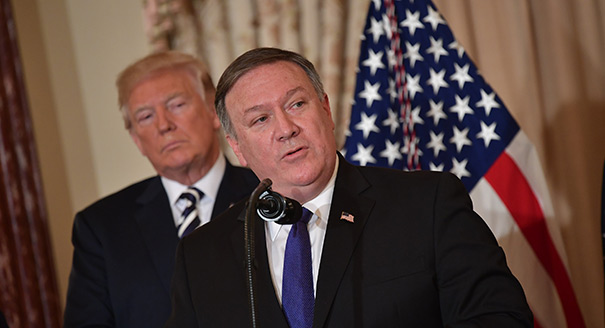
Source: Getty
The Trump administration does not have a plan to get Iran to do anything the United States wants. Pompeo’s new strategy to counter Iran’s behavior across the Middle East is just a long wish list of demands.
Source: Foreign Policy
In the wake of President Donald Trump’s announcement this month that the United States would no longer implement the Iran nuclear deal, Secretary of State Mike Pompeo on Monday laid out what he called a new strategy to counter Iran’s behavior across the Middle East. His speech, however, did not delineate a strategy so much as a wish list and a long one at that. Pompeo stated 12 demands — or “basic requirements,” as he called them — for Iran.
In addition to doing many of the things that it already had to do under the nuclear agreement that the United States just violated, Iran must do the following, according to Pom: end support for Middle Eastern terrorist groups, including Hezbollah, Hamas, and Palestinian Islamic Jihad; respect the sovereignty of the Iraqi government and permit the disarming, demobilization, and reintegration of Shiite militias; end military support for the Houthi militias in Yemen and work toward a peaceful political settlement there; withdraw all forces under Iranian command from Syria; end support for the Taliban and other terrorists in Afghanistan and the region and cease harboring al Qaeda; end the Islamic Revolutionary Guard Corps’ support for terrorists and militant partners; and cease its threatening behavior against its neighbors — many of which are U.S. allies. This certainly includes threats to destroy Israel and firing of missiles into Saudi Arabia and the United Arab Emirates. It also includes its threats to international shipping and destructive cyberattacks.
Everyone, including those who served in the Obama administration, would like Iran to stop these activities. However, most importantly, the Obama team wanted to stop Iran from being able to build a nuclear weapon in weeks, which is exactly what the nuclear deal did, although that outcome is now uncertain.
Trump and Pompeo claim to have a strategy for how to do all of this and more. What is that strategy? Pompeo says the United States “will apply unprecedented financial pressure on the Iranian regime. The leaders in Tehran will have no doubt about our seriousness.”
So the entire so-called strategy is a wish list built on a pipe dream — the idea that the Trump administration is going to get the rest of the world to sign on to a sanctions regime as tough or tougher than the one that existed from 2009 to 2012. The same administration that can’t do simple things like vet nominees, fill government positions, enact executive orders, or avoid alienating the United States’ oldest and closet allies is now going to recreate the most penetrating and effective sanctions system in human history? And they are going to do this with a president whom most U.S. allies don’t trust and who has proved that he will not abide by agreements negotiated in good faith?
The fact is: The Trump team does not have a plan or a strategy for how to get Iran to do any of the things that the United States rightly wants. And to make matters worst, the White House is less likely to get any of the cooperation it needs from Europe to apply “unprecedented financial pressure” because of how the Trump administration handled the Iran deal in recent months. First, the White House indicated to U.S. allies that the deal could be saved but never undertook serious efforts to broker a supplemental agreement. Then, after violating the deal, the Trump administration had the audacity to both blame its European allies for failing to save the agreement and claim that the Iranians had violated the deal even as Iran was adhering to it.
Understandably, Europe isn’t in the mood to now abandon an accord it claims to want to preserve (however difficult that might be moving forward). European reactions to Pompeo’s speech were largely negative. British Foreign Secretary Boris Johnson, striving to use all the diplomatic tact he could muster, called Pompeo’s “jumbo” plan “very difficult.”
Through this Iran speech, the Trump administration is again showing its lack of experience. It has outlined an entirely unrealistic list of demands both in terms of means and ends. As the administration learned in the case of the North Koreans, who supposedly surprised the president with their refusal to agree to full nuclear disarmament on day one, negotiations require prioritization and a clear but incremental path forward. Instead of fleshing out a detailed road map behind closed doors with U.S. allies, Pompeo simply cited 12 ways the Iranians are fueling global and regional instability and supporting terrorism. The Obama administration spent years working diligently with its allies to get the most damning item off that list. Now we’re back to nothing more than a list.
So, Iran remains a problem, the United States is more isolated and less trusted abroad, and Iran is now able to, at a time of its choosing, turn up the nuclear pressure, because the nuclear accord is on life support. That is not a strategy for success. It is a strategy for disaster.
Former Nonresident Scholar, Nuclear Policy Program
Jon Wolfsthal was a nonresident scholar with the Nuclear Policy Program.
Julie Smith
Julianne ("Julie") Smith is director of the transatlantic security program at the Center for a New American Security. Prior to joining CNAS, she served as the deputy national security advisor to Vice President Joe Biden from 2012 to 2013.
Carnegie India does not take institutional positions on public policy issues; the views represented herein are those of the author(s) and do not necessarily reflect the views of Carnegie, its staff, or its trustees.

How is AI reshaping space security, creating governance challenges, and where does international diplomacy stand today?


Tejas Bharadwaj, Almudena Azcárate Ortega

After the chill in ties between 2020 and 2024 that brought India–China relations to their lowest point in several decades, the two countries have engaged each other afresh. This paper argues that there are predominantly four imperatives guiding India’s approach to China, and they exist in an order of priority.

Saheb Singh Chadha

This piece argues that India’s central challenge is not managing a single flashpoint but resolving the underlying tension between expansion and institutional coherency of the BRICS grouping.

Vrinda Sahai

A partnership between India, a country of subcontinental size, and Africa, a continent of fifty-four countries, may seem asymmetric until one notes that both are home to nearly the same number of people—1.4 billion. This essay spells out the existing challenges to the partnership, its optimal potential, and the possible pathways to realize it over the next quarter-century.

Rajiv Bhatia

The U.S.–India semiconductor cooperation story is well-stocked with top-level strategic intent. What remains unresolved, however, are some underlying challenges that will determine whether the cooperation actually functions. Three such friction points stand out.

Shruti Mittal