

Commentary
How is AI reshaping space security, creating governance challenges, and where does international diplomacy stand today?
Tejas Bharadwaj, Almudena Azcárate Ortega
{
  "authors": [
    "Erik Brattberg",
    "Jamie Fly"
  ],
  "type": "other",
  "centerAffiliationAll": "dc",
  "centers": [
    "Carnegie Endowment for International Peace"
  ],
  "collections": [],
  "englishNewsletterAll": "ctw",
  "nonEnglishNewsletterAll": "",
  "primaryCenter": "Carnegie Endowment for International Peace",
  "programAffiliation": "EP",
  "programs": [
    "Europe"
  ],
  "projects": [],
  "regions": [
    "North America",
    "United States",
    "Eastern Europe",
    "Western Europe",
    "Iran"
  ],
  "topics": [
    "Democracy",
    "Foreign Policy",
    "Global Governance"
  ]
}
Source: Getty
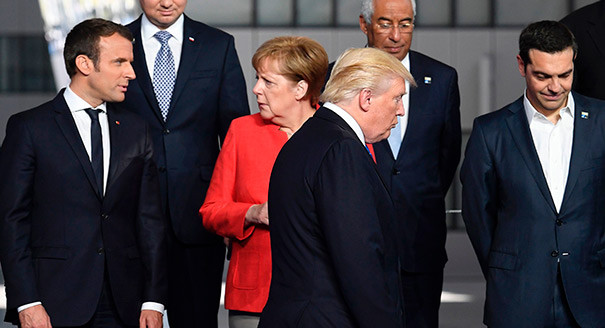
The traditional partnership between the U.S. and Europe is under duress. A step forward on areas of agreement must be found despite current challenges.
Source: German Marshall Fund
Almost eighteen months into the Trump administration, much of the traditional partnership between the United States and Europe is under severe, and in many ways unprecedented, stress. Up to this point, the relationship has been dominated by the myriad of issues on which Washington and European capitals diverge — whether the Paris agreement, the recognition of Jerusalem as the capital of Israel, withdrawal from the JCPOA with Iran, or more recently steel and aluminum tariffs. The Trump administration certainly bears primary responsibility for what is perceived in Europe as a rudderless if not even hostile alliance policy. Yet, despite these differences, the United States and Europe are the most natural partners to confront the 21st century challenges facing liberal democracies. The threats from challengers such as China and Russia will only grow more unmanageable if transatlantic partners retreat into their corners. A way forward on areas of agreement, and areas where mutually beneficial bargains can be carved out, must be found despite the turmoil.
Managing ongoing cooperation and avoiding a split over the inevitable disagreements will be a key challenge for policymakers on both sides of the Atlantic over the coming months and years. Yet, there is a need to go beyond just managing ongoing cooperative efforts to also reinvent the transatlantic agenda — it is time for Washington and European capitals to develop a positive agenda that gives new meaning to the transatlantic alliance. This should include stepping up the U.S. engagement within Europe itself, strengthening the U.S. presence and engagement on Europe’s periphery, and capitalizing on opportunities to work with Europe on addressing shared global challenges. In particular, the Trump administration should focus on four key objectives in the coming three years — cooperation on addressing the rise of China, supporting new EU defense initiatives as part of transatlantic burden-sharing, completing the European project, and ensuring strong U.K.–EU ties post-Brexit. Ultimately, U.S. and European policymakers still share some common ground where practical cooperation can be advanced.
This paper was originally published by German Marshall Fund.

Former Director, Europe Program, Fellow
Erik Brattberg was director of the Europe Program and a fellow at the Carnegie Endowment for International Peace in Washington. He is an expert on European politics and security and transatlantic relations.
Jamie Fly
Jamie Fly is a senior fellow at the German Marshall Fund and previously served as Senator Marco Rubio's foreign policy advisor.
Carnegie India does not take institutional positions on public policy issues; the views represented herein are those of the author(s) and do not necessarily reflect the views of Carnegie, its staff, or its trustees.

How is AI reshaping space security, creating governance challenges, and where does international diplomacy stand today?


Tejas Bharadwaj, Almudena Azcárate Ortega

After the chill in ties between 2020 and 2024 that brought India–China relations to their lowest point in several decades, the two countries have engaged each other afresh. This paper argues that there are predominantly four imperatives guiding India’s approach to China, and they exist in an order of priority.

Saheb Singh Chadha

This piece argues that India’s central challenge is not managing a single flashpoint but resolving the underlying tension between expansion and institutional coherency of the BRICS grouping.

Vrinda Sahai

A partnership between India, a country of subcontinental size, and Africa, a continent of fifty-four countries, may seem asymmetric until one notes that both are home to nearly the same number of people—1.4 billion. This essay spells out the existing challenges to the partnership, its optimal potential, and the possible pathways to realize it over the next quarter-century.

Rajiv Bhatia

The U.S.–India semiconductor cooperation story is well-stocked with top-level strategic intent. What remains unresolved, however, are some underlying challenges that will determine whether the cooperation actually functions. Three such friction points stand out.

Shruti Mittal