

Commentary
Alexander Gabuev
{
  "authors": [
    "Alexander Gabuev"
  ],
  "type": "legacyinthemedia",
  "centerAffiliationAll": "",
  "centers": [
    "Carnegie Endowment for International Peace",
    "Carnegie Russia Eurasia Center"
  ],
  "collections": [],
  "englishNewsletterAll": "",
  "nonEnglishNewsletterAll": "",
  "primaryCenter": "Carnegie Endowment for International Peace",
  "programAffiliation": "",
  "programs": [],
  "projects": [],
  "regions": [
    "North America",
    "United States",
    "Russia"
  ],
  "topics": [
    "Foreign Policy"
  ]
}
Source: Getty
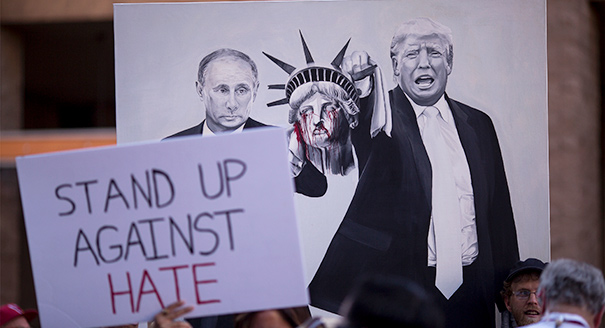
As Trump prepares to meet Vladimir Putin, there is no sign that he has absorbed the lessons of multiple rounds of Western sanctions against Russia since 2014.
Source: The Hill
Donald Trump wrote in “The Art of the Deal” about the importance of leverage. “The best thing you can do is deal from strength, and leverage is the biggest strength you can have. Leverage is something the other guy wants. Or better yet, needs. Or best of all, simply can’t do without.”
The American president seems to believe this approach can work for achieving his foreign policy goals, and views U.S. sanctions as a silver bullet that gives him leverage over adversaries. Before meeting Kim Jong Un in Singapore, the Trump administration invested a lot of effort in ratcheting up sanctions against North Korea as part of its “maximum pressure” strategy. The same logic is applied with Iran, as Trump walked away from the carefully negotiated nuclear agreement, thinking that it somehow frees his hand to isolate and pressure Tehran.
As Trump prepares to meet Vladimir Putin, there is no sign that he has absorbed the lessons of multiple rounds of Western sanctions against Russia since 2014. If Trump believes that sanctions relief is what the Kremlin “needs or simply can’t do without,” he is sorely mistaken. As unpleasant as the sanctions may be for certain oligarchs and parts of the economy, they are more of a blessing than a curse for Putin.
First of all, the toll of sanctions on the Russian economy is not large enough to pose an existential threat. According to former finance minister Alexei Kudrin, a liberal stalwart, sanctions have shaved off a mere 0.5 percent of GDP per year. Many Russian state banks and companies have lost access to Western capital markets, but the Kremlin is all too happy to fill the gap using state coffers flush with oil revenues.
Ruble depreciation and low inflation have enabled the government to raise nominal wages and cushion the impact on the public. The Russian economy is not doing great, but the current growth rate of 1.8 percent is nothing to sneeze at. At the end of the day, it is the lack of structural reforms to deal with endemic corruption and dodgy respect for property rights and the rule of law that hold the economy back, not the sanctions.
Then there is the increasing number of constituencies in Russia who are thriving on sanctions. A ban imposed by the Kremlin on food imports from the United States and European Union has played into the hands of local businesses in agriculture, particularly those with good ties to the regime. Industrial import substitution has not made Russian manufacturing globally competitive, but it helped to increase market share of the bloated state conglomerates at the expense of Western firms. The sanctioned state banks have received massive capital injections from the central bank and are aggressively consolidating control over the entire sector.
Even more importantly, sanctions give an enormous political boost to forces in Russia that see only the upside in the current breakdown in relations with the West. Ever since the massive street protests in Moscow in 2011 and 2012, Putin has consistently demanded that the elite return back home and limit their susceptibility to being exploited by the hostile West. That initial effort largely failed since very few members of the Russian elite who were not subject to travel and asset bans actually wanted to say goodbye to the good life in London, New York and Miami.
A renewed push by Western governments to squeeze Russian money in Britain, Cyprus and the Baltic states, which were long a safe haven for wealthy Russians, play straight into Putin’s hands and help him to “nationalize” the elite. Since its reputation abroad is largely irrelevant for the Kremlin, Putin’s closest friends and the “siloviks” from the security services feel emboldened to do whatever they want and to use any tools at their disposal to go after their business rivals and redistribute assets.
Last but not least, in the wake of the sanctions signed by Congress into law last year, sanctions are seen as more or less a permanent reality by the Kremlin. Senior members of Putin’s team do not expect live long enough to see meaningful sanctions relief, and probably doubt that their kids will either. Trump’s hands are tied, and Putin knows that all too well. If anything, the Helsinki summit will prove that the “deterrence through sanctions” policy against Russia is not working. The paradox is that it will also prove that the West has no other feasible policy to deal with Russia since Putin will not offer any alternative acceptable to the United States.

Director, Carnegie Russia Eurasia Center
Alexander Gabuev is director of the Carnegie Russia Eurasia Center. Gabuev’s research is focused on Russian foreign policy with particular focus on the impact of the war in Ukraine and the Sino-Russia relationship. Since joining Carnegie in 2015, Gabuev has contributed commentary and analysis to a wide range of publications, including the Financial Times, the New York Times, the Wall Street Journal, and the Economist.
Recent Work
Alexander Gabuev
Alexander Gabuev
Carnegie India does not take institutional positions on public policy issues; the views represented herein are those of the author(s) and do not necessarily reflect the views of Carnegie, its staff, or its trustees.

How is AI reshaping space security, creating governance challenges, and where does international diplomacy stand today?


Tejas Bharadwaj, Almudena Azcárate Ortega

After the chill in ties between 2020 and 2024 that brought India–China relations to their lowest point in several decades, the two countries have engaged each other afresh. This paper argues that there are predominantly four imperatives guiding India’s approach to China, and they exist in an order of priority.

Saheb Singh Chadha

This piece argues that India’s central challenge is not managing a single flashpoint but resolving the underlying tension between expansion and institutional coherency of the BRICS grouping.

Vrinda Sahai

A partnership between India, a country of subcontinental size, and Africa, a continent of fifty-four countries, may seem asymmetric until one notes that both are home to nearly the same number of people—1.4 billion. This essay spells out the existing challenges to the partnership, its optimal potential, and the possible pathways to realize it over the next quarter-century.

Rajiv Bhatia

The U.S.–India semiconductor cooperation story is well-stocked with top-level strategic intent. What remains unresolved, however, are some underlying challenges that will determine whether the cooperation actually functions. Three such friction points stand out.

Shruti Mittal