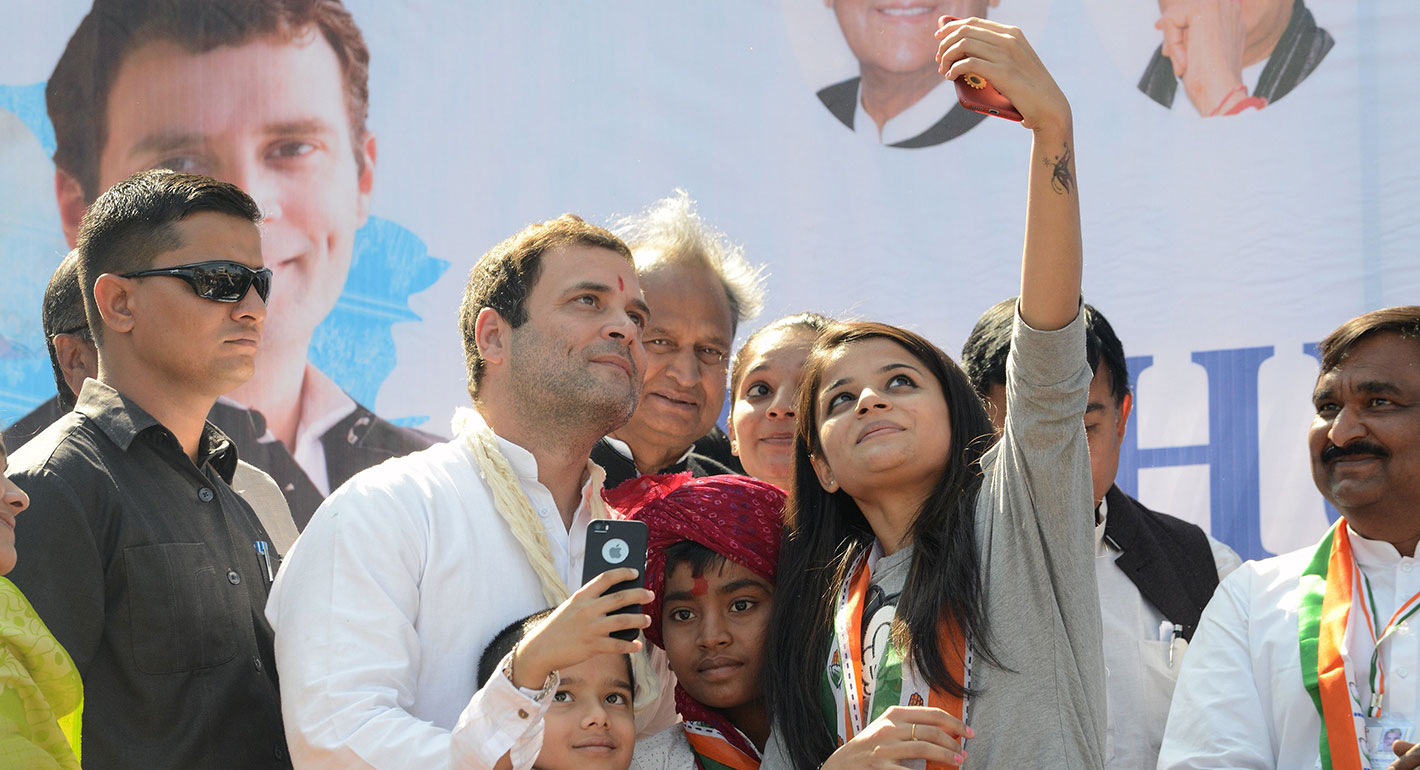
When the Congress party cobbled together an eleventh-hour coalition of convenience with the Janata Dal (Secular) following May’s state assembly election in Karnataka, party sympathisers breathed a sigh of relief. As if the 2014 Lok Sabha results did not do enough to deflate the hopes of Congress’ die-hard supporters, the party’s fortunes have precipitously declined in state assembly elections over the past four years. As recently as 2014, the Congress boasted 11 chief ministers across India – a far cry from the heyday of the Congress dominance, but a respectable tally that was more than double the five states the BJP could call its own. Today, Congress chief ministers call the shots in just three states (Mizoram, Puducherry, and Punjab), equal to a paltry 2.5 per cent of India’s total population – the party’s smallest tally in history. The party’s previous low was four states in 1979 as it reeled from the aftershock of the Emergency rule. Against this backdrop, a share of power in Karnataka is nothing to sneeze at. A populous and economically dynamic state, it is the last major state in India where the Congress can claim a slice of power.
If the Congress has hit rock bottom when it comes to controlling the levers of power at the state level, the question is where does it go from here? In a clutch of states, the Congress remains a viable contender for power (Table 1). In seven states, it finished as the top vote-getter in the most recent assembly election, and it claimed the runner-up position in another 10. These states are, by and large, characterised by bipolar political competition between the Congress and the BJP. In these regions, the BJP has out-muscled the Congress in recent years – its rising stature serves as a mirror image of the Congress’ decline. In just four years, the BJP has managed to triple its tally of chief ministers (from five to 15) while its allies claim another five states. But, since these are two-party states, the Congress at least has a plausible shot at coming back to power if the voters are in a mood for change. Indeed, one reason the Congress is so bullish about this December’s assembly elections in Chhattisgarh, Madhya Pradesh, and Rajasthan is its belief that anti-incumbent votes will inevitably flow to it and allow the party to execute a clean sweep. While this confidence has ebbed somewhat thanks to the Bahujan Samaj Party’s decision to independently contest all three elections, Congress leaders know that a third force will not be able to deprive it of a top-two finish.
The situation is more complicated in other states, and this is where the Congress is facing a crisis of confidence – and with good reason. In the past, some analysts have hypothesised that once the Congress falls to third place or below in a given state, it is never able to climb back up. In 2014, economist Swaminathan Aiyar perceptively wrote that “wherever the Congress has slipped to third or fourth position in a state, anti-incumbency has favoured the No.2 party, leaving the No.3 party out in the cold. The Congress has never been able to bounce back in any state where it has fallen to third position”. To our knowledge, this hypothesis has never been empirically verified. To do so, we examined electoral results in all assembly elections between 1980 and 2018, ranking the Congress’ performance in each state on the basis of the vote share it obtained. Because the Congress was electorally punished in so many states following the Emergency, we begin our analysis in 1980.
At the state assembly level, the Congress has dropped out of the top two vote-earners in 13 states at one point or another. In five states (Bihar, Delhi, Tamil Nadu, Uttar Pradesh, and West Bengal), the dip has endured for two or more elections. In these states (save for Delhi), the party has been out of power for three decades or more; in Tamil Nadu, the Congress last occupied the chief minister’s chair in 1967 (Table 2).
In all of these states – with the possible exception of Delhi, where it formed the government as recently as 2013 – it is virtually inconceivable that the Congress will be able to come back to power anytime soon (aside from being a token ally in a grand coalition of much more consequential players). In another six states (Andhra Pradesh, Haryana, Jammu and Kashmir, Maharashtra, Nagaland, and Tripura), the Congress has fallen out of the top two, but its drop occurred in the most recent assembly election. Hence, it is unclear if this is an aberration or the beginning of a longer trend.
The good news for the Congress is that we could identify two instances of the party dropping out of the top two and recovering: Jharkhand (2009) and Sikkim (2004). But this good news is buried by bad news: in both states, it subsequently fell out of the top two as soon as it recovered. In the most recent assembly elections in Jharkhand and Sikkim, the Congress finished in third and fourth place, respectively, in terms of its vote appeal.
As Congress leaders survey the state-level electoral landscape, they face a dilemma. On the one hand, the Congress must stem its electoral bleeding. On the other hand, in order for it to develop a sustainable footing for the long haul, it must rejuvenate its atrophied party organisation. Unfortunately for party leaders, the two objectives are in tension. The likely outcome is some version of the “Karnataka model,” whereby the party holds its nose and makes common cause with regional players. However, this also means it will struggle to reclaim political territory it cedes to others.
As for the national implications, Congress shows only slightly more resilience in general elections. The 1998 and 1999 Lok Sabha elections, which propelled BJP Prime Minister Atal Bihari Vajpayee to power, knocked Congress to third place in Jammu and Kashmir, Manipur, Sikkim, and Tripura, but in each state the Congress returned to the top two by 2004. The Congress also fell briefly to third place in Arunachal Pradesh and Goa in the 2004 and 2009 general elections, respectively, but recovered in both states in time for the next electoral cycle. These results suggest that the Congress can bounce back in Lok Sabha elections if it does so quickly; otherwise, it never regains relevance. Since the Congress dropped out of the top two vote-earners in five states in 2014 – Andhra Pradesh, Delhi, Haryana, Maharashtra, and Sikkim – its 2019 performance will be a crucial indicator of whether the party can remain a major player in these states for years to come.
Milan Vaishnav is a senior fellow and director of the South Asia Program and the host of the Grand Tamasha podcast at the Carnegie Endowment for International Peace. His primary research focus is the political economy of India, and he examines issues such as corruption and governance, state capacity, federalism, and electoral behavior. He also conducts research on the Indian diaspora.
Jamie Hintson
Former James C. Gaither Junior Fellow, South Asia Program
Jamie Hintson was a James C. Gaither Junior Fellow in the South Asia Program.
Carnegie India does not take institutional positions on public policy issues; the views represented herein are those of the author(s) and do not necessarily reflect the views of Carnegie, its staff, or its trustees.
In any defense establishment, change is an ongoing process. However, despite the best of intentions, existing bureaucracies, bound by habit and years of socialization, have their limits in implementing transformative change.
As AI grows more sophisticated, as the supply chains that power it become more contested, and as access to frontier models becomes geopolitically charged, India must begin to ask a different set of questions. Not what applications it can build on someone else’s infrastructure but what the world needs.
The Indian Ocean Region hosts one of the densest concentrations of subsea cables in the world. Yet, despite accounting for a significant share of global internet traffic, India’s participation remains limited.
After the chill in ties between 2020 and 2024 that brought India–China relations to their lowest point in several decades, the two countries have engaged each other afresh. This paper argues that there are predominantly four imperatives guiding India’s approach to China, and they exist in an order of priority.