

Research
- +6
Yasmine Farouk, Nathan J. Brown, Maysaa Shuja Al-Deen, …
{
  "authors": [
    "Michele Dunne"
  ],
  "type": "commentary",
  "centerAffiliationAll": "dc",
  "centers": [
    "Carnegie Endowment for International Peace",
    "Malcolm H. Kerr Carnegie Middle East Center"
  ],
  "collections": [],
  "englishNewsletterAll": "menaTransitions",
  "nonEnglishNewsletterAll": "",
  "primaryCenter": "Carnegie Endowment for International Peace",
  "programAffiliation": "MEP",
  "programs": [
    "Middle East"
  ],
  "projects": [],
  "regions": [
    "North Africa",
    "Egypt"
  ],
  "topics": [
    "Political Reform",
    "Democracy",
    "Foreign Policy"
  ]
}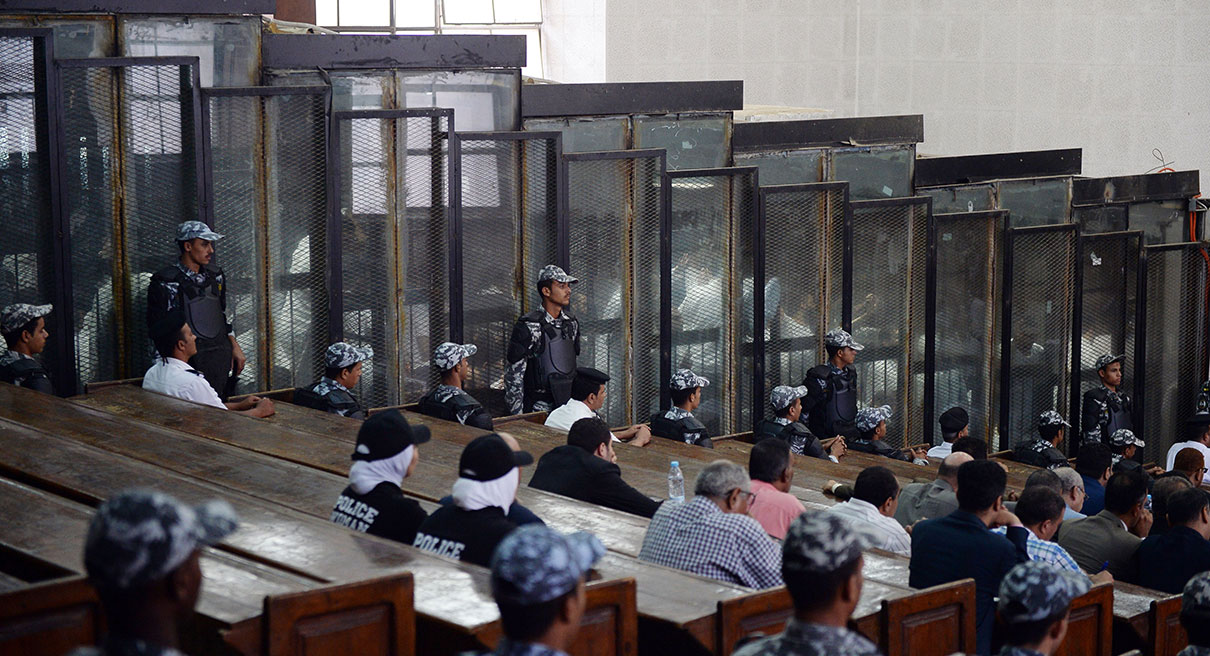
Source: Getty
Egypt has acquitted several foreign NGO workers who had been convicted of working without the Egyptian authorities’ permission. Is this Egypt’s olive branch to the international community?
A source of long-standing tension between Egypt and the United States came to a close with the December 20 acquittal of more than forty Egyptians, Americans, and others convicted in 2013 of carrying out nongovernmental organization (NGO) work without government permission, most of whom were forced to leave the country.
The U.S. NGOs (including the National Democratic Institute, International Republican Institute, and Freedom House—whose program director was my husband, Charles Dunne) had been carrying out programs such as organizing electoral observation in cooperation with Egyptian institutions, including the electoral commission. But security bodies had denied their requests for licensing, and used that as a pretext to close them down in dramatic raids in December 2011. The U.S. government, which was funding the activities amid what seemed to be a democratic opening, was shocked by the raids. Things became a bit clearer when that opening closed abruptly with a military coup, just weeks after the June 2013 verdicts.
The acquittals remove a bone that had been stuck in the throat of members of the U.S. Congress, particularly those responsible for providing more than $1 billion annually in aid to Egypt. They refused to accept that a partner government would treat workers of U.S. NGOs so poorly. There are still other sources of tension between the United States and Egypt, including the regime’s abysmal human rights practices and draconian NGO law, but this verdict sets the table for a more constructive conversation.
For Egyptian civil society, the acquittals’ implications are murky. The legal case under which the NGO activists were charged is still very much alive. Egyptian authorities have used it to interrogate, arrest, charge, ban from travel, or block the assets of dozens of local rights activists in the last few years. Lawyers will try to use the acquittals to the benefit of their clients, but there is no guarantee that will work in Egyptian courts. Similarly, local activists do not hold high hopes for the promised revision of the NGO law.
What the acquittals do make clear is that persistent international attention on an issue eventually brings results. Senior members of the U.S. Congress had kept the case alive since the 2011 raids and forced the U.S. administration to pursue a resolution. As with the 2002 case of Egyptian-American academic Saad Eddin Ibrahim, it took a cut or suspension of U.S. assistance to convince the Egyptian government that something had to be done. More recently, the international (and particularly U.S. Senate) furor over the October 2018 murder of Saudi journalist Jamal Khashoggi seems to have alarmed Arab authoritarian allies.
President Abdel Fattah el-Sisi is now taking a few steps to get himself out of the crosshairs of the U.S. Congress. A dark reading of the December 20 verdicts might be that Sisi wanted to appease the United States in advance of a renewed crackdown on local civil society, as well as a planned revision of the constitution to extend his presidency. But as it is Christmas, let us take this gift and hope it can pave the way for a better 2019 for Egypt’s beleaguered civil society.

Former Nonresident Scholar, Middle East Program
Michele Dunne was a nonresident scholar in Carnegie’s Middle East Program, where her research focuses on political and economic change in Arab countries, particularly Egypt, as well as U.S. policy in the Middle East.
Recent Work


Yasmine Farouk, Nathan J. Brown, Maysaa Shuja Al-Deen, …
Robert Springborg, Emile Hokayem, Becca Wasser, …
Carnegie India does not take institutional positions on public policy issues; the views represented herein are those of the author(s) and do not necessarily reflect the views of Carnegie, its staff, or its trustees.

After the chill in ties between 2020 and 2024 that brought India–China relations to their lowest point in several decades, the two countries have engaged each other afresh. This paper argues that there are predominantly four imperatives guiding India’s approach to China, and they exist in an order of priority.

Saheb Singh Chadha

This piece argues that India’s central challenge is not managing a single flashpoint but resolving the underlying tension between expansion and institutional coherency of the BRICS grouping.

Vrinda Sahai

A partnership between India, a country of subcontinental size, and Africa, a continent of fifty-four countries, may seem asymmetric until one notes that both are home to nearly the same number of people—1.4 billion. This essay spells out the existing challenges to the partnership, its optimal potential, and the possible pathways to realize it over the next quarter-century.

Rajiv Bhatia

The India–EU Free Trade Agreement (FTA) is shaping up to be one of the most consequential trade negotiations, both economically and strategically. But, what’s in the agreement, what’s missing, and what will determine its success in the years ahead
Vrinda Sahai, Nicolas Köhler-Suzuki

Trump 2.0 has unsettled India’s external environment—but has not overturned its foreign policy strategy, which continues to rely on diversification, hedging, and calibrated partnerships across a fractured order.



Milan Vaishnav, ed., Sameer Lalwani, Tanvi Madan, …