

Commentary
- +11
Cornelius Adebahr, Dan Baer, Rosa Balfour, …
{
  "authors": [
    "Erik Brattberg"
  ],
  "type": "commentary",
  "centerAffiliationAll": "dc",
  "centers": [
    "Carnegie Endowment for International Peace"
  ],
  "collections": [
    "European Foreign Policy in a New Transatlantic Context"
  ],
  "englishNewsletterAll": "ctw",
  "nonEnglishNewsletterAll": "",
  "primaryCenter": "Carnegie Endowment for International Peace",
  "programAffiliation": "EP",
  "programs": [
    "Europe"
  ],
  "projects": [],
  "regions": [
    "North America",
    "United States",
    "Western Europe",
    "Iran"
  ],
  "topics": [
    "Economy",
    "Trade",
    "Security",
    "Foreign Policy",
    "Global Governance"
  ]
}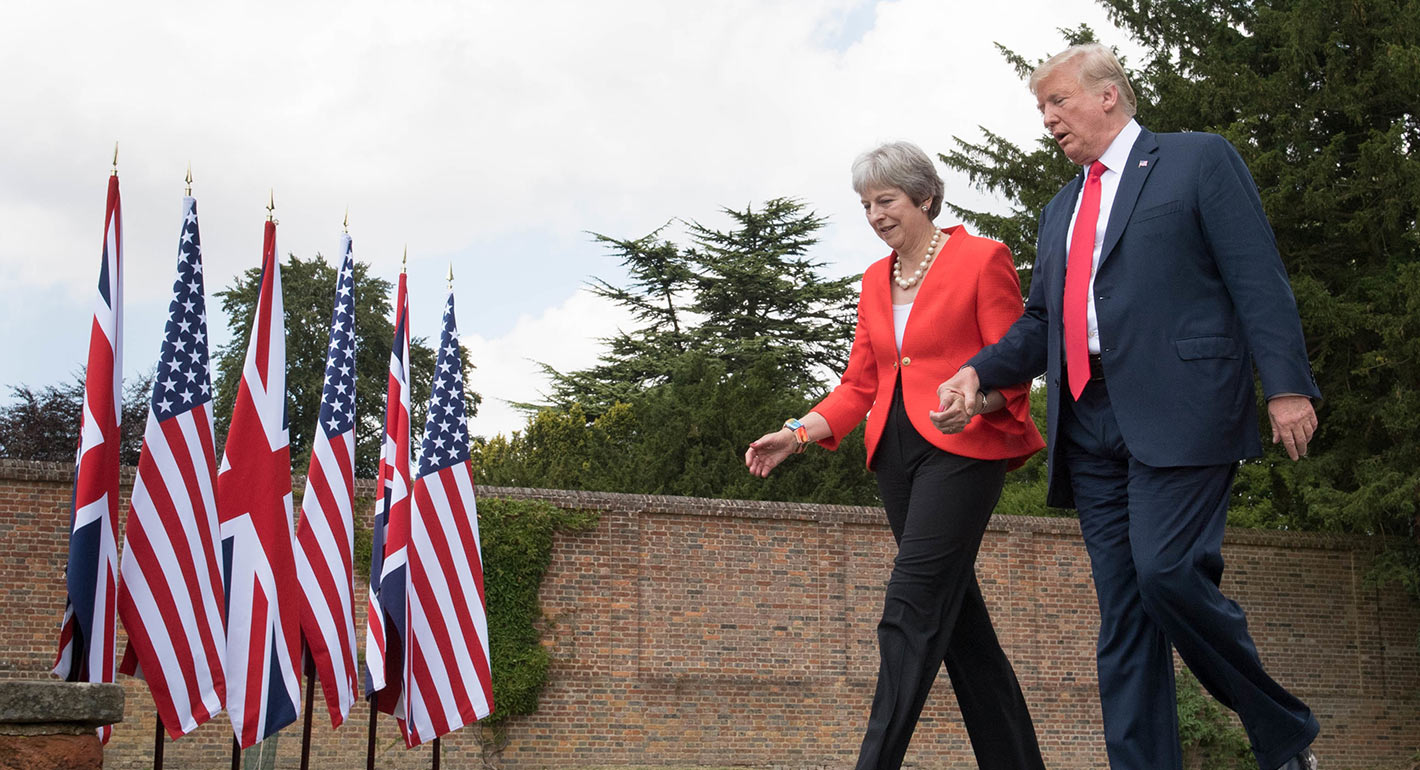
Source: Getty
This year, Trump and his European allies will skirmish over three main bones of contention.
Halfway into President Donald Trump’s first term in office, what was once a warm relationship between transatlantic allies has become deeply strained. 2019 is very likely to see both a continuation of ongoing disagreements and new clashes. Three crucial areas to watch in the U.S.-Europe relationship in the next twelve months are NATO, trade, and multilateralism.
During the first two years of the Trump presidency, European NATO allies have grown used to being repeatedly slammed by the U.S. president for not spending enough on defense. After a raucous NATO summit in Brussels last July, NATO allies have opted to “Trump proof” the alliance’s seventieth anniversary celebrations slated to be held in Washington on April 4, 2019. By excluding heads of government and only extending invitations to foreign ministers, NATO hopes to avoid another disorderly spectacle derailed by Trump’s comments and to project allied unity at a time of rising security challenges in Europe.
Overall U.S. support for deterrence efforts against Russia on the alliance’s eastern flank remains firm. But the recent departure of former secretary of defense James Mattis has unnerved European allies, who viewed him as a steady hand in the U.S. administration and a check against Trump’s isolationist instincts. Mattis’s departure means that Europe will feel more alone than ever against Russia’s attempts to subvert the EU and NATO.
On top of this, Trump’s sudden decision to withdraw U.S. forces from Syria risks leading to further destabilization in the Middle East, with negative spillover effects on European security. European allies worry that Trump may also seek to pull out from Afghanistan, where NATO forces remain. Both Syria and Afghanistan have been major sources of immigration to Europe, adding to the continent’s migration crisis.
During 2018, Trump firmly advanced his economic nationalist agenda. This led to new tariffs against European steel and aluminum producers under section 232 of the 1962 Trade Expansion Act, an obscure national security clause.
However, after several months of informal consultations following an agreement between Trump and European Commission President Jean-Claude Juncker last July, EU and U.S. trade officials will begin formal negotiations over a limited trade agreement in January, with the stated goal of reducing nontariff barriers. However, disagreements over issues such as agricultural market access will remain an obstacle in these talks.
The negotiations could also easily be derailed, should the U.S. administration decide to impose tariffs on European car manufacturers. The U.S. Commerce Department is currently investigating the national security implications of auto imports, and their findings could be used by Trump as justification for introducing such tariffs—something he has repeatedly threatened to do. On top of this, the U.S. administration’s continued emphasis on bilateral trade balances and its repeated threats to impose sanctions on European companies who are part of the Nord Stream 2 pipeline project between Germany and Russia, which could increase European reliance on Russian energy sources, could further upset trade relations with Europe’s top economy, Germany.
Finally, as part of its efforts to put pressure on China, the Trump administration is actively pushing European countries to cease doing business with Chinese technology companies like Huawei, which have been accused of working with the Chinese government and may pose security issues. This could lead to further transatlantic tensions, given that several European countries are already working with or planning to work with Chinese firms to build 5G infrastructure networks.
Two years into Trump’s presidency, a clear rift has emerged between Washington and European capitals over the role of multilateralism. These divisions were starkly illustrated in a speech that Secretary of State Mike Pompeo delivered in Brussels last December, where he criticized multilateral agreements and institutions as being outdated and called for more national sovereignty. In 2019, transatlantic disagreements—over issues like the Paris climate agreements, the Iran nuclear deal and, most recently, the Intermediate-Range Nuclear Forces Treaty—are expected to continue.
Notably, the Trump administration’s efforts to undermine the World Trade Organization (WTO) by blocking the appointment of judges to its appellate court, which handles trade disputes, could culminate in a serious crisis if efforts to reform the body fail. Trump has previously threatened to unilaterally withdraw the United States from the WTO altogether. However, even short of a complete breakdown, the continued erosion of WTO rules will undermine Europe’s desire to maintain a rules-based trading order.
Trump’s skepticism of the EU could also gain force in 2019—especially as the Brexit deadline nears at the end of March. Trump has repeatedly expressed his support for Brexit. He favors a hard Brexit scenario, which he believes would be advantageous to U.S. trade because London would be under pressure to sign an agreement with Washington. Moreover, Trump’s embrace of European populists, such as those in Poland, Hungary, and Italy, continues to be a worrisome trend. The European Parliament elections in May could see a stronger populist footprint in the EU, which would no doubt be welcomed by Trump.

Former Director, Europe Program, Fellow
Erik Brattberg was director of the Europe Program and a fellow at the Carnegie Endowment for International Peace in Washington. He is an expert on European politics and security and transatlantic relations.
Recent Work



Cornelius Adebahr, Dan Baer, Rosa Balfour, …

Erik Brattberg, Philippe Le Corre, Paul Stronski, …
Carnegie India does not take institutional positions on public policy issues; the views represented herein are those of the author(s) and do not necessarily reflect the views of Carnegie, its staff, or its trustees.

In any defense establishment, change is an ongoing process. However, despite the best of intentions, existing bureaucracies, bound by habit and years of socialization, have their limits in implementing transformative change.

Anit Mukherjee

How is AI reshaping space security, creating governance challenges, and where does international diplomacy stand today?


Tejas Bharadwaj, Almudena Azcárate Ortega

After the chill in ties between 2020 and 2024 that brought India–China relations to their lowest point in several decades, the two countries have engaged each other afresh. This paper argues that there are predominantly four imperatives guiding India’s approach to China, and they exist in an order of priority.

Saheb Singh Chadha

This piece argues that India’s central challenge is not managing a single flashpoint but resolving the underlying tension between expansion and institutional coherency of the BRICS grouping.

Vrinda Sahai

A partnership between India, a country of subcontinental size, and Africa, a continent of fifty-four countries, may seem asymmetric until one notes that both are home to nearly the same number of people—1.4 billion. This essay spells out the existing challenges to the partnership, its optimal potential, and the possible pathways to realize it over the next quarter-century.

Rajiv Bhatia