
• Research
  • About
  • Experts
Carnegie India logoCarnegie lettermark logo
AI
{
  "authors": [
    "Kathryn Botto"
  ],
  "type": "other",
  "centerAffiliationAll": "dc",
  "centers": [
    "Carnegie Endowment for International Peace"
  ],
  "collections": [],
  "englishNewsletterAll": "asia",
  "nonEnglishNewsletterAll": "",
  "primaryCenter": "Carnegie Endowment for International Peace",
  "programAffiliation": "AP",
  "programs": [
    "Asia"
  ],
  "projects": [],
  "regions": [
    "East Asia",
    "South Korea"
  ],
  "topics": [
    "Political Reform",
    "Security",
    "Foreign Policy"
  ]
}

Source: Getty

Other

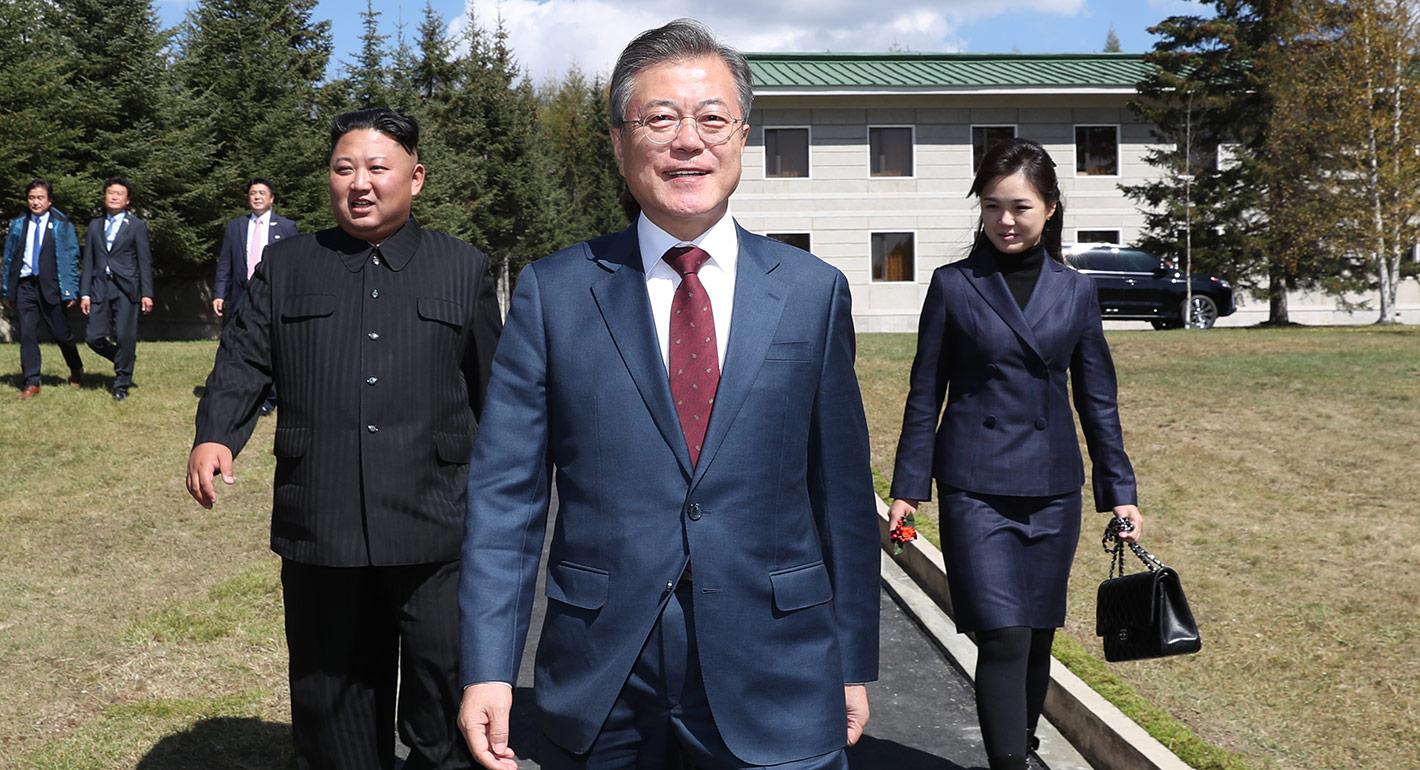
Moon Jae-in: Putting North Korea at the Center

It is impossible to divorce the U.S.-South Korean alliance and inter-Korean issues, or to separate them from the overall context of international relations not only in Northeast Asia, but also in the global arena.

Link Copied
By Kathryn Botto
Published on Jun 24, 2020

Source: Korea Economic Institute of America

While President Moon Jae-in has a calmer demeanor than his mentor and friend, former President Roh Moo-hyun, there can be no doubt that his vision for transforming Northeast Asia is as far-reaching. While Moon has been more careful to assuage the U.S. president, less abrasive in his language toward Japan, and more strategic in reaching out to leaders in China and Russia, his strategy of putting North Korea at the forefront of regional realignment has similar geopolitical ambition. The objective is the rejuvenation of a reintegrated peninsula with the capacity to steer actions by all of the great powers rather than falling prey again to their machinations that are not in Korea’s interest.

During his presidential election campaign, candidate Moon remarked of his life-long friend, Roh Moo-hyun: “If I take the office, I’ll tell him at his memorial service, ‘Now you rest in peace. I’ll realize your unachieved dreams.’” Though Moon served as a top aide in the Roh administration, he saw himself as ultimately returning to a career in law. But Roh’s tragic suicide galvanized Moon to enter electoral politics for the first time and win a seat in the National Assembly. It was fitting, then, that when Moon gave his first speech on his vision for inter-Korean relations at the Körber Foundation on July 6, 2017 he characterized himself as “inheriting” the engagement policy of his progressive predecessors Roh and Kim Dae-jung.

Read Full Text

This article was originally published by the Korea Economic Institute of America.

About the Author

Kathryn Botto

Former Senior Research Analyst, Asia Program

Kathryn Botto was a senior research analyst in the Asia Program at the Carnegie Endowment for International Peace. Her research focuses on Asian security issues, with particular emphasis on the Korean Peninsula and U.S. defense policy towards East Asia.

Kathryn Botto
Former Senior Research Analyst, Asia Program
Political ReformSecurityForeign PolicyEast AsiaSouth Korea

Carnegie India does not take institutional positions on public policy issues; the views represented herein are those of the author(s) and do not necessarily reflect the views of Carnegie, its staff, or its trustees.

More Work from Carnegie India

  • Commentary
    The Impact of U.S. Sanctions and Tariffs on India’s Russian Oil Imports

    This piece examines India’s response to U.S. sanctions and tariffs, specifically assessing the immediate market consequences, such as alterations in import costs, and the broader strategic implications for India’s energy security and foreign policy orientation.

      Vrinda Sahai

  • Article
    Military Lessons from Operation Sindoor

    The India-Pakistan conflict that played out between May 6 and May 10, 2025, offers several military lessons. This article presents key takeaways from Operation Sindoor and breaks down how India’s preparations shaped the outcome and what more is needed to strengthen future readiness.

      Dinakar Peri

  • Book
    India and the Sovereignty Principle: The Disaggregation Imperative

    This book offers a comprehensive analysis of India's evolving relationship with sovereignty in a complex global order. Moving beyond conventional narratives, it examines how the sovereignty principle shapes India's behavior across four critical domains—from traditional military power to contemporary data governance.

      Rudra Chaudhuri, Nabarun Roy

  • Commentary
    NISAR Soars While India-U.S. Tariff Tensions Simmer

    On July 30, 2025, the United States announced 25 percent tariffs on Indian goods. While diplomatic tensions simmered on the trade front, a cosmic calm prevailed at the Sriharikota launch range. Officials from NASA and ISRO were preparing to launch an engineering marvel into space—the NASA-ISRO Synthetic Aperture Radar (NISAR), marking a significant milestone in the India-U.S. bilateral partnership.

      Tejas Bharadwaj

  • Article
    Hidden Tides: IUU Fishing and Regional Security Dynamics for India

    This article examines the scale and impact of Chinese IUU fishing operations globally and identifies the nature of the challenge posed by IUU fishing in the Indian Ocean Region (IOR). It also investigates why existing maritime law and international frameworks have struggled to address this growing threat.

      Ajay Kumar, Charukeshi Bhatt

Get more news and analysis from
Carnegie India
Carnegie India logo, white
Unit C-4, 5, 6, EdenparkShaheed Jeet Singh MargNew Delhi – 110016, IndiaPhone: 011-40078687
  • Research
  • About
  • Experts
  • Projects
  • Events
  • Contact
  • Careers
  • Privacy
  • For Media
Get more news and analysis from
Carnegie India
© 2026 Carnegie Endowment for International Peace. All rights reserved.





