
• Research
  • About
  • Experts
Carnegie India logoCarnegie lettermark logo
AI
{
  "authors": [
    "Philippe Le Corre",
    "John Ferguson"
  ],
  "type": "legacyinthemedia",
  "centerAffiliationAll": "dc",
  "centers": [
    "Carnegie Endowment for International Peace"
  ],
  "collections": [],
  "englishNewsletterAll": "ctw",
  "nonEnglishNewsletterAll": "",
  "primaryCenter": "Carnegie Endowment for International Peace",
  "programAffiliation": "EP",
  "programs": [
    "Europe"
  ],
  "projects": [],
  "regions": [
    "East Asia",
    "China",
    "Western Europe",
    "France",
    "Germany",
    "Iran"
  ],
  "topics": [
    "Political Reform",
    "Foreign Policy"
  ]
}

Source: Getty

In The Media

China’s Diplomatic Duo Fails to Engineer a Successful Summit with Europe

The meeting—although depicted as a decisive diplomatic victory by Chinese state media—was especially disappointing to Chinese leadership considering they were trying to accomplish larger geostrategic goals. One was to prevent the creation of a united transatlantic front against China.

Link Copied
By Philippe Le Corre and John Ferguson
Published on Sep 21, 2020

Source: National Interest

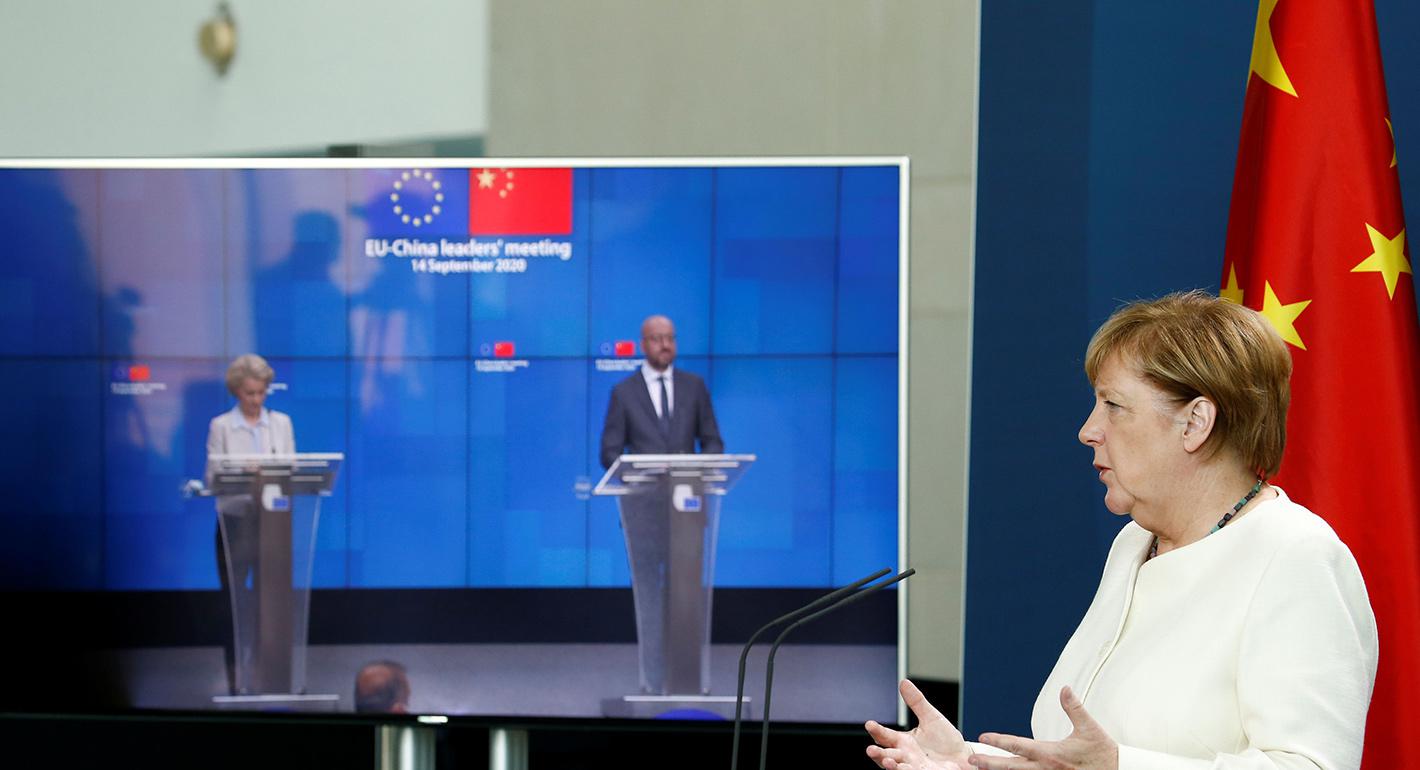
While China had declared 2020 a critical year for relations with Europe, the EU-China virtual summit which took place on September 14 between Chinese president Xi Jinping and EU leaders German Chancellor Angela Merkel, European Council head Charles Michel, and Commission President Ursula von der Leyen fell short of expectations. Some Europeans were optimistically hoping to conclude the negotiations on the long-awaited Common Agreement on Investment, which have now dragged into their seventh year. Others in Brussels were relieved that the summit didn’t take place in Leipzig in the presence of the twenty-eight leaders (twenty-seven EU countries and China) as was originally planned by Germany, the holder of the six-month rotating presidency. In the end, despite statements about what has been achieved in the meeting by European leaders—addressing Chinese state aid and addressing technology transfers from Europe to China—the actual outcome had little substance. In particular, China did not agree on economic reciprocity—the primary demand from the European side.

The meeting—although depicted as a decisive diplomatic victory by Chinese state media—was especially disappointing to Chinese leadership considering they were trying to accomplish larger geostrategic goals. One was to prevent the creation of a united transatlantic front against China, spurred on by recent visits to Western and Central Europe by U.S. Secretary of State Mike Pompeo and National Security Adviser Robert O’Brien. Rejecting any kind of strategic alignment either in the direction of the United States or China, President Charles Michel told reporters afterward “Europe is a player, not a playing field.” The second broad Chinese goal was to reassure Europeans after souring relations this year after coronavirus. Still reeling from the pandemic, the accompanying economic recession, and now—what many perceive to be an opportunistic expansion of Chinese aggression—Europe has recently channeled pain and anger into pushback on contentious foreign policy issues against China, mainly on Huawei (5G) and Hong Kong, but also on the treatment by the PRC of the Uighur minority in Xinjiang.

Read the Full Text

This article was originally published by the National Interest.

About the Authors

Philippe Le Corre

Former Nonresident Senior Fellow, Europe Program

Philippe Le Corre was a nonresident senior fellow in the Europe Program at the Carnegie Endowment for International Peace.

John Ferguson

John Ferguson is a research assistant at the Harvard Kennedy School’s M-RCBG.

Authors

Philippe Le Corre
Former Nonresident Senior Fellow, Europe Program
John Ferguson

John Ferguson is a research assistant at the Harvard Kennedy School’s M-RCBG.

Political ReformForeign PolicyEast AsiaChinaWestern EuropeFranceGermanyIran

Carnegie India does not take institutional positions on public policy issues; the views represented herein are those of the author(s) and do not necessarily reflect the views of Carnegie, its staff, or its trustees.

More Work from Carnegie India

  • Commentary
    The Impact of U.S. Sanctions and Tariffs on India’s Russian Oil Imports

    This piece examines India’s response to U.S. sanctions and tariffs, specifically assessing the immediate market consequences, such as alterations in import costs, and the broader strategic implications for India’s energy security and foreign policy orientation.

      Vrinda Sahai

  • Paper
    India-China Economic Ties: Determinants and Possibilities

    This paper examines the evolution of India-China economic ties from 2005 to 2025. It explores the impact of global events, bilateral political ties, and domestic policies on distinct spheres of the economic relationship.

      Santosh Pai

  • Commentary
    NISAR Soars While India-U.S. Tariff Tensions Simmer

    On July 30, 2025, the United States announced 25 percent tariffs on Indian goods. While diplomatic tensions simmered on the trade front, a cosmic calm prevailed at the Sriharikota launch range. Officials from NASA and ISRO were preparing to launch an engineering marvel into space—the NASA-ISRO Synthetic Aperture Radar (NISAR), marking a significant milestone in the India-U.S. bilateral partnership.

      Tejas Bharadwaj

  • Article
    Hidden Tides: IUU Fishing and Regional Security Dynamics for India

    This article examines the scale and impact of Chinese IUU fishing operations globally and identifies the nature of the challenge posed by IUU fishing in the Indian Ocean Region (IOR). It also investigates why existing maritime law and international frameworks have struggled to address this growing threat.

      Ajay Kumar, Charukeshi Bhatt

  • Commentary
    Indian Airstrikes in Pakistan: May 7, 2025

    On May 7, 2025, between 1:05 and 1:30 a.m. (IST), airstrikes carried out by the Indian Air Force hit nine locations inside Pakistan and Pakistan occupied Kashmir (PoK). It was codenamed Operation Sindoor.

      Rudra Chaudhuri

Get more news and analysis from
Carnegie India
Carnegie India logo, white
Unit C-4, 5, 6, EdenparkShaheed Jeet Singh MargNew Delhi – 110016, IndiaPhone: 011-40078687
  • Research
  • About
  • Experts
  • Projects
  • Events
  • Contact
  • Careers
  • Privacy
  • For Media
Get more news and analysis from
Carnegie India
© 2026 Carnegie Endowment for International Peace. All rights reserved.