

Commentary
Andrei Kolesnikov
{
  "authors": [
    "Andrei Kolesnikov"
  ],
  "type": "legacyinthemedia",
  "centerAffiliationAll": "",
  "centers": [
    "Carnegie Endowment for International Peace",
    "Carnegie Russia Eurasia Center"
  ],
  "collections": [],
  "englishNewsletterAll": "",
  "nonEnglishNewsletterAll": "",
  "primaryCenter": "Carnegie Endowment for International Peace",
  "programAffiliation": "",
  "programs": [],
  "projects": [],
  "regions": [
    "Russia"
  ],
  "topics": [
    "Political Reform"
  ]
}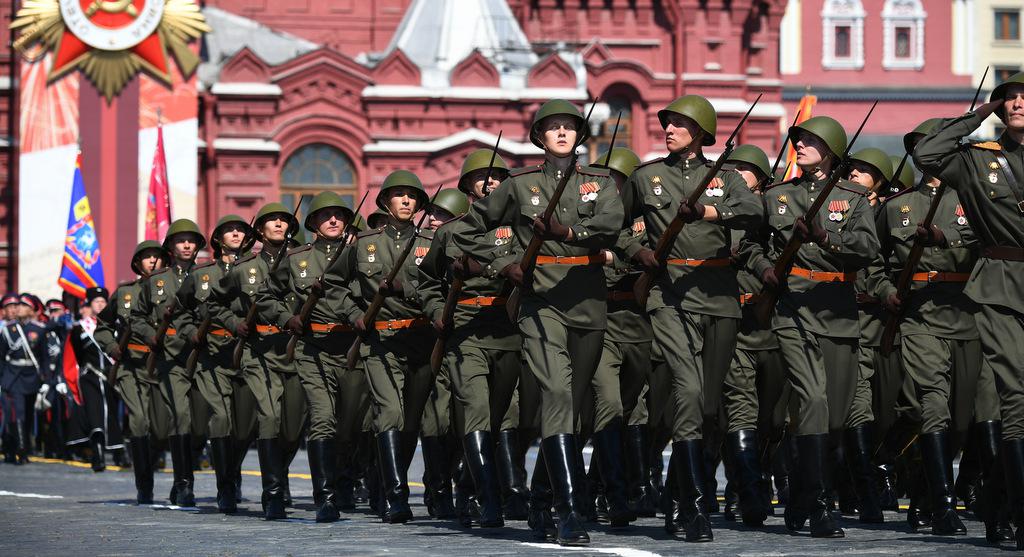
Source: Getty
Russia needs to restore, rather than erase, the memory of the millions of victims of totalitarianism and cease putting it in competition with the memory of those who fell in battle in World War II.
Source: Foreign Affairs
To mark the first day back at school on September 1, Russian schoolchildren received an online lesson from none other than President Vladimir Putin. He chose the subject of history, which has in recent years become close to his heart. His specific focus was a topic he has been talking about obsessively for almost a year now: the rewriting of Russian history, in particular that of World War II.
Putin is primarily concerned with two issues. One is the Molotov-Ribbentrop Pact between the Third Reich and the Soviet Union, which Western historians have long believed “paved the way for the outbreak of the Second World War.” Putin holds that Stalin had no choice but to sign the pact with Germany. The other is the decisive role that the Soviet Union played in defeating the Nazis, which Putin believes other nations fail adequately to recognize.
If these were the views of a private individual, others could simply agree or disagree with them. But when a head of state presses them repeatedly, they become national ideological dogma. So far as the security services of an authoritarian state are concerned, they are nothing short of a call for action.
“People who cooperate with the enemy during a war are called and have always and everywhere been called collaborationists. Those who agree with the rewriters of history can easily be called the collaborationists of today,” Putin said during the public lesson on September 1. And sure enough, Russia’s Investigative Committee, a federal body with far-reaching powers, took no time at all in establishing a new department to investigate crimes related to the rehabilitation of Nazism and the falsification of history. The hunt for historical “collaborationists” is on.
Under Russian law, the rehabilitation of Nazism is a crime. But what criteria investigative bodies will use to assess the “rewriting of history,” and how they will punish those found guilty of it, remains unclear. Alexander Bastrykin, the head of the Investigative Committee and a friend of Putin’s from his St. Petersburg days, has defined such infractions as “attempts to put equal responsibility for the outbreak of war on Nazi criminals and on the Allied countries,” such as the Soviet Union.
By criminalizing certain interpretations of history, Putin is taking aim less at the West than at domestic figures, who, faced with the threat of prosecution, will hesitate to digress from the official narrative of the pre–World War II Soviet Union, for example. Similarly, when the committee opens criminal investigations into events abroad—as it did in the Czech Republic in April, when municipal authorities in Prague removed the city’s monument to the Soviet war hero Marshal Ivan Konev—the message to ordinary Russians is the real object. Look how little they like us in the West: they defile the memory of our victory and our heroes.
By creating a new department to avenge history in this manner, the Kremlin risks criminalizing the work of professional historians. There were already incidents shading in that direction: in 2018, the Ministry of Justice classified as extremist an article by the historian Kirill Alexandrov about the Ukrainian nationalist leader Stepan Bandera, despite the fact that the article made no attempt to justify Bandera’s actions during World War II. Alexandrov was to receive a doctoral degree in 2017, but the Ministry of Education and Science withheld it on political grounds: he had written his dissertation about soldiers who joined a collaborationist unit during World War II.
Anything and everything to do with the Great Patriotic War, as Russians refer to World War II, is extremely sensitive for the Russian leadership. The memory of victory in that war is one of the few remaining bonds to hold the Russian nation together and legitimize the Putin regime as the heir to great triumphant ancestors. Putin has gone so far as to enshrine his fight against the falsification of history in the constitution by passing amendments to that effect this summer (alongside his better-known move to reset the clock on presidential terms, allowing himself to stay in power beyond 2024).
The trouble with this new official historical discourse is that it implicitly vindicates Stalin and Stalinism. To criticize Putin’s version of history is to criticize the sacred memory of the war, and to criticize Stalin is to detract from public appreciation of Russia’s victory in that war. This paradigm is precisely the one on which the Soviet regime under Leonid Brezhnev built its official propaganda. Stirring up unpleasantness around repression under Stalin was the dirty business of dissidents: Stalin was above all to be remembered as the leader who won the war.
The revival of this narrative has already begun to expunge important chapters of Russian history from public discussion. Scholars, writers, and the public no longer explore the Winter War that Stalin unleashed against Finland in 1939. They don’t consider Stalin’s shameless cooperation with Hitler, which included holding joint parades and handing over German antifascists to the Nazis. They can’t talk about details of the occupation of the Baltic states or the invasion of Poland in accordance with the secret protocols to the Molotov-Ribbentrop Pact and under the pretext of liberating Ukrainian and Belarusian “brothers” there.
There will likely be little further scholarship on the Soviet secret police’s shooting of more than 20,000 Polish officers in Katyn in 1940. Earlier propaganda had suggested that it was the Germans who executed the Poles in Katyn. Putin himself once debunked that notion. But now the idea has resurfaced in an article that the official state agency, RIA Novosti, published in March. Moreover, this spring, the prosecutor’s office in Tver ordered the removal of memorial plaques from a building in whose basement Stalin’s death squads had executed more than 6,000 Poles.
The atmosphere in today’s Russia encourages the vindication of Stalinism and its atrocities. By simplifying and mythologizing history, the Russian president is encouraging the deterioration of public knowledge of historical events. Historical discourse that was once marginal is becoming mainstream, with the state’s endorsement. Those who commemorate the victims of repression face official persecution. The historian Yury Dmitriev, for example, discovered a mass grave of victims of political repression in Karelia, in northern Russia. This summer he was sentenced to three and a half years’ imprisonment for pedophilia—a charge widely believed to be a vengeful fabrication. The prosecutor’s office appealed the sentence as too lenient, and the Karelian Supreme Court added another nine and a half years. The Ministry of Justice has labeled Memorial, a nongovernmental organization that for several decades has heroically and painstakingly pieced together Stalin-era crimes, as a “foreign agent,” and one court after another has ravaged it with fines. Such is the context in which the Investigative Committee intends to punish people for “knowingly spreading false information about the deeds of the U.S.S.R.”
While Russia’s Investigative Committee was thinking up new ways to combat historical dissidence, parliamentarians in Spain began debate over a new draft law on “democratic memory.” The Spanish law, which has come under fierce criticism, includes “a plan to recover the remains of victims of the civil war and setting up a special prosecutor to investigate human-rights abuses from 1936 to 1978.”
If and when Russia transitions from Putin’s authoritarianism to democracy, it should look to Spain’s example. Russia needs to restore, rather than erase, the memory of the millions of victims of totalitarianism and cease putting it in competition with the memory of those who fell in battle in World War II. Promoting that false opposition is a deliberate tactic to deepen the national divide.
Former Senior Fellow, Carnegie Russia Eurasia Center
Kolesnikov was a senior fellow at the Carnegie Russia Eurasia Center.
Recent Work
Andrei Kolesnikov
Andrei Kolesnikov
Carnegie India does not take institutional positions on public policy issues; the views represented herein are those of the author(s) and do not necessarily reflect the views of Carnegie, its staff, or its trustees.
As India’s economy recovers from the coronavirus pandemic, Indian businesses need efficient financial structures to regain their ground. Key reforms to India’s Insolvency and Bankruptcy Code could fill these gaps.

Anirudh Burman
Access to cross-border data is an integral piece of the law enforcement puzzle. India is well placed to lead the discussions on international data agreements subject to undertaking necessary surveillance reforms.

Smriti Parsheera, Prateek Jha
After the coronavirus pandemic wanes, how will China’s reorientation of the Belt and Road Initiative to address global health concerns influence its relationships with South Asian countries?
Deep Pal, Rahul Bhatia
Early in the outbreak, government researchers forecast several high-risk scenarios that were downplayed or ignored in public messaging.
Gautam I. Menon
Governments around the world are turning to new forms of digital surveillance to monitor the spread of the coronavirus, though they are mostly using existing laws to do so.
Anirudh Burman