

Q&A
Darshana M. Baruah, Satyendra Prasad, Denghua Zhang
{
  "authors": [
    "Darshana M. Baruah"
  ],
  "type": "commentary",
  "centerAffiliationAll": "dc",
  "centers": [
    "Carnegie Endowment for International Peace"
  ],
  "collections": [],
  "englishNewsletterAll": "ctw",
  "nonEnglishNewsletterAll": "",
  "primaryCenter": "Carnegie Endowment for International Peace",
  "programAffiliation": "SAP",
  "programs": [
    "South Asia"
  ],
  "projects": [
    "Indian Ocean Initiative"
  ],
  "regions": [
    "United States",
    "China"
  ],
  "topics": [
    "Economy",
    "Climate Change",
    "Security"
  ]
}
Source: Getty
While Washington and Beijing focus on defense and security-related issues, the islands are demanding action on climate change.
For more on this subject, join Ocean Nations: An Indo-Pacific Island Dialogue on September 18–19, 2022.
“We are not threatened by geopolitical competition,” Fiji’s defense minister, Inia Seruiratu, told the audience at the Shangri-La Dialogue in Singapore in June. “In our blue Pacific continent, machine guns, fighter jets, grey ships, and green battalions are not our primary security concerns. The single greatest threat to our very existence is climate change.”
Seruiratu took the stage to share a perspective on security challenges and defense priorities that differed greatly from his counterparts around the world. While the United States, China, and others identified each other as strategic threats and destabilizing actors to regional stability, Seruiratu underlined the contradiction between small islands and bigger powers on the definition of security, which he noted is now “broader than many of us have traditionally defined.”
This contradiction is at the heart of the increasingly mismatched policy approaches toward island nations, as geopolitical competition over influence and access to island shores skyrockets. In the past few months, the Pacific islands have seen a flurry of attention and official visits—such those from Australia’s new foreign minister, Penny Wong, and U.S. Deputy Secretary of State Wendy Sherman—and the first ever U.S.-Pacific Island Country Summit scheduled for September 28–29. But as this competition increases, so must the major powers’ focus on the issues most important to islands—and the concept of security, as discussed in strategy and policy circles, must now include climate change to better reflect the geopolitical conversations occurring on the ground in island nations.
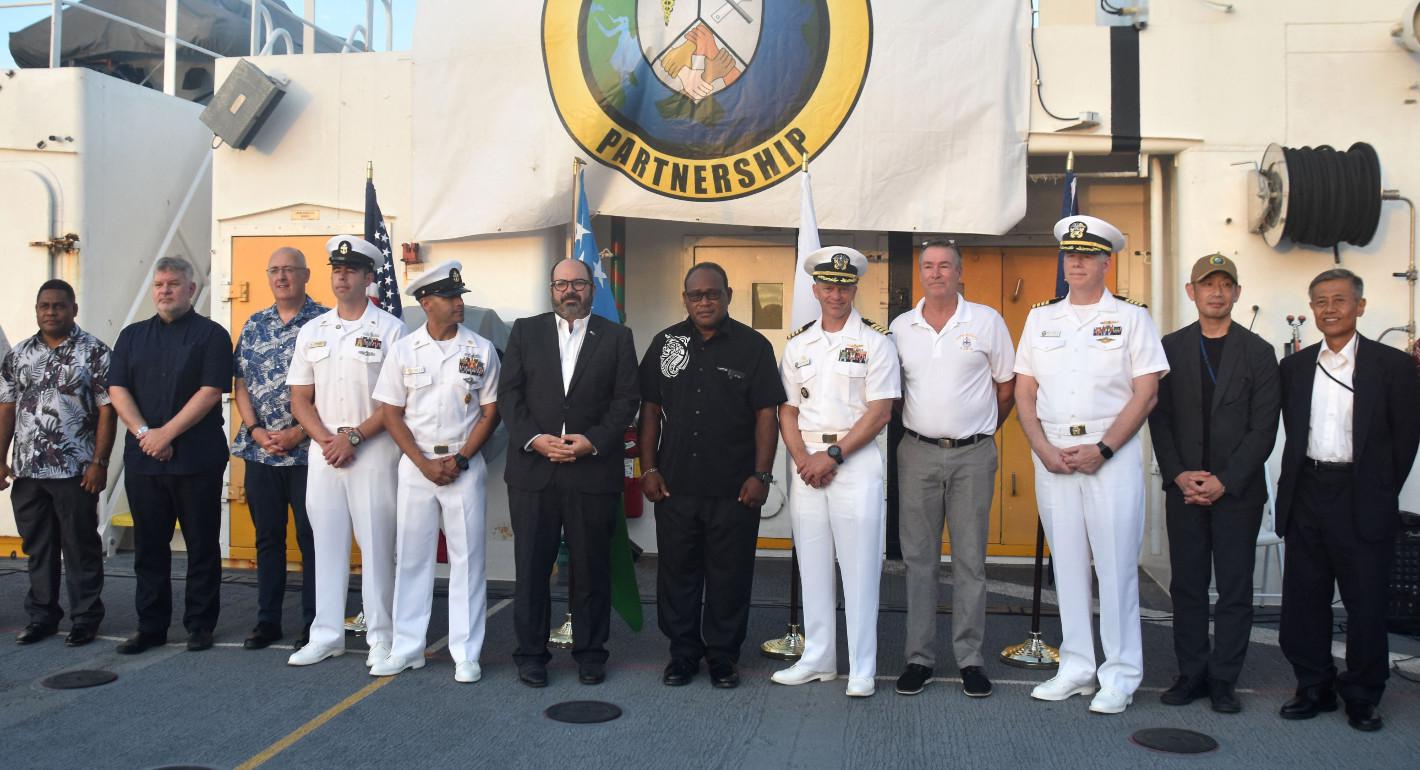
There is no denying the China factor in the growing interest in the Pacific islands. (This is also true for the islands in the Indian Ocean.) In April, Solomon Islands announced a new security agreement with China. The five-year pact allows Honiara to request Chinese police and armed forces to maintain social order, protect lives and property, and provide humanitarian assistance. China will also have the opportunity to make ship visits, carry out logistical replenishments, and have maritime stopovers and transitions across the Solomon Islands.
The deal drew sharp reactions from the United States, Australia, and others across the region, and the government in Canberra was criticized for being caught off guard. The arrival of Kurt Campbell, the U.S. Indo-Pacific coordinator, in Honiara after reports of the agreement reflects the deep discomfort within Washington. The United States considers the islands—and region—critical, but it has sidelined both for decades, and Campbell’s visit is a reflection of growing competition between Washington and Beijing as well as the impact of island agency on bigger powers across the region.
Islands historically have been critical to bigger powers’ regional ambitions and to establishing naval dominance across vast oceans. During the colonial period, overseas bases on strategically located islands were a critical aspect of projecting naval power and securing energy, economic, political, and strategic interests. But the end of the Cold War and a series of developments in the Middle East and Afghanistan pushed the geopolitics of the maritime domain to the periphery. The lack of a direct competition against Washington in both the Indian and the Pacific oceans also led to strategic inertia in maritime geopolitics. The emergence of China and its global ambitions have brought the maritime domain back into focus. This is also why reports of possible Chinese military bases, whether in Sri Lanka or Solomon Islands, makes governments across the Indo-Pacific nervous and uncomfortable.
But this time, the rules of the game are different: the islands are equipped with their priorities and a credible alternative in Beijing to turn to. And as the United States and China compete over critical sea routes and islands, the two powers should quickly realize the different conversations on the ground. While Washington and Beijing focus on defense and security-related issues, the islands and littorals are demanding action on climate change. As the two powers jostle to win favors or deny influence, climate change will become the central issue for competition. It is the core challenge and concern faced by the island nations.
Island nations should seize the moment to maximize this competition in favor of climate-related incentives. In China, the United States faces a credible player with resources capable of establishing facilities and widening its influence in areas critical to its national interests. Beijing has also been more present in the region in the last decades, from building a hospital in Papua New Guinea to dormitories for Solomon Islands National University to parks and roads across the region. In contrast, Antony Blinken’s visit to Fiji in February was the first in thirty-seven years from a U.S. secretary of state, and the U.S. closed its Solomon Islands embassy in 1993 (although it now plans to reopen it). China has an embassy on the islands and has maintained regular senior officials visits across the region.
This makes the attention on the islands a new phenomenon in foreign policy engagements, and it could force the major powers to address island concerns—primarily related to climate—in new ways. For instance, Vanuatu’s ambitious climate plan—which includes generating 100 percent of its electricity from renewables by 2030—could push major powers to act, via their own targets or through compensation for climate-related damages. Another step could be to restudy island and maritime dynamics through the lens of island agency and the twenty-first century. Washington and its partners will have to find enduring policy shifts in its engagements, collaboration, and conversations with island nations in a new geopolitical climate.
Island nations have been voicing their concerns and challenges for decades, but they’ve largely gone unheeded. The United States and its allies should not only to listen to those concerns but also understand the agency islands carry and the consequences of the shifting dynamics in the maritime domain—in stark contrast to the previous century. By overhauling its regional policy, Washington would assure the islands that their concerns will remain a priority long after the news cycle has moved on.
Thanks to Nitya Labh for her research assistance for this piece.

Former Nonresident Scholar, South Asia Program
Darshana M. Baruah was a nonresident scholar with the South Asia Program at the Carnegie Endowment for International Peace where she directs the Indian Ocean Initiative.
Recent Work

Darshana M. Baruah, Satyendra Prasad, Denghua Zhang
Darshana M. Baruah
Carnegie India does not take institutional positions on public policy issues; the views represented herein are those of the author(s) and do not necessarily reflect the views of Carnegie, its staff, or its trustees.

In any defense establishment, change is an ongoing process. However, despite the best of intentions, existing bureaucracies, bound by habit and years of socialization, have their limits in implementing transformative change.

Anit Mukherjee

How is AI reshaping space security, creating governance challenges, and where does international diplomacy stand today?


Tejas Bharadwaj, Almudena Azcárate Ortega

After the chill in ties between 2020 and 2024 that brought India–China relations to their lowest point in several decades, the two countries have engaged each other afresh. This paper argues that there are predominantly four imperatives guiding India’s approach to China, and they exist in an order of priority.

Saheb Singh Chadha

This piece argues that India’s central challenge is not managing a single flashpoint but resolving the underlying tension between expansion and institutional coherency of the BRICS grouping.

Vrinda Sahai

The U.S.–India semiconductor cooperation story is well-stocked with top-level strategic intent. What remains unresolved, however, are some underlying challenges that will determine whether the cooperation actually functions. Three such friction points stand out.

Shruti Mittal