


This piece argues that India’s central challenge is not managing a single flashpoint but resolving the underlying tension between expansion and institutional coherency of the BRICS grouping.
Vrinda Sahai
{
"authors": [
"Cornelius Adebahr",
"Barbara Mittelhammer"
],
"type": "other",
"centerAffiliationAll": "dc",
"centers": [
"Carnegie Endowment for International Peace",
"Carnegie Europe"
],
"collections": [
"Europe’s Southern Neighborhood"
],
"englishNewsletterAll": "ctw",
"nonEnglishNewsletterAll": "",
"primaryCenter": "Carnegie Europe",
"programAffiliation": "EP",
"programs": [
"Europe"
],
"projects": [],
"regions": [
"Middle East",
"Iran",
"Western Europe"
],
"topics": [
"Foreign Policy",
"EU",
"Political Reform",
"EU Foreign Policy"
]
}Source: Getty
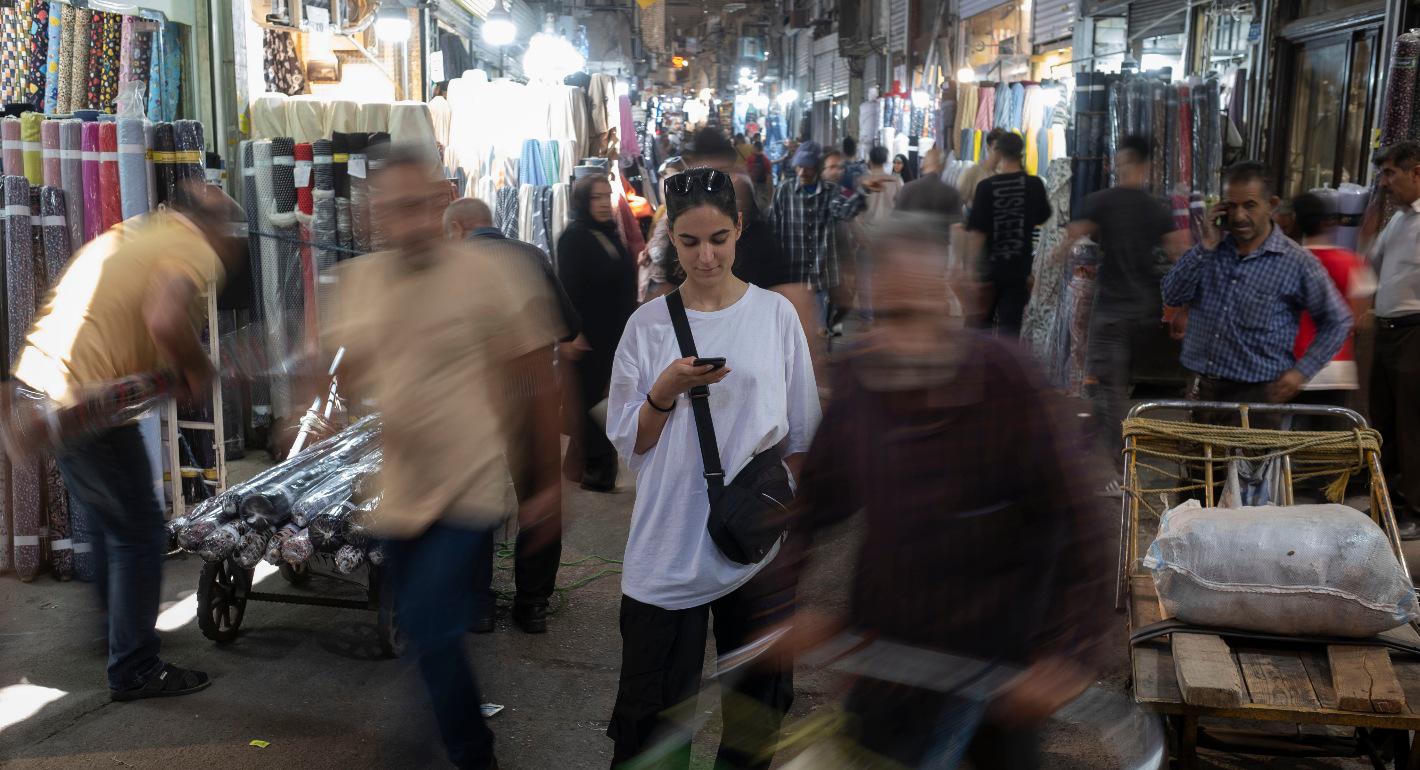
Iran’s regime is using digital repression to control the country’s citizens and further isolate them from the world. The EU should ensure safe online spaces for Iranian activists and tie its Iran policy into a comprehensive global strategy against digital authoritarianism.
Cracking down on internet access and digital rights has been an integral part of the Iranian regime’s violent repression of the Woman, Life, Freedom movement. Since fall 2022, regular internet shutdowns have become a new normal; in Sistan and Baluchestan Province, they have occurred every single Friday for fourteen consecutive months. This clampdown is part of a much larger pattern under which the Iranian authorities have worked toward a national information network by centralizing Iran’s internet infrastructure over the past two decades.
Beyond impediments like surveillance, the throttling of bandwidth to inhibit traffic, the censorship of web pages or services, and occasional complete shutdowns of mobile data or the internet, the state’s monopolization of internet infrastructure has led to the digital isolation of Iranians and near-total governmental control. These measures severely infringe Iranians’ human rights, inhibiting them from communicating and interacting socially, politically, and economically with each other and with the international community. In response, the EU’s strategic interest lies in mitigating censorship and enabling access to information, especially for civil society.
Digital repression by the Iranian authorities goes far beyond the infringement of internet access and individual rights. Instead, the regime is pursuing a strategic plan to advance and continue its digital repression and control to further isolate the country’s citizens from the world. So far, the EU’s response has not been commensurate with the scope of such actions and the urgency of their implications—even though it is in the union’s interest both to realize Iranians’ digital rights and to prevent authoritarian regimes worldwide from strengthening their repressive capacities.
Barbara Mittelhammer is an independent political analyst and consultant. Her research focuses on human security, gender in peace and security, feminist foreign policy, and the role of civil society in foreign policy making.
Former Nonresident Fellow, Carnegie Europe
Cornelius Adebahr was a nonresident fellow at Carnegie Europe. His research focuses on foreign and security policy, in particular regarding Iran and the Persian Gulf, on European and transatlantic affairs, and on citizens’ engagement.
Barbara Mittelhammer
Barbara Mittelhammer is an independent political analyst and consultant. Her research focuses on human security, gender in peace and security, feminist foreign policy, and the role of civil society in foreign policy making.
Carnegie India does not take institutional positions on public policy issues; the views represented herein are those of the author(s) and do not necessarily reflect the views of Carnegie, its staff, or its trustees.
This piece argues that India’s central challenge is not managing a single flashpoint but resolving the underlying tension between expansion and institutional coherency of the BRICS grouping.
Vrinda Sahai
A partnership between India, a country of subcontinental size, and Africa, a continent of fifty-four countries, may seem asymmetric until one notes that both are home to nearly the same number of people—1.4 billion. This essay spells out the existing challenges to the partnership, its optimal potential, and the possible pathways to realize it over the next quarter-century.
Rajiv Bhatia
The India–EU Free Trade Agreement (FTA) is shaping up to be one of the most consequential trade negotiations, both economically and strategically. But, what’s in the agreement, what’s missing, and what will determine its success in the years ahead
Vrinda Sahai, Nicolas Köhler-Suzuki
Trump 2.0 has unsettled India’s external environment—but has not overturned its foreign policy strategy, which continues to rely on diversification, hedging, and calibrated partnerships across a fractured order.
Milan Vaishnav, ed., Sameer Lalwani, Tanvi Madan, …
This piece examines India’s response to U.S. sanctions and tariffs, specifically assessing the immediate market consequences, such as alterations in import costs, and the broader strategic implications for India’s energy security and foreign policy orientation.
Vrinda Sahai







