Rapprochement or Rivalry? Russia-China Relations in a Changing Asia
U.S., Russian, and Chinese scholars analyze the most important issues posed by the relationship between China and Russia, and weigh the prospects for real cooperation between Russia, a severely weakened power, and China, a power on the rise.
The emerging relationship between China and Russia is perhaps the most important force redefining international relations in post-Cold War Asia. In recent years, Russia and China have built a strategic partnership aimed at the 21st century—a development that deeply worries some Western observers and puzzles others.
In this first comprehensive study of Russian-Chinese relations, Sherman Garnett and a team of fifteen U.S., Russian, and Chinese scholars analyze the most important issues posed by the relationship, including: cross-border trade, the impact of Russia’s center-periphery politics, migration, arms sales, and (mis)perceptions of one another. The book assesses what will be one of the most important relationships, economically and strategically, in the dynamic region stretching from Central Asia to the Far East. It also weighs the prospects for real cooperation between Russia, a severely weakened power, and China, a power on the rise.
Contributing authors include: Sherman Garnett, Harry Gelman, Li Jingjie, Michael McFaul, Lu Nanquan, Kathleen Newland, Martha Brill Olcott, Gilbert Rozman, Judith Thornton, Dmitri Trenin, Tamara Troyakova, Galina Vitkovskaya, Alexei Voskressenski, Elizabeth Wishnick, and Zhanna Zayonchkovskaya.
Advance Praise
“…[T]his is an informative and broadly balanced set of contributions which focus coherently on the key issues in the bilateral relationship.” —Roland Dannreuther, Geneva Centre for Security Policy
Former Senior Associate, Russia and Eurasia Program and, Co-director, al-Farabi Carnegie Program on Central Asia
Olcott is professor emerita at Colgate University, having taught political science there from 1974 to 2002. Prior to her work at the endowment, Olcott served as a special consultant to former secretary of state Lawrence Eagleburger.
In addition to his role at Carnegie, McFaul is Peter and Helen Bing Senior Fellow at the Hoover Institution and associate professor of political science at Stanford University.
Carnegie India does not take institutional positions on public policy issues; the views represented herein are those of the author(s) and do not necessarily reflect the views of Carnegie, its staff, or its trustees.
After the chill in ties between 2020 and 2024 that brought India–China relations to their lowest point in several decades, the two countries have engaged each other afresh. This paper argues that there are predominantly four imperatives guiding India’s approach to China, and they exist in an order of priority.
This piece argues that India’s central challenge is not managing a single flashpoint but resolving the underlying tension between expansion and institutional coherency of the BRICS grouping.
A partnership between India, a country of subcontinental size, and Africa, a continent of fifty-four countries, may seem asymmetric until one notes that both are home to nearly the same number of people—1.4 billion. This essay spells out the existing challenges to the partnership, its optimal potential, and the possible pathways to realize it over the next quarter-century.
The India–EU Free Trade Agreement (FTA) is shaping up to be one of the most consequential trade negotiations, both economically and strategically. But, what’s in the agreement, what’s missing, and what will determine its success in the years ahead
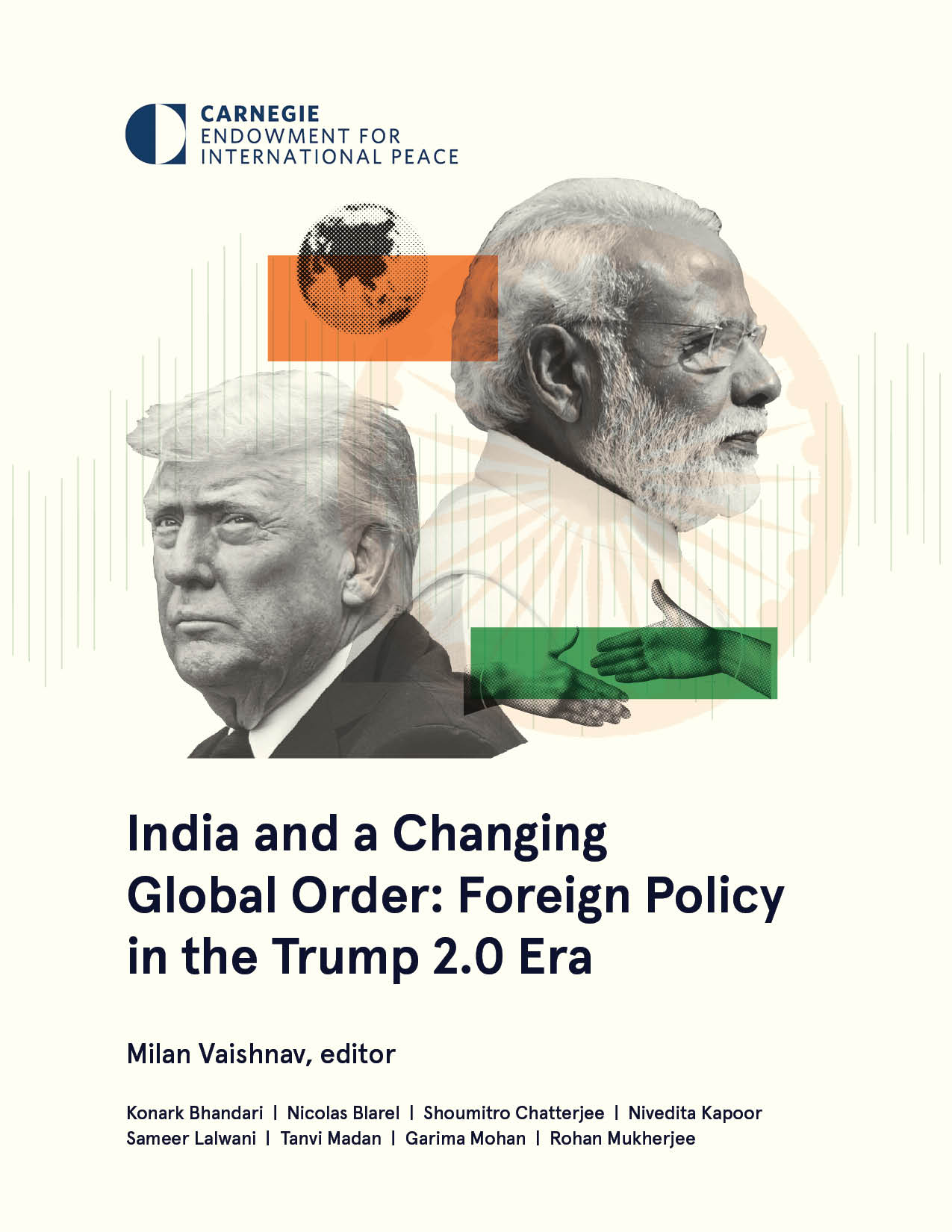
Trump 2.0 has unsettled India’sexternal environment—buthas notoverturned its foreign policystrategy,which continuesto relyon diversification, hedging,and calibrated partnerships across a fractured order.
+6
Milan Vaishnav, ed., Sameer Lalwani, Tanvi Madan, …