

In The Media
Branko Milanovic
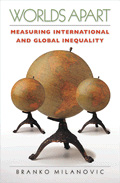
Top World Bank economist Branko Milanovic analyzes income distribution worldwide using, for the first time, household survey data from more than 100 countries. This offers a more accurate way of measuring inequality and discusses the relevant policies of first-world countries and NGOs.
Source: Princeton

Inequality has increased between nations over the last half century (richer countries have generally grown faster than poorer countries). And yet the two most populous nations, China and India, have also grown fast. But over the past two decades inequality within countries has increased. As complex as reconciling these three data trends may be, it is clear: the inequality between the world's individuals is staggering. At the turn of the twenty-first century, the richest 5 percent of people receive one-third of total global income, as much as the poorest 80 percent. While a few poor countries are catching up with the rich world, the differences between the richest and poorest individuals around the globe are huge and likely growing.
ABOUT THE AUTHOR
Branko Milanovic is Lead Economist in the World Bank research department, working on income inequality and poverty. The author of Income, Inequality, and Poverty during the Transition and the coauthor of Income and Influence: Social Policy in Emerging Market Economies, he is currently a senior associate with the Carnegie Endowment for International Peace and a visiting professor at the School for Advanced International Studies, Johns Hopkins University.
REVIEWS
"Don't be fooled by globalization's noisy naysayers or proponents, who invoke the rise or decline of 'global inequality' to make their case. Here, in the first comprehensive look at inequality across the world's individuals as well as the world's nations, are laid out the many definitions of global inequality, and comprehensive, evidence-based analysis about the course of global inequality, variously defined, before and during our globalization era."
—Nancy Birdsall, founding President of the Center for Global Development
"Branko Milanovic's painstaking work takes us closest to a global understanding of income disparities at the present time. Among many other things, his work underscores that while national level income disparities are often obscene, international differences account for much more of the even more obscene level of global income inequality."
—Jomo K. S., Assistant Secretary General for Economic Development, United Nations
"Worlds Apart is a real tour de force. It presents a new interpretation of trends in the distribution of income among the world's countries and individuals, and makes a strong argument that global income inequality can be and should be reduced. In this emerging issue area of international politics it will become a standard reference."
—Robert Hunter Wade, London School of Economics
"A fascinating read. This book is a helpful primer to help you find your way around the complex debates surrounding global inequality. It is also a forceful demonstration that the world economy remains much too unequal."
—Dani Rodrik, Harvard University
"An important book by a master of the relevant data. Milanovic provides hard answers to tough questions."
—Samuel Bowles, Santa Fe Institute, author of Microeconomics: Behavior, Institutions, and Evolution

Former Adjunct Scholar
Milanovic is a lead economist in the World Bank's research department,where he has been working on the topics of income inequality and globalization. Previously, he was a World Bank country economist for Poland and a research fellow at the Institute of Economic Sciences in Belgrade.
Recent Work
Branko Milanovic
Branko Milanovic
Carnegie India does not take institutional positions on public policy issues; the views represented herein are those of the author(s) and do not necessarily reflect the views of Carnegie, its staff, or its trustees.

How is AI reshaping space security, creating governance challenges, and where does international diplomacy stand today?


Tejas Bharadwaj, Almudena Azcárate Ortega

After the chill in ties between 2020 and 2024 that brought India–China relations to their lowest point in several decades, the two countries have engaged each other afresh. This paper argues that there are predominantly four imperatives guiding India’s approach to China, and they exist in an order of priority.

Saheb Singh Chadha

This piece argues that India’s central challenge is not managing a single flashpoint but resolving the underlying tension between expansion and institutional coherency of the BRICS grouping.

Vrinda Sahai

The U.S.–India semiconductor cooperation story is well-stocked with top-level strategic intent. What remains unresolved, however, are some underlying challenges that will determine whether the cooperation actually functions. Three such friction points stand out.

Shruti Mittal

On March 10, 2026, India’s Union Cabinet approved amendments to Press Note 3, a regulation that mandated government approval on all foreign direct investment (FDI) from countries sharing a land border with India. This amendment raises questions primarily about whether its stated benefits will materialize and if the risks have been adequately weighed. This piece will address the same.

Konark Bhandari