

Commentary
How is AI reshaping space security, creating governance challenges, and where does international diplomacy stand today?
Tejas Bharadwaj, Almudena Azcárate Ortega
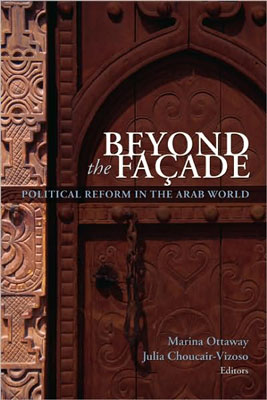
Reform is a politically charged issue in the Middle East. Carnegie experts force us to recognize the reality of conflicting interests and the limitations of external actors to bring about political reform, while drawing lessons on how to make international democracy promotion more effective.
Source: Washington

Some governments have taken steps toward political reform. Are these meaningful changes, or empty attempts to pacify domestic and international public opinion? How do we distinguish reforms that alter the character of the political system from those that are only window dressing?
Beyond the Façade: Political Reform in the Arab World evaluates the changes that are taking place in the region and explores the potential for further reform. The essays provide careful, detailed examinations of ten countries, highlighting the diversity of processes and problems. Beyond the Facade forces us to recognize the reality of conflicting interests and the limitations of external actors to bring about political reform, while drawing lessons on how to make international democracy promotion more effective.
About the Editors
Marina Ottaway is a senior associate in the Democracy and Rule of Law Program and director of the Carnegie Middle East Program. Her most recent book, Uncharted Journey: Promoting Democracy in the Middle East (co-edited with Thomas Carothers), was published in January 2005.
Julia Choucair-Vizoso is a former associate at the Carnegie Endowment for International Peace in Washington, D.C. She is currently a Ph.D. candidate in Political Science at Yale University. Her research focuses on the possibility of democratic change in the Arab world, with attention to political, economic, and social reform trends in the region.
"This superb collection traces the empirical reality of political reform in the Arab world, recounting the experience of ten countries in a coherent, concise, and consistently insightful fashion."
—Foreign Affairs
“A significant and needed contribution ... the only volume which addresses political reform across the Arab world with country chapters written by leading specialists.”
—Robert Springborg, MBI Al Jaber Chair in Middle East Studies and director, London Middle East Institute, School of Oriental and African Studies, University of London
“Beyond the Façade is a non-ideological and therefore faithful, well argued, and well documented answer to a question more open than ever: what is the future of politics in that most sensitive part of the world?”
—Ghassan Salamé, Professor of International Relations, Institut d'études politique de Paris, and former minister of culture, Lebanon

Former Senior Associate, Middle East Program
Before joining the Endowment, Ottaway carried out research in Africa and in the Middle East for many years and taught at the University of Addis Ababa, the University of Zambia, the American University in Cairo, and the University of the Witwatersrand in South Africa.
Julia Choucair-Vizoso
Former Editor in Chief, Sada
Julia Choucair Vizoso is editor in chief of the online journal, Sada. Her research interests include Middle Eastern politics, authoritarianism, and identity politics.
Carnegie India does not take institutional positions on public policy issues; the views represented herein are those of the author(s) and do not necessarily reflect the views of Carnegie, its staff, or its trustees.

How is AI reshaping space security, creating governance challenges, and where does international diplomacy stand today?


Tejas Bharadwaj, Almudena Azcárate Ortega

After the chill in ties between 2020 and 2024 that brought India–China relations to their lowest point in several decades, the two countries have engaged each other afresh. This paper argues that there are predominantly four imperatives guiding India’s approach to China, and they exist in an order of priority.

Saheb Singh Chadha

This piece argues that India’s central challenge is not managing a single flashpoint but resolving the underlying tension between expansion and institutional coherency of the BRICS grouping.

Vrinda Sahai

A partnership between India, a country of subcontinental size, and Africa, a continent of fifty-four countries, may seem asymmetric until one notes that both are home to nearly the same number of people—1.4 billion. This essay spells out the existing challenges to the partnership, its optimal potential, and the possible pathways to realize it over the next quarter-century.

Rajiv Bhatia

The U.S.–India semiconductor cooperation story is well-stocked with top-level strategic intent. What remains unresolved, however, are some underlying challenges that will determine whether the cooperation actually functions. Three such friction points stand out.

Shruti Mittal