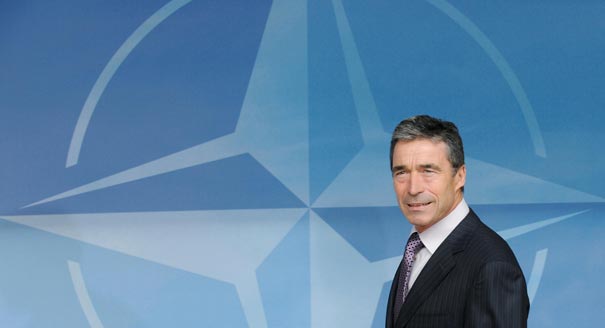
As inaugurations go, Anders Fogh Rasmussen’s has been more workmanlike than ceremonial. That probably suits the new NATO Secretary-General, who assumes office on 1st August. The former Danish Prime Minister, known in his home country for a meticulous even robotic style, will probably be keen to get down to work.
And the agenda could not be fuller. Whilst NATO has just reached the age of 60, it faces existential questions more attuned to a teenager than the silver age.
With NATO’s Afghan mission, talk of retirement seems far off – though failure may now be a realistic option
Until 9/11 graceful retirement, to many, seemed an option for NATO. It had succeeded in the Cold War against the Warsaw Pact without firing a shot, bombed its way to peace in both Bosnia-Herzegovina and Kosovo and expanded well into the former Warsaw Pact.
But with NATO’s Afghan mission, talk of retirement seems far off – though failure may now be a realistic option. Too complex command structures, the absence of a comprehensive civil-military plan, unwillingness by European allies to fight, and an inability to deal with Pakistan are threatening NATO’s effectiveness. If there are enough military resources to hunt insurgents, creating a sense of enduring security among local communities remains difficult for a military-only alliance.
Fewer and fewer Europeans think NATO is vital for their security.
Back in Europe, other problems loom. Fewer and fewer Europeans think NATO is vital for their security. In Brussels, NATO and the EU are locked in a “frozen conflict”, despite France’s re-entry into NATO’s military structures and U.S. backing for a stand-alone European defence capability.
The U.S. push for a détente with Russia seem to be bypassing NATO entirely, in part because the Europeans are so divided about how to deal with their large, gas-powered neighbour.
Rasmussen should launch an alliance-wide process of public consultations, drawing in younger and more diverse stakeholders even from outside the Euro-Atlantic area.
Yet exactly because of the magnitude of these challenges, Rasmussen’s tenure could be transformational in a way that his predecessors never were - or needed to be. But re-setting the foundation for a modern NATO role will require bold action on many fronts. Here is a way forward.
Ignoring those who would want NATO’s new Strategic Concept - the alliance’s playbook for the next decade - to be drafted ad minima, Rasmussen should launch an alliance-wide process of public consultations, drawing in younger and more diverse stakeholders even from outside the Euro-Atlantic area. Like the Harmel exercise in 1967, a new Strategic Concept is a once-in-a decade opportunity to re-set NATO’s purpose.
Part of the challenge of writing a new concept will be defining when NATO should lead; when it should collaborate with others; when it should address new challenges like cyber threats, piracy and energy security; and when it should take a back seat. Rasmussen must not be forward in stepping back - being modern and relevant does not mean chasing every “new” security issue around.
NATO’s relationship with Russia, however, deserves special treatment. In his first 100 days in office, Rasmussen should travel to Moscow and propose that he and President Medvedev appoint a Joint Strategic Review, co-chaired by senior Russian and allied representatives, to develop a joint threat assessment and, through workshops in Brussels and Moscow, scenarios for NATO-Russia cooperation. This way NATO can find its proper place in the US-Russian détente.
NATO will have to find ways to assuage the likes of Poland, Estonia and Lithuania who feel threatened by Russia.
Then NATO will have to find ways to assuage the likes of Poland, Estonia and Lithuania who feel threatened by Russia. To do so, the Alliance should offer to establish a non-military NATO facility in the region, for example a research institute or a training centre. This would give the new NATO members a sense that their allies care about their predicament without being provocative to Moscow.
The future Alliance's strength will come as much from building up NATO's solidarity and enlarging its membership, as from strengthening its partnership with other regional organisations, first among which is the EU. As long as the Cyprus conflict remains unsolved, it may be best to eschew large scale initiatives, which might be vetoed by Turkey.
Closer NATO-EU entente, especially on how both organisations can collaborate on delivering a civilian-military effort on the ground, could help avert Brussels becoming strategic fly-over land for U.S. diplomats.
But it should be possible to create a working-level basis for improved EU/NATO cooperation. Within weeks of starting work, much of Rasmussen’s time will be dominated by NATO’s Afghan mission. But the NATO chief’s actual role in the run-up to the Afghan presidential elections will be negligible, while strategy will be set by the U.S. administration. A closer NATO-EU entente, especially on how both organisations can collaborate on delivering a civilian-military effort on the ground, could help avert Brussels becoming strategic fly-over land for U.S. diplomats.
To avoid the fate of his predecessor, who became a European salesman for the U.S.-led operation over which he had little influence, Rasmussen should take a lead in shaping a different role for NATO - that of the world’s premier trainer of local security forces, starting with the build-up of Afghan and Pakistani security forces.
To this end, he should push for the creation of a NATO Military Advisory Corps, specially prepared to train the Afghan army, and create a Military Advisory Training Centre as a center of excellence.
Finally, NATO itself needs to change. Reforms are needed to improve both current and future operations, including adjustments to NATO's command structures, so that greater authority can be delegated to military commanders and in-theatre integration with partners like the United Nations can be improved. Changes in the way NATO missions are financed should also be explored, perhaps through a commonly financed NATO operations budget.
Transformational leadership, not just status-quo management, is needed for NATO to bridge the chasm between its ambitions and its capacities. Anders Fogh Rasmussen needs to take steps, both real and symbolic, from his first days in office to show he means to provide that kind of leadership.