

Paper
Alejandro Foxley, Fernando Sossdorf
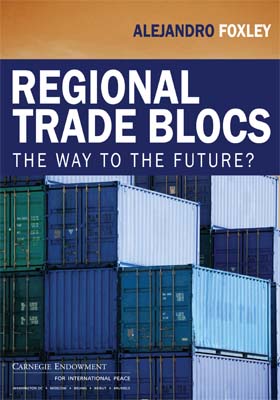
With global trade talks stalled and lower demand from major economies that were hit hard by the global economic crisis, three regions—Eastern Europe, Latin America, and East Asia—are managing to increase trade within their borders and building a broader free trade system.
With global trade talks stalled and lower demand from major economies that were hit hard by the global economic crisis, regional trade agreements are emerging as a way for middle-income countries to increase trade, spur growth, and lower unemployment rates. In a report, Alejandro Foxley analyzes how three regions—Eastern Europe, Latin America, and East Asia—are increasing trade within their borders and building a broader free trade system.
Using the findings from three vastly different experiences, Foxley says that regional trade agreements work best when participating countries have few political differences, coordinate their monetary and fiscal policies, and embrace globalization. And bottom-up approaches in which companies develop regional supply chains are more effective in improving regional integration than top-down approaches imposed by governments.
“Pursuing stronger regional trade agreements can help form the building blocks for global free trade deals,” Foxley writes. “Increasing trade will not only help middle-income economies develop but also drive growth around the world as the financial crisis recedes.”
Former Senior Associate, International Economics Program
Foxley was previously minister of foreign affairs, senator, and minister of finance of the Republic of Chile. While minister of finance he concurrently served as a governor of the Inter-American Development Bank and the World Bank.
Recent Work
Alejandro Foxley, Fernando Sossdorf
Alejandro Foxley
Carnegie India does not take institutional positions on public policy issues; the views represented herein are those of the author(s) and do not necessarily reflect the views of Carnegie, its staff, or its trustees.

The ASML MoU with Tata Electronics is an indicator of how far the Indian semiconductor ecosystem has come. This ecosystem has been years in the making and represents real commercial logic.

Konark Bhandari

The India–EU Free Trade Agreement (FTA) is shaping up to be one of the most consequential trade negotiations, both economically and strategically. But, what’s in the agreement, what’s missing, and what will determine its success in the years ahead

Vrinda Sahai, Nicolas Köhler-Suzuki

On March 10, 2026, India’s Union Cabinet approved amendments to Press Note 3, a regulation that mandated government approval on all foreign direct investment (FDI) from countries sharing a land border with India. This amendment raises questions primarily about whether its stated benefits will materialize and if the risks have been adequately weighed. This piece will address the same.
Konark Bhandari

This piece examines India’s response to U.S. sanctions and tariffs, specifically assessing the immediate market consequences, such as alterations in import costs, and the broader strategic implications for India’s energy security and foreign policy orientation.
Vrinda Sahai

This paper examines the evolution of India-China economic ties from 2005 to 2025. It explores the impact of global events, bilateral political ties, and domestic policies on distinct spheres of the economic relationship.

Santosh Pai