

Paper
George Perkovich
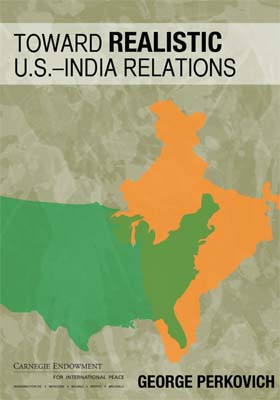
Near-term expectations for a partnership between the United States and India too often overlook how the interests, policies, and diplomatic style of the two countries sometimes diverge.
As President Obama prepares to visit India next month, he faces criticism that his administration has done too little to enhance U.S.-India relations. George Perkovich argues that expectations for a partnership between the two countries in the near term are unrealistically high and overlook how their interests, policies, and diplomatic style will often diverge. U.S. policy cannot do much to help India’s rise, but it can inflict major damage on global problem-solving efforts if it defers too readily to the narrow, often mercantile demands of the current relationship.
“Rather than maintaining the pretense of partnership, a truly pro-India policy would acknowledge that India has different near-term needs and interests as a developing country than does the United States, even as it recognizes that each will benefit in the long run from the success of the other,” writes Perkovich. “Most of what the U.S. government can do for India lies in the broader global arena, and most of what India needs at home it must do for itself.”

Japan Chair for a World Without Nuclear Weapons, Senior Fellow
George Perkovich is the Japan Chair for a World Without Nuclear Weapons and a senior fellow in the Carnegie Endowment for International Peace’s Nuclear Policy Program. He works primarily on nuclear deterrence, nonproliferation, and disarmament issues, and is leading a study on nuclear signaling in the 21st century.
Recent Work
George Perkovich
George Perkovich
Carnegie India does not take institutional positions on public policy issues; the views represented herein are those of the author(s) and do not necessarily reflect the views of Carnegie, its staff, or its trustees.

A partnership between India, a country of subcontinental size, and Africa, a continent of fifty-four countries, may seem asymmetric until one notes that both are home to nearly the same number of people—1.4 billion. This essay spells out the existing challenges to the partnership, its optimal potential, and the possible pathways to realize it over the next quarter-century.

Rajiv Bhatia

The U.S.–India semiconductor cooperation story is well-stocked with top-level strategic intent. What remains unresolved, however, are some underlying challenges that will determine whether the cooperation actually functions. Three such friction points stand out.

Shruti Mittal

The India–EU Free Trade Agreement (FTA) is shaping up to be one of the most consequential trade negotiations, both economically and strategically. But, what’s in the agreement, what’s missing, and what will determine its success in the years ahead

Vrinda Sahai, Nicolas Köhler-Suzuki

Drawing on ten public discussions from the India AI Impact Summit 2026, this article highlights key outlooks on open source in AI that are likely to shape policy and governance conversations going forward.
Shruti Mittal
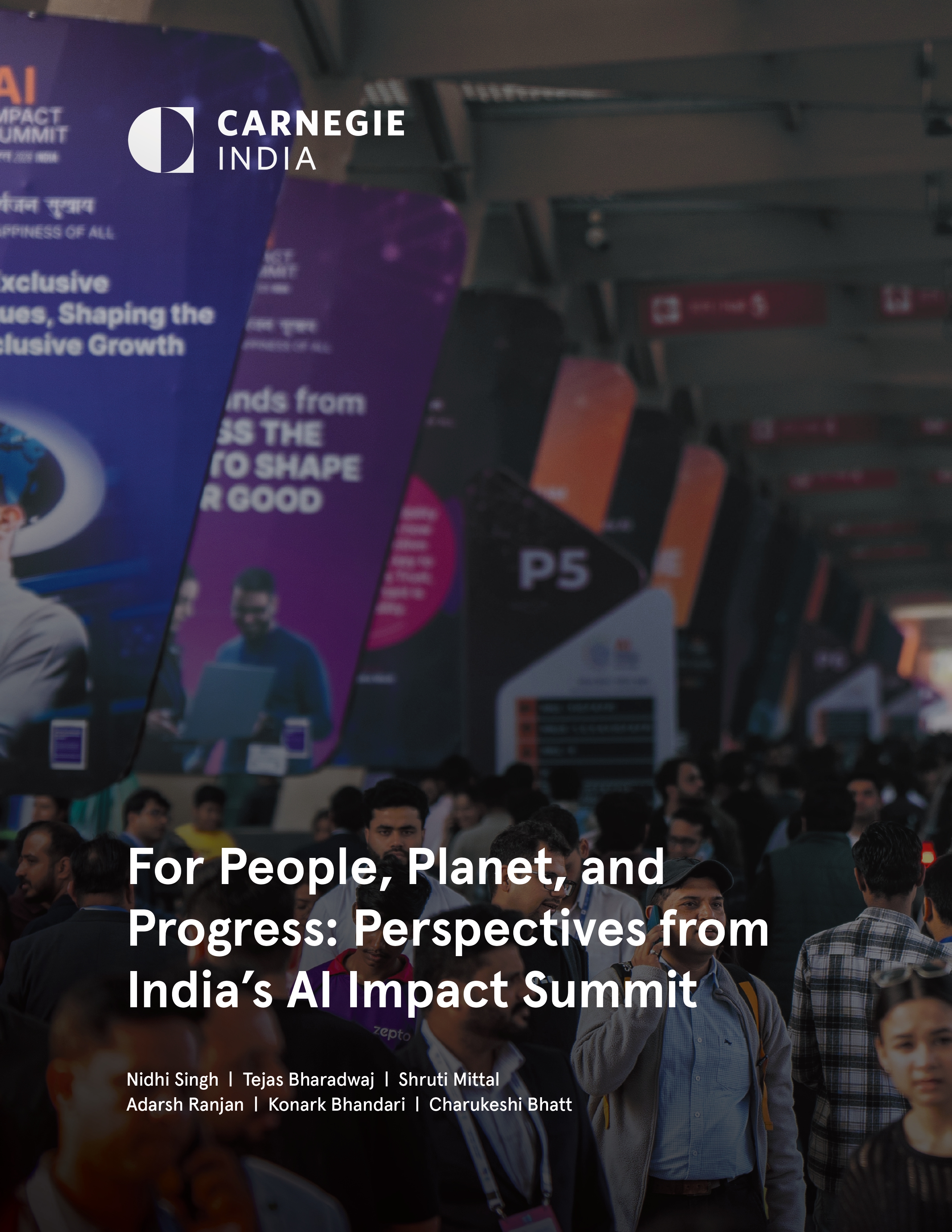
This collection of essays by scholars from Carnegie India’s Technology and Society program traces the evolution of the AI summit series and examines India’s framing around the three sutras of people, planet, and progress. Scholars have catalogued and assessed the concrete deliverables that emerged and assessed what the precedent of a Global South country hosting means for the future of the multilateral conversation.


Nidhi Singh, Tejas Bharadwaj, Shruti Mittal, …