

Research
- +5
Alper Coşkun, Fatih Ceylan, Tacan İldem, …
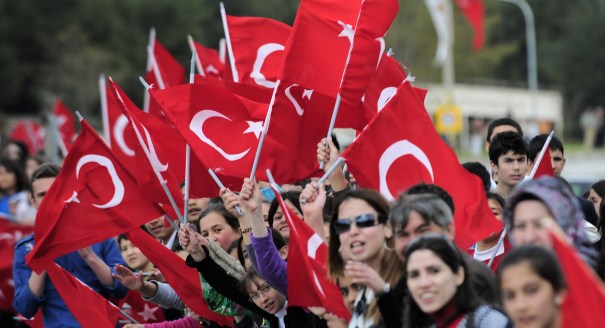
Source: Getty
While Turkey’s vote against additional UN Security Council sanctions on Iran was viewed by some as a sign that Turkey is drifting away from the West, in reality the relationship is much more complicated.
Turkey’s vote against additional UN Security Council sanctions on Iran this year was viewed by many observers as a sign that Turkey is drifting away from the West. In reality, Ankara’s relationship with the United States and the EU is much more complicated. Turkey’s ambitious foreign policy and growing influence present the West with an opportunity to demand that Turkey play a more constructive role in the international community.
There is no doubt that a reorientation of Turkish foreign policy is under way, an evolution that began after the ruling Justice and Development Party (AKP) rose to power in 2002. This transformation was underpinned by the strategic vision of Foreign Minister Ahmet Davutoglu, who pledged to establish Turkey as an important player in international diplomacy. Turkey’s new foreign policy has been driven by three key factors: reconceptualizing Turkey’s identity and international role, desecuritizing its foreign relations, and increasing its strength as a trading state.
As a result, Ankara has become a more confident and assertive international player, vastly improved its relations with Arab neighbors, and grown its economy to the sixteenth largest in the world. With a balanced web of relations with other countries, the EU and the United States no longer occupy the central place in Turkey’s foreign policy. While this does not mean that Turkey is moving away from the West—or that the West has lost Turkey—Turkey is striving to create more space in its neighborhood to further its ambitious foreign policy position.
As the West accepts Ankara’s new approach and growing stature, the challenge for the EU and the United States is to ensure Turkey remains anchored to Western interests. For the EU, this includes adopting a more welcoming attitude toward Turkey, such as jump-starting the stalled EU accession process. The EU should also seek an institutionalized foreign policy dialogue with Turkey to address their shared desire for regional stability.
For its part, the United States must accept that its interests and Turkey’s are more likely to diverge in the future—as is the case with Iran. In this instance and in others, as the United States grants more leeway to Turkey in pursuing a broader foreign policy, it must ensure that Turkish policy makers share the costs and benefits of providing solutions to global challenges.
By insisting that Turkey adopt this more normative approach to foreign policy, the West can help Ankara become a true international partner and serve as a role model for other emerging powers in the future.

Senior Fellow, Carnegie Europe
Sinan Ülgen is a senior fellow at Carnegie Europe in Brussels, where his research focuses on Turkish foreign policy, transatlantic relations, international trade, economic security, and digital policy.
Recent Work

Alper Coşkun, Fatih Ceylan, Tacan İldem, …
Carnegie India does not take institutional positions on public policy issues; the views represented herein are those of the author(s) and do not necessarily reflect the views of Carnegie, its staff, or its trustees.

After the chill in ties between 2020 and 2024 that brought India–China relations to their lowest point in several decades, the two countries have engaged each other afresh. This paper argues that there are predominantly four imperatives guiding India’s approach to China, and they exist in an order of priority.

Saheb Singh Chadha

This piece argues that India’s central challenge is not managing a single flashpoint but resolving the underlying tension between expansion and institutional coherency of the BRICS grouping.

Vrinda Sahai

The ASML MoU with Tata Electronics is an indicator of how far the Indian semiconductor ecosystem has come. This ecosystem has been years in the making and represents real commercial logic.

Konark Bhandari

A partnership between India, a country of subcontinental size, and Africa, a continent of fifty-four countries, may seem asymmetric until one notes that both are home to nearly the same number of people—1.4 billion. This essay spells out the existing challenges to the partnership, its optimal potential, and the possible pathways to realize it over the next quarter-century.

Rajiv Bhatia

The India–EU Free Trade Agreement (FTA) is shaping up to be one of the most consequential trade negotiations, both economically and strategically. But, what’s in the agreement, what’s missing, and what will determine its success in the years ahead
Vrinda Sahai, Nicolas Köhler-Suzuki