• Research
  • About
  • Experts
Carnegie India logoCarnegie lettermark logo
AI
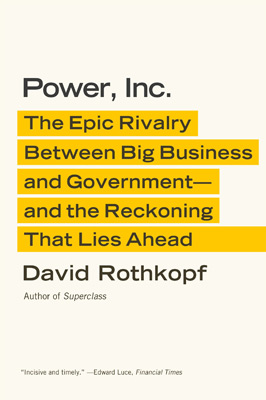
Power, Inc.: The Epic Rivalry Between Big Business and Government—and the Reckoning that Lies Ahead
Book

Power, Inc.: The Epic Rivalry Between Big Business and Government—and the Reckoning that Lies Ahead

An important look at the power struggle that is defining modern times, Power, Inc. also offers critical insights into how to navigate the tumultous years ahead.

Link Copied
By David Rothkopf
Published on Mar 1, 2012

Source: Farrar, Straus and Giroux, 2012

The world’s largest company, Wal-Mart Stores, has revenues higher than the GDP of all but twenty-five of the world’s countries. Its employees outnumber the populations of almost a hundred nations. The world’s largest asset manager, a secretive New York company called Black Rock, controls assets greater than the national reserves of any country on the planet. A private philanthropy, the Bill and Melinda Gates Foundation, spends as much worldwide on health care as the World Health Organization.  

The rise of private power may be the most important and least understood trend of our time. David Rothkopf provides a fresh, timely look at how we have reached a point where thousands of companies have greater power than all but a handful of states. Beginning with the story of an inquisitive Swedish goat wandering off from his master and inadvertently triggering the birth of the oldest company still in existence, Power, Inc. follows the rise and fall of kings and empires, the making of great fortunes, and the chaos of bloody revolutions. A fast-paced tale in which champions of liberty are revealed to be paid pamphleteers of moneyed interests and greedy scoundrels trigger changes that lift billions from deprivation, Power, Inc. traces the bruising jockeying for influence right up to today’s financial crises, growing inequality, broken international system, and battles over the proper role of government and markets.

Rothkopf argues that these recent developments, coupled with the rise of powers like China and India, may not lead to the triumph of American capitalism that was celebrated just a few years ago. Instead, he considers an unexpected scenario, a contest among competing capitalisms offering different visions for how the world should work, a global ideological struggle in which European and Asian models may have advantages. An important look at the power struggle that is defining our times, Power, Inc. also offers critical insights into how to navigate the tumultous years ahead.

About the Author

David Rothkopf

Former Visiting Scholar

David Rothkopf was a visiting scholar at the Carnegie Endowment as well as the former CEO and editor in chief of the FP Group.

    Recent Work

  • In The Media
    How Bush, Obama, and Trump Ended Pax Americana

      David Rothkopf

  • In The Media
    A Bigger Clubhouse

      David Rothkopf

David Rothkopf
Former Visiting Scholar
David Rothkopf
North AmericaUnited StatesEastern EuropeWestern EuropePolitical ReformDemocracyEconomyTrade

Carnegie India does not take institutional positions on public policy issues; the views represented herein are those of the author(s) and do not necessarily reflect the views of Carnegie, its staff, or its trustees.

More Work from Carnegie India

  • Commentary
    The Unresolved Challenges in U.S.–India Semiconductor Cooperation

    The U.S.–India semiconductor cooperation story is well-stocked with top-level strategic intent. What remains unresolved, however, are some underlying challenges that will determine whether the cooperation actually functions. Three such friction points stand out.

      Shruti Mittal

  • Article
    India’s Press Note 3 Gamble: Opening the FDI Door to China

    On March 10, 2026, India’s Union Cabinet approved amendments to Press Note 3, a regulation that mandated government approval on all foreign direct investment (FDI) from countries sharing a land border with India. This amendment raises questions primarily about whether its stated benefits will materialize and if the risks have been adequately weighed. This piece will address the same.

      Konark Bhandari

  • Article
    What Could a Reciprocal Defense Procurement Agreement Do for U.S.-India Ties?

    India and the United States are close to concluding a Reciprocal Defense Procurement Agreement (RDPA) that will allow firms from the two countries to sell to each other’s defense establishments more easily. While this may not remedy the specific grievances both sides may have regarding larger bilateral issues, an RDPA could restore some momentum, following the trade deal announcement.

      Konark Bhandari

  • Commentary
    India Signs the Pax Silica—A Counter to Pax Sinica?

    On the last day of the India AI Impact Summit, India signed Pax Silica, a U.S.-led declaration seemingly focused on semiconductors. While India’s accession to the same was not entirely unforeseen, becoming a signatory nation this quickly was not on the cards either.

      Konark Bhandari

  • Commentary
    The Impact of U.S. Sanctions and Tariffs on India’s Russian Oil Imports

    This piece examines India’s response to U.S. sanctions and tariffs, specifically assessing the immediate market consequences, such as alterations in import costs, and the broader strategic implications for India’s energy security and foreign policy orientation.

      Vrinda Sahai

Get more news and analysis from
Carnegie India
Carnegie India logo, white
Unit C-4, 5, 6, EdenparkShaheed Jeet Singh MargNew Delhi – 110016, IndiaPhone: 011-40078687
  • Research
  • About
  • Experts
  • Projects
  • Events
  • Contact
  • Careers
  • Privacy
  • For Media
Get more news and analysis from
Carnegie India
© 2026 Carnegie Endowment for International Peace. All rights reserved.