
• Research
  • About
  • Experts
Carnegie India logoCarnegie lettermark logo
AI
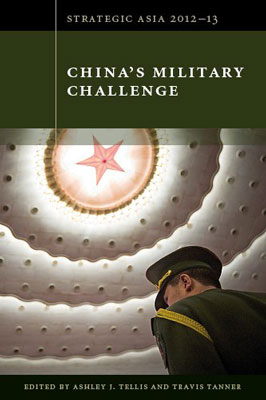
Strategic Asia 2012-13: China's Military Challenge
Book

Strategic Asia 2012-13: China's Military Challenge

This book examines what China's military rise means for the region and the world, looking at China’s strategic aims and the challenges and opportunities facing the United States.

Link Copied
By Ashley J. Tellis and Travis Tanner
Published on Oct 26, 2012

Additional Links

Overview by Ashley J. Tellis

Source: National Bureau of Asian Research

Co-edited and introduced by Ashley Tellis, this book, the twelfth volume in the Strategic Asia series, examines what China's military rise means for the region and the world. What are China’s strategic aims? What are the challenges and opportunities facing the United States? How is the region responding to China’s military power and to the U.S. policy of “strategic rebalancing”?


Order this book, or read the introduction by Ashley J. Tellis for free.

About the Editors:

Ashley J. Tellis is a Senior Associate at the Carnegie Endowment for International Peace and Research Director of the Strategic Asia Program at NBR, served in the U.S. Department of State as senior adviser to the Undersecretary of State of Public Affairs, and previously as senior adviser to the Ambassador at the U.S. Embassy in India. He also served on the National Security Council Staff as special assistant to the President and senior director for Strategic Planning and Southwest Asia. He is the author of India’s Emerging Nuclear Posture (2001) and co-author of Interpreting China’s Grand Strategy: Past, Present, and Future (2000), as well as the co-editor of the eight most recent volumes of Strategic Asia, published by NBR.

Travis Tanner is is the Senior Project Director and Director of the Pyle Center for Northeast Asian Studies at the National Bureau of Asian Research.

About the Authors

Ashley J. Tellis

Former Senior Fellow

Ashley J. Tellis was a senior fellow at the Carnegie Endowment for International Peace.

Travis Tanner

NBR

Authors

Ashley J. Tellis
Former Senior Fellow
Travis Tanner
NBR
South AsiaIndiaAfghanistanPakistanEast AsiaChinaSecurityMilitaryForeign PolicyArms Control

Carnegie India does not take institutional positions on public policy issues; the views represented herein are those of the author(s) and do not necessarily reflect the views of Carnegie, its staff, or its trustees.

More Work from Carnegie India

  • Article
    Managing Divergence: India’s BRICS Presidency in 2026

    This piece argues that India’s central challenge is not managing a single flashpoint but resolving the underlying tension between expansion and institutional coherency of the BRICS grouping.

      Vrinda Sahai

  • Commentary
    India’s Semiconductor Ecosystem Is Maturing—and ASML Is Taking Notice

    The ASML MoU with Tata Electronics is an indicator of how far the Indian semiconductor ecosystem has come. This ecosystem has been years in the making and represents real commercial logic.

      Konark Bhandari

  • Paper
    A Review of India's 2023 Space Policy and Entrepreneurship Ecosystem

    This paper examines the relationship between India’s evolving space policy and the corresponding growth in private space ventures. It analyzes both the enabling factors created by recent regulatory changes and the persistent challenges facing entrepreneurs in this capital-intensive, highly regulated industry.

      Harshan Vazhakunnam

  • Article
    India–Africa Strategic Partnership: Challenges, Potential, and Possible Pathways

    A partnership between India, a country of subcontinental size, and Africa, a continent of fifty-four countries, may seem asymmetric until one notes that both are home to nearly the same number of people—1.4 billion. This essay spells out the existing challenges to the partnership, its optimal potential, and the possible pathways to realize it over the next quarter-century.

      Rajiv Bhatia

  • Commentary
    The Unresolved Challenges in U.S.–India Semiconductor Cooperation

    The U.S.–India semiconductor cooperation story is well-stocked with top-level strategic intent. What remains unresolved, however, are some underlying challenges that will determine whether the cooperation actually functions. Three such friction points stand out.

      Shruti Mittal

Get more news and analysis from
Carnegie India
Carnegie India logo, white
Unit C-4, 5, 6, EdenparkShaheed Jeet Singh MargNew Delhi – 110016, IndiaPhone: 011-40078687
  • Research
  • About
  • Experts
  • Projects
  • Events
  • Contact
  • Careers
  • Privacy
  • For Media
Get more news and analysis from
Carnegie India
© 2026 Carnegie Endowment for International Peace. All rights reserved.






