

Commentary
Michael Pettis
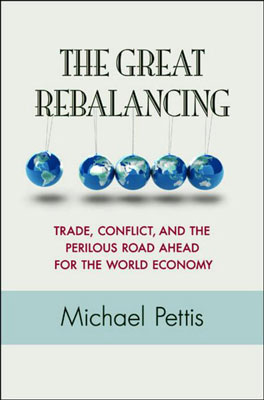
China's economic growth is sputtering, the Euro is under threat, and the United States is combating serious trade disadvantages. However, this is not another great recession but rather a critical rebalancing of world economies.
Source: Princeton University Press
China's economic growth is sputtering, the Euro is under threat, and the United States is combating serious trade disadvantages. Another Great Depression? Not quite. Noted economist and China expert Michael Pettis argues instead that we are undergoing a critical rebalancing of the world economies. Debunking popular misconceptions, Pettis shows that severe trade imbalances spurred on the recent financial crisis were the result of unfortunate policies that distorted the savings and consumption patterns of certain nations. Pettis examines the reasons behind these destabilizing policies, and he predicts severe economic dislocations--a lost decade for China, the breaking of the Euro, and a receding of the U.S. dollar--that will have long-lasting effects.Pettis explains how China has maintained massive--but unsustainable--investment growth by artificially lowering the cost of capital. He discusses how Germany is endangering the Euro by favoring its own development at the expense of its neighbors. And he looks at how the U.S. dollar's role as the world's reserve currency burdens America's economy. Although various imbalances may seem unrelated, Pettis shows that all of them--including the U.S. consumption binge, surging debt in Europe, China's investment orgy, Japan's long stagnation, and the commodity boom in Latin America--are closely tied together, and that it will be impossible to resolve any issue without forcing a resolution for all.
Demonstrating how economic policies can carry negative repercussions the world over, The Great Rebalancing sheds urgent light on our globally linked economic future.

Nonresident Senior Fellow, Carnegie China
Michael Pettis is a nonresident senior fellow at the Carnegie Endowment for International Peace. An expert on China’s economy, Pettis is professor of finance at Peking University’s Guanghua School of Management, where he specializes in Chinese financial markets.
Recent Work
Michael Pettis
Michael Pettis
Carnegie India does not take institutional positions on public policy issues; the views represented herein are those of the author(s) and do not necessarily reflect the views of Carnegie, its staff, or its trustees.

How is AI reshaping space security, creating governance challenges, and where does international diplomacy stand today?


Tejas Bharadwaj, Almudena Azcárate Ortega

After the chill in ties between 2020 and 2024 that brought India–China relations to their lowest point in several decades, the two countries have engaged each other afresh. This paper argues that there are predominantly four imperatives guiding India’s approach to China, and they exist in an order of priority.

Saheb Singh Chadha

This piece argues that India’s central challenge is not managing a single flashpoint but resolving the underlying tension between expansion and institutional coherency of the BRICS grouping.

Vrinda Sahai

The U.S.–India semiconductor cooperation story is well-stocked with top-level strategic intent. What remains unresolved, however, are some underlying challenges that will determine whether the cooperation actually functions. Three such friction points stand out.

Shruti Mittal

On March 10, 2026, India’s Union Cabinet approved amendments to Press Note 3, a regulation that mandated government approval on all foreign direct investment (FDI) from countries sharing a land border with India. This amendment raises questions primarily about whether its stated benefits will materialize and if the risks have been adequately weighed. This piece will address the same.

Konark Bhandari